Thank you for visiting SNEWPapers!
Sign up free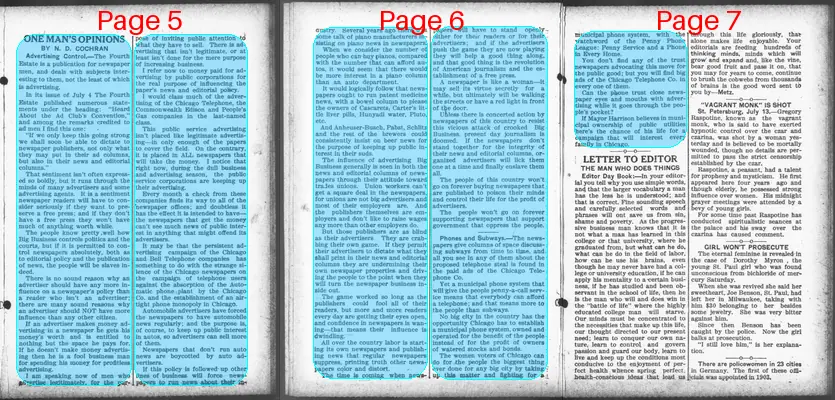
The Day Book
Chicago, Cook County County, Illinois
What is this article about?
N.D. Cochran criticizes advertisers' growing influence over newspaper news and editorial content, warning it threatens press freedom. He highlights public utility ads in Chicago silencing coverage of telephone monopoly and urges resistance to preserve independent journalism. Also advocates for municipal phone system.
Merged-components note: Continuation of the editorial 'One Man's Opinions' by N. D. Cochran on advertising control, influence on press, and related topics; split across pages 5-7.
Clippings
1 of 3
OCR Quality
Full Text
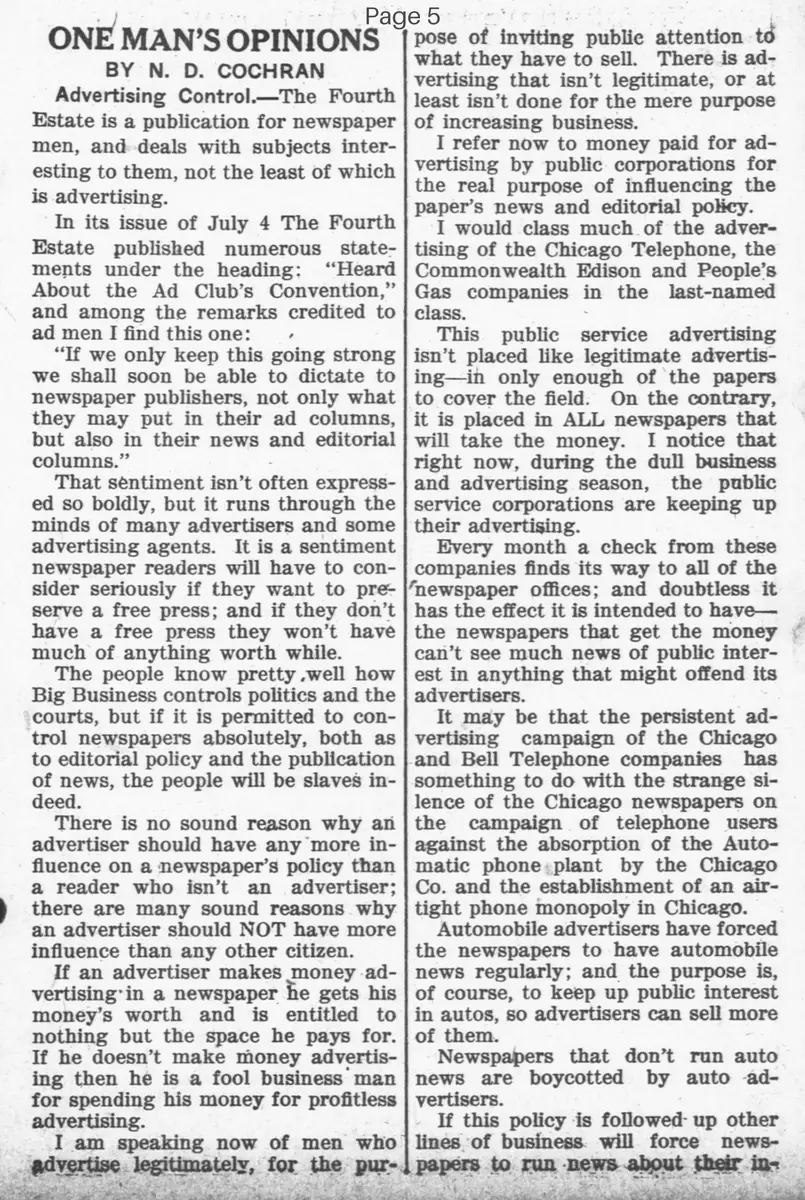
BY N. D. COCHRAN
Advertising Control.—The Fourth Estate is a publication for newspaper men, and deals with subjects interesting to them, not the least of which is advertising.
In its issue of July 4 The Fourth Estate published numerous statements under the heading:
"Heard About the Ad Club's Convention,"
and among the remarks credited to ad men I find this one:
"If we only keep this going strong we shall soon be able to dictate to newspaper publishers, not only what they may put in their ad columns, but also in their news and editorial columns."
That sentiment isn't often expressed so boldly, but it runs through the minds of many advertisers and some advertising agents. It is a sentiment newspaper readers will have to consider seriously if they want to preserve a free press; and if they don't have a free press they won't have much of anything worth while.
The people know pretty well how Big Business controls politics and the courts, but if it is permitted to control newspapers absolutely, both as to editorial policy and the publication of news, the people will be slaves indeed.
There is no sound reason why an advertiser should have any more influence on a newspaper's policy than a reader who isn't an advertiser: there are many sound reasons why an advertiser should NOT have more influence than any other citizen.
If an advertiser makes money advertising in a newspaper he gets his money's worth and is entitled to nothing but the space he pays for. If he doesn't make money advertising then he is a fool business man for spending his money for profitless advertising.
I am speaking now of men who advertise legitimately, for the purpose of inviting public attention to what they have to sell.
There is advertising that isn't legitimate, or at least isn't done for the mere purpose of increasing business. I refer now to money paid for advertising by public corporations for the real purpose of influencing the paper's news and editorial policy.
I would class much of the advertising of the Chicago Telephone, the Commonwealth Edison and People's Gas companies in the last-named class.
This public service advertising isn't placed like legitimate advertising—in only enough of the papers to cover the field. On the contrary, it is placed in ALL newspapers that will take the money.
I notice that right now, during the dull business and advertising season, the public service corporations are keeping up their advertising. Every month a check from these companies finds its way to all of the newspaper offices; and doubtless it has the effect it is intended to have—the newspapers that get the money can't see much news of public interest in anything that might offend its advertisers.
It may be that the persistent advertising campaign of the Chicago and Bell Telephone companies has something to do with the strange silence of the Chicago newspapers on the campaign of telephone users against the absorption of the Automatic phone plant by the Chicago Co. and the establishment of an air-tight phone monopoly in Chicago.
Automobile advertisers have forced the newspapers to have automobile news regularly; and the purpose is, of course, to keep up public interest in autos, so advertisers can sell more of them.
Newspapers that don't run auto news are boycotted by auto advertisers.
If this policy is followed up other lines of business will force newspapers to run news about their industries.
Austria. Several years ago there was some talk of piano manufacturers insisting on piano news in newspapers.
When we consider the number of people who can buy pianos, compared with the number that can afford autos, it would seem that there would be more interest in a piano column than an auto department.
It would logically follow that newspapers ought to run patent medicine news, with a bowel column to please the owners of Cascarets; Carter's little liver pills, Hunyadi water, Pluto, etc.
And Anheuser-Busch, Pabst, Schlitz and the rest of the brewers could consistently insist on beer news for the purpose of keeping up public interest in their suds.
The influence of advertising Big Business generally is seen in both the news and editorial columns of newspapers through their attitude toward trades unions.
Union workers can't get a square deal in the newspapers, for unions are not big advertisers and most of their employers are.
And the publishers themselves are employers and don't like to raise wages any more than other employers do.
But those publishers are as blind as their advertisers. They are crabbing their own game. If they permit their advertisers to dictate what they shall print in their news and editorial columns they are undermining their own newspaper properties and driving the people to the point when they will turn the newspaper business inside out.
The game worked so long as the publishers could fool all of their readers, but more and more readers every day are getting their eyes open, and confidence in newspapers is waning—that means their influence is dwindling.
All over the country labor is starting its own newspapers and publishing news that regular newspapers suppress, printing truth other newspapers color and distort.
The time is coming when newspapers will have to stand openly either for their readers or for their advertisers; and if the advertisers push the game they are now playing they will help a good thing along, and that good thing is the revolution of American journalism and the establishment of a free press.
A newspaper is like a woman—it may sell its virtue secretly for a while, but ultimately will be walking the streets or have a red light in front of the door.
Unless there is concerted action by newspapers of this country to resist this vicious attack of crooked Big Business, present day journalism is doomed. If the newspapers don't stand together for the integrity of their news and editorial columns, organized advertisers will lick them one at a time and finally enslave them all.
The people of this country won't go on forever buying newspapers that are published to poison their minds and control their life for the profit of advertisers.
The people won't go on forever supporting newspapers that support government that oppress the people.
Phones and Subways.—The newspapers give columns of space discussing subways from time to time, and all you see in any of them about the proposed telephone steal is found in the paid ads of the Chicago Telephone Co.
Yet a municipal phone system that will give the people penny-a-call service means that everybody can afford a telephone; and that means more to the people than subways.
No big city in the country has the opportunity Chicago has to establish a municipal phone system, owned and operated for the benefit of the people instead of for the profit of owners of watered stocks and bonds.
The women voters of Chicago can do for the people the biggest thing ever done for any big city by taking up this matter and fighting for a
Municipal phone system, with the watchword of the Penny Phone League: Penny Service and a Phone in Every Home.
You don't find any of the trust newspapers advocating this move for the public good; but you will find big ads of the Chicago Telephone Co. in every one of them.
Can the phone trust close newspaper eyes and mouths with advertising while it goes through the people's pocket?
If Mayor Harrison believes in municipal ownership of public utilities here's the chance of his life for a campaign that will interest every family in Chicago.
What sub-type of article is it?
What keywords are associated?
What entities or persons were involved?
Editorial Details
Primary Topic
Advertiser Control Over Newspaper Content And Advocacy For Free Press
Stance / Tone
Strongly Critical Of Corporate Advertising Influence, Urging Resistance For Press Integrity
Key Figures
Key Arguments