Thank you for visiting SNEWPapers!
Sign up free
Letter to Editor
April 1, 1840
The North Carolina Standard
Raleigh, Wake County, North Carolina
What is this article about?
A letter criticizing Whig efforts to elect Gen. Harrison in 1840, questioning his qualifications beyond military fame, detailing his alleged military failures, contrasting with Jackson's successes, and praising Van Buren. Signed ROMEO.
Clipping
OCR Quality
95%
Excellent
Full Text
COMMUNICATIONS.
FOR THE NORTH CAROLINA STANDARD.
CALM & RATIONAL CONSIDERATIONS.
Addressed to the American People, on the Presidential Election for 1840.
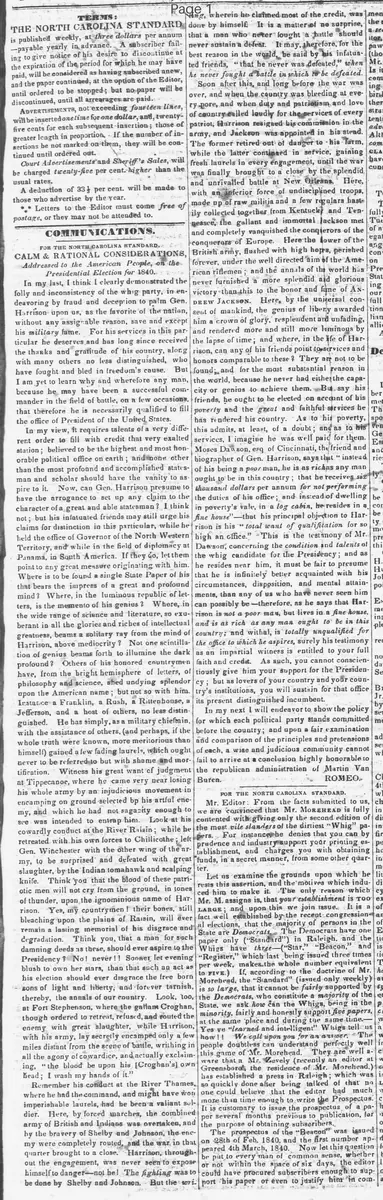
In my last, I think I clearly demonstrated the folly and inconsistency of the whig party, in endeavoring by fraud and deception to palm Gen. Harrison upon us, as the favorite of the nation, without any assignable reason, save and except his military fame. For his services in this particular he deserves and has long since received the thanks and gratitude of his country, along with many others no less distinguished, who have fought and bled in freedom's cause. But I am yet to learn why and wherefore any man, because he may have been a successful commander in the field of battle, on a few occasions, that therefore he is necessarily qualified to fill the office of President of the United States.
In my view, it requires talents of a very different order to fill with credit that very exalted station; believed to be the highest and most honorable political office on earth; and none other than the most profound and accomplished statesman and scholar should have the vanity to aspire to it. Now, can Gen. Harrison presume to have the arrogance to set up any claim to the character of a great and able statesman? I think not; but his infatuated friends may still urge his claims or distinction in this particular, while he held the office of Governor of the North Western Territory, and while in the field of diplomacy at Panama, in South America. If they do, let them point to any great measure originating with him. Where is to be found a single State Paper of his that bears the impress of a great and profound mind? Where, in the luminous republic of letters, is the memento of his genius? Where, in the wide range of science and literature, so exuberant in all the glories and riches of intellectual greatness, beams a solitary ray from the mind of Harrison, above mediocrity? Not one scintillation of genius beams forth to illumine the dark profound? Others of his honored countrymen have, from the bright hemisphere of letters, of philosophy and science, shed undying splendor upon the American name; but not so with him. Instance a Franklin, a Rush, a Rittenhouse, a Jefferson, and a host of others, no less distinguished. He has simply, as a military chieftain, with the assistance of others, (and perhaps, if the whole truth were known, more meritorious than himself) gained a few fading laurels, which ought never to be referred to but with shame and mortification. Witness his great want of judgment at Tippecanoe, where he came very near losing his whole army by an injudicious movement in encamping on ground selected by his artful enemy, and which he had not sagacity enough to see was intended to entrap him. Look at his cowardly conduct at the River Raisin: while he retreated with his own forces to Chillicothe; left Gen. Winchester with the other wing of the army, to be surprised and defeated with great slaughter, by the Indian tomahawk and scalping knife. Think you that the blood of these patriotic men will not cry from the ground, in tones of thunder, upon the ignominious name of Harrison. Yes, my countrymen! their bones, still bleaching upon the plains of Raisin, will ever remain a lasting memorial of his disgrace and degradation. Think you, that a man for such damning deeds as these, should ever aspire to the Presidency? No! never!! Sooner let evening blush to own her stars, than that such an act as his election should ever disgrace the free born sons of light and liberty; and forever tarnish, thereby, the annals of our country. Look, too, at Fort Stephenson, where the gallant Croghan, though ordered to retreat, refused, and routed the enemy with great slaughter, while Harrison, with his army, lay secretly encamped only a few miles distant from the scene of battle, writhing in all the agony of cowardice, and actually exclaiming, "the blood be upon his [Croghan's] own head; I wash my hands of it." Remember his conduct at the River Thames, where he had the command, and might have won imperishable laurels, had he been a valiant soldier. Here, by forced marches, the combined army of British and Indians was overtaken, and by the bravery of Shelby and Johnson, the enemy were completely routed, and the war in that quarter brought to a close. Harrison, throughout the engagement, was never seen to expose himself to danger--not he! The fighting was to be done by Shelby and Johnson. But the writer of his famous letter to Secretary Eustis, leng, wherein he claimed most of the credit, was done by himself. It is a matter of no surprise, that a man who never fought a battle should never sustain a defeat. It may, therefore, for the best reason in the world, be said by his infatuated friends, that he never was defeated, when he never fought a battle in which to be defeated. Soon after this, and long before the war was over, and when the country was bleeding at every pore, and when duty and patriotism and love of country called loudly for the services of every patriot; Harrison resigned his commission in the army, and Jackson was appointed in his stead. The former retired out of danger to his farm, while the latter continued in service, gaining fresh laurels in every engagement, until the war was finally brought to a close by the splendid and unrivalled battle at New Orleans. Here, with an inferior force of undisciplined troops, made up of raw militia and a few regulars hastily collected together from Kentucky and Tennessee, the gallant and immortal Jackson met and completely vanquished the conquerors of Europe. Here the flower of the British army, flushed with high hopes, perished forever, under the well directed aim of the American riflemen; and the annals of this world has never furnished a more splendid and glorious victory than this to the honor and fame of Andrew Jackson. Here, by the universal consent of mankind, the genius of liberty awarded him a crown of glory, resplendent and unfading, and rendered more and still more luminous by the lapse of time; and where, in the life of Harrison, can any of his friends point to services and honors comparable to these? They are not to be found; and for the most substantial reason in the world, because he never had either the capacity or genius to achieve them. But, say his friends, he ought to be elected on account of his poverty and the great and faithful services he has rendered his country. As to his poverty, this admits, at least, of a doubt; and as to his services, I imagine he was well paid for them. Moses Dawson, esq. of Cincinnati, the friend and biographer of Gen. Harrison, says that "instead of his being a poor man, he is as rich as any man ought to be in this country; that he receives six thousand dollars per annum for not performing the duties of his office; and instead of dwelling in poverty's vale, in a log cabin, he resides in a fine house"--that his principal objection to Harrison is his "total want of qualification for so high an office." This is the testimony of Mr. Dawson, concerning the condition and talents of the whig candidate for the Presidency: and as he resides near him, it must be fair to presume that he is infinitely better acquainted with his circumstances, disposition, and mental attainments, than any of us who have never seen him can possibly be--therefore, as he says that Harrison is not a poor man, but lives in a fine house, and is as rich as any man ought to be in this country; and withal, is totally unqualified for the office to which he aspires, surely his testimony as an impartial witness is entitled to your full faith and credit. As such, you cannot conscientiously give him your support for the Presidency; but as lovers of your country and your country's institutions, you will sustain for that office its present distinguished incumbent.
In my next I will endeavor to show the policy for which each political party stands committed before the country; and upon a fair examination and comparison of the principles and pretensions of each, a wise and judicious community cannot fail to arrive at a conclusion highly honorable to the republican administration of Martin Van Buren.
ROMEO.
FOR THE NORTH CAROLINA STANDARD.
CALM & RATIONAL CONSIDERATIONS.
Addressed to the American People, on the Presidential Election for 1840.
In my last, I think I clearly demonstrated the folly and inconsistency of the whig party, in endeavoring by fraud and deception to palm Gen. Harrison upon us, as the favorite of the nation, without any assignable reason, save and except his military fame. For his services in this particular he deserves and has long since received the thanks and gratitude of his country, along with many others no less distinguished, who have fought and bled in freedom's cause. But I am yet to learn why and wherefore any man, because he may have been a successful commander in the field of battle, on a few occasions, that therefore he is necessarily qualified to fill the office of President of the United States.
In my view, it requires talents of a very different order to fill with credit that very exalted station; believed to be the highest and most honorable political office on earth; and none other than the most profound and accomplished statesman and scholar should have the vanity to aspire to it. Now, can Gen. Harrison presume to have the arrogance to set up any claim to the character of a great and able statesman? I think not; but his infatuated friends may still urge his claims or distinction in this particular, while he held the office of Governor of the North Western Territory, and while in the field of diplomacy at Panama, in South America. If they do, let them point to any great measure originating with him. Where is to be found a single State Paper of his that bears the impress of a great and profound mind? Where, in the luminous republic of letters, is the memento of his genius? Where, in the wide range of science and literature, so exuberant in all the glories and riches of intellectual greatness, beams a solitary ray from the mind of Harrison, above mediocrity? Not one scintillation of genius beams forth to illumine the dark profound? Others of his honored countrymen have, from the bright hemisphere of letters, of philosophy and science, shed undying splendor upon the American name; but not so with him. Instance a Franklin, a Rush, a Rittenhouse, a Jefferson, and a host of others, no less distinguished. He has simply, as a military chieftain, with the assistance of others, (and perhaps, if the whole truth were known, more meritorious than himself) gained a few fading laurels, which ought never to be referred to but with shame and mortification. Witness his great want of judgment at Tippecanoe, where he came very near losing his whole army by an injudicious movement in encamping on ground selected by his artful enemy, and which he had not sagacity enough to see was intended to entrap him. Look at his cowardly conduct at the River Raisin: while he retreated with his own forces to Chillicothe; left Gen. Winchester with the other wing of the army, to be surprised and defeated with great slaughter, by the Indian tomahawk and scalping knife. Think you that the blood of these patriotic men will not cry from the ground, in tones of thunder, upon the ignominious name of Harrison. Yes, my countrymen! their bones, still bleaching upon the plains of Raisin, will ever remain a lasting memorial of his disgrace and degradation. Think you, that a man for such damning deeds as these, should ever aspire to the Presidency? No! never!! Sooner let evening blush to own her stars, than that such an act as his election should ever disgrace the free born sons of light and liberty; and forever tarnish, thereby, the annals of our country. Look, too, at Fort Stephenson, where the gallant Croghan, though ordered to retreat, refused, and routed the enemy with great slaughter, while Harrison, with his army, lay secretly encamped only a few miles distant from the scene of battle, writhing in all the agony of cowardice, and actually exclaiming, "the blood be upon his [Croghan's] own head; I wash my hands of it." Remember his conduct at the River Thames, where he had the command, and might have won imperishable laurels, had he been a valiant soldier. Here, by forced marches, the combined army of British and Indians was overtaken, and by the bravery of Shelby and Johnson, the enemy were completely routed, and the war in that quarter brought to a close. Harrison, throughout the engagement, was never seen to expose himself to danger--not he! The fighting was to be done by Shelby and Johnson. But the writer of his famous letter to Secretary Eustis, leng, wherein he claimed most of the credit, was done by himself. It is a matter of no surprise, that a man who never fought a battle should never sustain a defeat. It may, therefore, for the best reason in the world, be said by his infatuated friends, that he never was defeated, when he never fought a battle in which to be defeated. Soon after this, and long before the war was over, and when the country was bleeding at every pore, and when duty and patriotism and love of country called loudly for the services of every patriot; Harrison resigned his commission in the army, and Jackson was appointed in his stead. The former retired out of danger to his farm, while the latter continued in service, gaining fresh laurels in every engagement, until the war was finally brought to a close by the splendid and unrivalled battle at New Orleans. Here, with an inferior force of undisciplined troops, made up of raw militia and a few regulars hastily collected together from Kentucky and Tennessee, the gallant and immortal Jackson met and completely vanquished the conquerors of Europe. Here the flower of the British army, flushed with high hopes, perished forever, under the well directed aim of the American riflemen; and the annals of this world has never furnished a more splendid and glorious victory than this to the honor and fame of Andrew Jackson. Here, by the universal consent of mankind, the genius of liberty awarded him a crown of glory, resplendent and unfading, and rendered more and still more luminous by the lapse of time; and where, in the life of Harrison, can any of his friends point to services and honors comparable to these? They are not to be found; and for the most substantial reason in the world, because he never had either the capacity or genius to achieve them. But, say his friends, he ought to be elected on account of his poverty and the great and faithful services he has rendered his country. As to his poverty, this admits, at least, of a doubt; and as to his services, I imagine he was well paid for them. Moses Dawson, esq. of Cincinnati, the friend and biographer of Gen. Harrison, says that "instead of his being a poor man, he is as rich as any man ought to be in this country; that he receives six thousand dollars per annum for not performing the duties of his office; and instead of dwelling in poverty's vale, in a log cabin, he resides in a fine house"--that his principal objection to Harrison is his "total want of qualification for so high an office." This is the testimony of Mr. Dawson, concerning the condition and talents of the whig candidate for the Presidency: and as he resides near him, it must be fair to presume that he is infinitely better acquainted with his circumstances, disposition, and mental attainments, than any of us who have never seen him can possibly be--therefore, as he says that Harrison is not a poor man, but lives in a fine house, and is as rich as any man ought to be in this country; and withal, is totally unqualified for the office to which he aspires, surely his testimony as an impartial witness is entitled to your full faith and credit. As such, you cannot conscientiously give him your support for the Presidency; but as lovers of your country and your country's institutions, you will sustain for that office its present distinguished incumbent.
In my next I will endeavor to show the policy for which each political party stands committed before the country; and upon a fair examination and comparison of the principles and pretensions of each, a wise and judicious community cannot fail to arrive at a conclusion highly honorable to the republican administration of Martin Van Buren.
ROMEO.
What sub-type of article is it?
Persuasive
Political
Provocative
What themes does it cover?
Politics
Military War
What keywords are associated?
Presidential Election 1840
William Henry Harrison
Martin Van Buren
Andrew Jackson
Whig Party
Military Criticism
Tippecanoe
River Raisin
New Orleans
What entities or persons were involved?
Romeo
The American People
Letter to Editor Details
Author
Romeo
Recipient
The American People
Main Argument
gen. harrison is unqualified for the presidency due to lack of statesmanship and questionable military leadership, as evidenced by failures at tippecanoe, river raisin, and others; contrasts with jackson's successes and urges support for van buren.
Notable Details
Criticism Of Harrison's Actions At Tippecanoe, River Raisin, Fort Stephenson, River Thames
Praise For Jackson At New Orleans
Quote From Moses Dawson On Harrison's Wealth And Qualifications