Thank you for visiting SNEWPapers!
Sign up free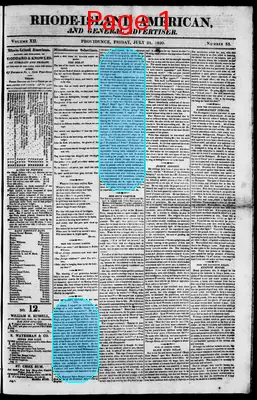
Literary
July 21, 1820
The Rhode Island American, And General Advertiser
Providence, Providence County, Rhode Island
What is this article about?
Coleridge describes his schooling under Rev. James Bowyer at Christ Hospital, who shaped his literary preferences for ancient authors like Demosthenes and Homer, emphasized logical structure in poetry, and enforced plain, sensible writing by banning clichéd metaphors and allusions.
Clipping
OCR Quality
98%
Excellent
Full Text
FROM COLERIDGE'S SKETCHES OF HIS OWN LIFE.
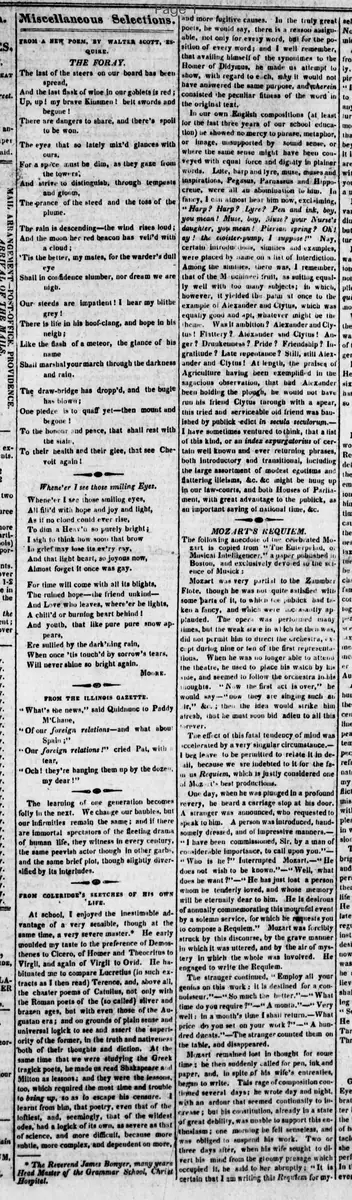
At school, I enjoyed the inestimable advantage of a very sensible, though at the same time, a very severe master. He early moulded my taste to the preference of Demosthenes to Cicero, of Homer and Theocritus to Virgil, and again of Virgil to Ovid. He habituated me to compare Lucretius (in such extracts as I then read) Terence, and, above all, the chaster poems of Catullus, not only with the Roman poets of the (so called) silver and brazen ages, but with even those of the Augustan era; and on grounds of plain sense and universal logic to see and assert the superiority of the former, in the truth and nativeness both of their thoughts and diction. At the same time that we were studying the Greek tragic poets, he made us read Shakespeare and Milton as lessons; and they were the lessons, too, which required the most time and trouble to bring up, so as to escape his censure. I learnt from him, that poetry, even that of the loftiest, and, seemingly, that of the wildest odes, had a logic of its own, as severe as that of science, and more difficult, because more subtle, more complex, and dependent on more, and more fugitive causes. In the truly great poets, he would say, there is a reason assignable, not only for every word, but for the position of every word; and I well remember, that availing himself of the synonyms to the Homer of Didymus, he made us attempt to show, with regard to each, why it would not have answered the same purpose, and wherein consisted the peculiar fitness of the word in the original text. In our own English compositions (at least for the last three years of our school education) we showed no mercy to phrase, metaphor, or image, unsupported by sound sense, or where the same sense might have been conveyed with equal force and dignity in plainer words. Lute, harp and lyre, muse, muses and inspirations, Pegasus, Parnassus and Hippocrene, were all an abomination to him. In fancy, I can almost hear him now, exclaiming, "Harp? Harp? Lyre? Pen and ink, boy! you mean! Muse, boy, Muse? your Nurse's daughter, you mean! Pierian spring? Oh! ay! the cloister-pump, I suppose!" Nay, certain introductions, similes and examples, were placed by name on a list of interdiction. Among the similes, there was, I remember, that of the Manchineel fruit, as suiting equally well with too many subjects; in which, however, it yielded the palm at once to the example of Alexander and Clytus, which was equally good and apt, whatever might be the theme. Was it ambition? Alexander and Clytus! Flattery? Alexander and Clytus! Anger? Drunkenness? Pride? Friendship? Ingratitude? Late repentance? Still, still Alexander and Clytus! At length, the praises of Agriculture having been exemplified in the sagacious observation, that had Alexander been holding the plough, he would not have run his friend Clytus through with a spear, this tried and serviceable old friend was banished by public edict in secula seculorum. I have sometimes ventured to think, that a list of this kind, or an index expurgatorius of certain well known and ever returning phrases, both introductory and transitional, including the large assortment of modest egotisms and flattering illeisms, &c. &c. might be hung up in our law-courts, and both Houses of Parliament, with great advantage to the public, as an important saving of national time, &c.
* The Reverend James Bowyer, many years Head Master of the Grammar School, Christ Hospital.
At school, I enjoyed the inestimable advantage of a very sensible, though at the same time, a very severe master. He early moulded my taste to the preference of Demosthenes to Cicero, of Homer and Theocritus to Virgil, and again of Virgil to Ovid. He habituated me to compare Lucretius (in such extracts as I then read) Terence, and, above all, the chaster poems of Catullus, not only with the Roman poets of the (so called) silver and brazen ages, but with even those of the Augustan era; and on grounds of plain sense and universal logic to see and assert the superiority of the former, in the truth and nativeness both of their thoughts and diction. At the same time that we were studying the Greek tragic poets, he made us read Shakespeare and Milton as lessons; and they were the lessons, too, which required the most time and trouble to bring up, so as to escape his censure. I learnt from him, that poetry, even that of the loftiest, and, seemingly, that of the wildest odes, had a logic of its own, as severe as that of science, and more difficult, because more subtle, more complex, and dependent on more, and more fugitive causes. In the truly great poets, he would say, there is a reason assignable, not only for every word, but for the position of every word; and I well remember, that availing himself of the synonyms to the Homer of Didymus, he made us attempt to show, with regard to each, why it would not have answered the same purpose, and wherein consisted the peculiar fitness of the word in the original text. In our own English compositions (at least for the last three years of our school education) we showed no mercy to phrase, metaphor, or image, unsupported by sound sense, or where the same sense might have been conveyed with equal force and dignity in plainer words. Lute, harp and lyre, muse, muses and inspirations, Pegasus, Parnassus and Hippocrene, were all an abomination to him. In fancy, I can almost hear him now, exclaiming, "Harp? Harp? Lyre? Pen and ink, boy! you mean! Muse, boy, Muse? your Nurse's daughter, you mean! Pierian spring? Oh! ay! the cloister-pump, I suppose!" Nay, certain introductions, similes and examples, were placed by name on a list of interdiction. Among the similes, there was, I remember, that of the Manchineel fruit, as suiting equally well with too many subjects; in which, however, it yielded the palm at once to the example of Alexander and Clytus, which was equally good and apt, whatever might be the theme. Was it ambition? Alexander and Clytus! Flattery? Alexander and Clytus! Anger? Drunkenness? Pride? Friendship? Ingratitude? Late repentance? Still, still Alexander and Clytus! At length, the praises of Agriculture having been exemplified in the sagacious observation, that had Alexander been holding the plough, he would not have run his friend Clytus through with a spear, this tried and serviceable old friend was banished by public edict in secula seculorum. I have sometimes ventured to think, that a list of this kind, or an index expurgatorius of certain well known and ever returning phrases, both introductory and transitional, including the large assortment of modest egotisms and flattering illeisms, &c. &c. might be hung up in our law-courts, and both Houses of Parliament, with great advantage to the public, as an important saving of national time, &c.
* The Reverend James Bowyer, many years Head Master of the Grammar School, Christ Hospital.
What sub-type of article is it?
Essay
What themes does it cover?
Moral Virtue
What keywords are associated?
Coleridge Autobiography
School Education
Classical Literature
Poetry Logic
Rhetorical Style
What entities or persons were involved?
Coleridge
Literary Details
Title
From Coleridge's Sketches Of His Own Life.
Author
Coleridge
Subject
Recollections Of School Education Under Rev. James Bowyer
Form / Style
Autobiographical Prose Reflection
Key Lines
He Early Moulded My Taste To The Preference Of Demosthenes To Cicero, Of Homer And Theocritus To Virgil, And Again Of Virgil To Ovid.
Poetry, Even That Of The Loftiest, And, Seemingly, That Of The Wildest Odes, Had A Logic Of Its Own, As Severe As That Of Science, And More Difficult, Because More Subtle, More Complex, And Dependent On More, And More Fugitive Causes.
In Fancy, I Can Almost Hear Him Now, Exclaiming, "Harp? Harp? Lyre? Pen And Ink, Boy! You Mean! Muse, Boy, Muse? Your Nurse's Daughter, You Mean! Pierian Spring? Oh! Ay! The Cloister Pump, I Suppose!"
Still, Still Alexander And Clytus!