Thank you for visiting SNEWPapers!
Sign up free
Letter to Editor
August 16, 1776
The Virginia Gazette
Williamsburg, Virginia
What is this article about?
On July 29, 1776, from Belleville in Richmond, an anonymous writer urges printer Mr. Purdie to publish an extract from Roman general Paulus Aemilius's speech to counter public defamation of American officers, including Col. W---d---d and General L---s, over the Gwyn's Island affair, arguing against uninformed criticism of military leaders.
Clipping
OCR Quality
95%
Excellent
Full Text
BELLEVILLE, in Richmond, July 29, 1776.
MR. PURDIE,
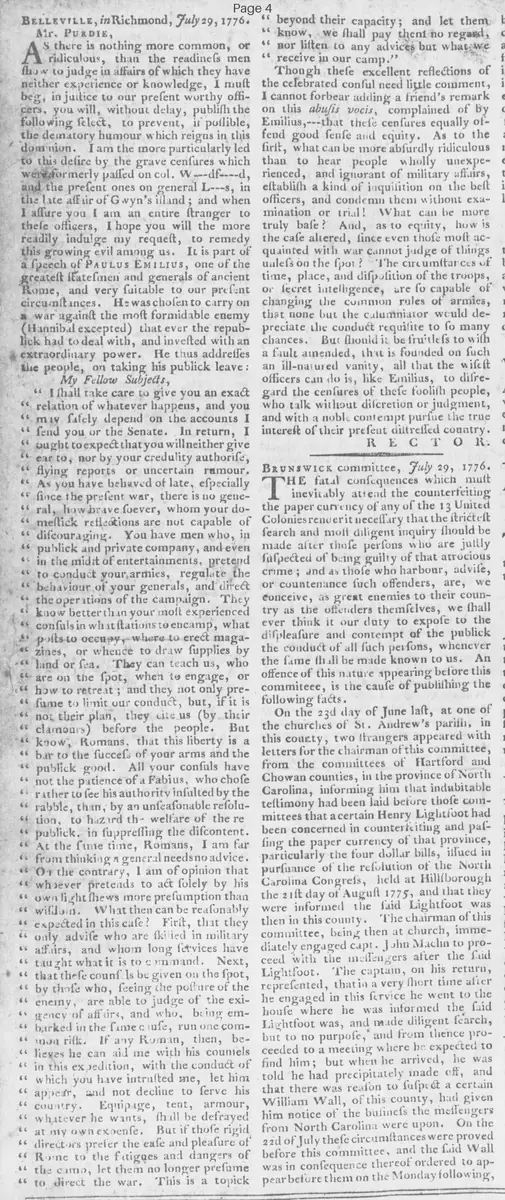
As there is nothing more common, or ridiculous, than the readiness men show to judge in affairs of which they have neither experience nor knowledge, I must beg, in justice to our present worthy officers, you will, without delay, publish the following extract, to prevent, if possible, the defamatory humour which reigns in this dominion. I am the more particularly led to this desire by the grave censures which were formerly passed on col. W---d---d, and the present ones on general L---s, in the late affair of Gwyn's island; and when I assure you I am an entire stranger to these officers, I hope you will the more readily indulge my request, to remedy this growing evil among us. It is part of a speech of Paulus Aemilius, one of the greatest statesmen and generals of ancient Rome, and very suitable to our present circumstances. He was chosen to carry on a war against the most formidable enemy (Hannibal excepted) that ever the republic had to deal with, and invested with an extraordinary power. He thus addresses the people, on taking his publick leave:
My Fellow Subjects,
"I shall take care to give you an exact relation of whatever happens, and you may safely depend on the accounts I send you or the Senate. In return, I ought to expect that you will neither give ear to, nor by your credulity authorise, flying reports or uncertain rumour. As you have behaved of late, especially since the present war, there is no general, how brave soever, whom your domestick reflections are not capable of discouraging. You have men who, in publick and private company, and even in the midst of entertainments, pretend to conduct your armies, regulate the behaviour of your generals, and direct the operations of the campaign. They know better than your most experienced consuls in what stations to encamp, what posts to occupy, where to erect magazines, or whence to draw supplies by land or sea. They can teach us, who are on the spot, when to engage, or how to retreat; and they not only presume to limit our conduct, but, if it is not their plan, they cite us (by their clamours) before the people. But know, Romans, that this liberty is a bar to the success of your arms and the publick good. All your consuls have not the patience of a Fabius, who chose rather to see his authority insulted by the rabble, than, by an unreasonable resolution, to hazard the welfare of the republic in suppressing the discontent. At the same time, Romans, I am far from thinking a general needs no advice. On the contrary, I am of opinion that whoever pretends to act solely by his own light shows more presumption than wisdom. What then can be reasonably expected in this case? First, that they only advise who are skilled in military affairs, and whom long services have taught what it is to command. Next, that these counsels be given on the spot, by those who, seeing the posture of the enemy, are able to judge of the exigency of affairs, and who, being embarked in the same cause, run one common risk. If any Roman, then, believes he can aid me with his counsels in this expedition, with the conduct of which you have intrusted me, let him appear, and not decline to serve his country. Equipage, tent, armour, whatever he wants, shall be defrayed at my own expense. But if those rigid directors prefer the ease and pleasure of Rome to the fatigues and dangers of the camp, let them no longer presume to direct the war. This is a topick
"beyond their capacity; and let them know, we shall pay them no regard, nor listen to any advices but what we receive in our camp."
Though these excellent reflections of the celebrated consul need little comment, I cannot forbear adding a friend's remark on this abuse of voice, complained of by Aemilius,—that these censures equally offend good sense and equity. As to the first, what can be more absurdly ridiculous than to hear people wholly unexperienced, and ignorant of military affairs, establish a kind of inquisition on the best officers, and condemn them without examination or trial! What can be more truly base? And, as to equity, how is the case altered, since even those most acquainted with war cannot judge of things unless on the spot? The circumstances of time, place, and disposition of the troops, or secret intelligence, are so capable of changing the common rules of armies, that none but the calumniator would depreciate the conduct requisite to so many chances. But should it be fruitless to wish a fault amended, that is founded on such an ill-natured vanity, all that the wisest officers can do is, like Aemilius, to disregard the censures of these foolish people, who talk without discretion or judgment, and with a noble contempt pursue the true interest of their present distressed country.
MR. PURDIE,
As there is nothing more common, or ridiculous, than the readiness men show to judge in affairs of which they have neither experience nor knowledge, I must beg, in justice to our present worthy officers, you will, without delay, publish the following extract, to prevent, if possible, the defamatory humour which reigns in this dominion. I am the more particularly led to this desire by the grave censures which were formerly passed on col. W---d---d, and the present ones on general L---s, in the late affair of Gwyn's island; and when I assure you I am an entire stranger to these officers, I hope you will the more readily indulge my request, to remedy this growing evil among us. It is part of a speech of Paulus Aemilius, one of the greatest statesmen and generals of ancient Rome, and very suitable to our present circumstances. He was chosen to carry on a war against the most formidable enemy (Hannibal excepted) that ever the republic had to deal with, and invested with an extraordinary power. He thus addresses the people, on taking his publick leave:
My Fellow Subjects,
"I shall take care to give you an exact relation of whatever happens, and you may safely depend on the accounts I send you or the Senate. In return, I ought to expect that you will neither give ear to, nor by your credulity authorise, flying reports or uncertain rumour. As you have behaved of late, especially since the present war, there is no general, how brave soever, whom your domestick reflections are not capable of discouraging. You have men who, in publick and private company, and even in the midst of entertainments, pretend to conduct your armies, regulate the behaviour of your generals, and direct the operations of the campaign. They know better than your most experienced consuls in what stations to encamp, what posts to occupy, where to erect magazines, or whence to draw supplies by land or sea. They can teach us, who are on the spot, when to engage, or how to retreat; and they not only presume to limit our conduct, but, if it is not their plan, they cite us (by their clamours) before the people. But know, Romans, that this liberty is a bar to the success of your arms and the publick good. All your consuls have not the patience of a Fabius, who chose rather to see his authority insulted by the rabble, than, by an unreasonable resolution, to hazard the welfare of the republic in suppressing the discontent. At the same time, Romans, I am far from thinking a general needs no advice. On the contrary, I am of opinion that whoever pretends to act solely by his own light shows more presumption than wisdom. What then can be reasonably expected in this case? First, that they only advise who are skilled in military affairs, and whom long services have taught what it is to command. Next, that these counsels be given on the spot, by those who, seeing the posture of the enemy, are able to judge of the exigency of affairs, and who, being embarked in the same cause, run one common risk. If any Roman, then, believes he can aid me with his counsels in this expedition, with the conduct of which you have intrusted me, let him appear, and not decline to serve his country. Equipage, tent, armour, whatever he wants, shall be defrayed at my own expense. But if those rigid directors prefer the ease and pleasure of Rome to the fatigues and dangers of the camp, let them no longer presume to direct the war. This is a topick
"beyond their capacity; and let them know, we shall pay them no regard, nor listen to any advices but what we receive in our camp."
Though these excellent reflections of the celebrated consul need little comment, I cannot forbear adding a friend's remark on this abuse of voice, complained of by Aemilius,—that these censures equally offend good sense and equity. As to the first, what can be more absurdly ridiculous than to hear people wholly unexperienced, and ignorant of military affairs, establish a kind of inquisition on the best officers, and condemn them without examination or trial! What can be more truly base? And, as to equity, how is the case altered, since even those most acquainted with war cannot judge of things unless on the spot? The circumstances of time, place, and disposition of the troops, or secret intelligence, are so capable of changing the common rules of armies, that none but the calumniator would depreciate the conduct requisite to so many chances. But should it be fruitless to wish a fault amended, that is founded on such an ill-natured vanity, all that the wisest officers can do is, like Aemilius, to disregard the censures of these foolish people, who talk without discretion or judgment, and with a noble contempt pursue the true interest of their present distressed country.
What sub-type of article is it?
Persuasive
Historical
Reflective
What themes does it cover?
Military War
Politics
Morality
What keywords are associated?
Military Criticism
Defamatory Rumors
Paulus Aemilius
Gwyn's Island
Colonial Officers
Armchair Generals
Roman Speech
What entities or persons were involved?
Mr. Purdie
Letter to Editor Details
Recipient
Mr. Purdie
Main Argument
public defamation of military officers by uninformed critics harms the war effort; an extract from paulus aemilius's speech should be published to remind people to withhold judgment on military affairs unless they have experience and are present on the scene.
Notable Details
References Col. W D D
References General L S
Gwyn's Island Affair
Speech By Paulus Aemilius
Ancient Rome Against Formidable Enemy (Hannibal Excepted)
Compares To Fabius's Patience