Thank you for visiting SNEWPapers!
Sign up free
Norfolk Gazette And Publick Ledger
Norfolk, Virginia
What is this article about?
In a letter dated March 8, 1815, from the Tonnant off St. Mary's, Georgia, British Admiral Alexander Cochrane demands proofs from U.S. Secretary of State James Monroe regarding accusations of selling escaped slaves in the West Indies by British forces. Cochrane denies the claims, stating refugees were sent to Bermuda or Halifax and treated freely. No response was given.
Clipping
OCR Quality
Full Text
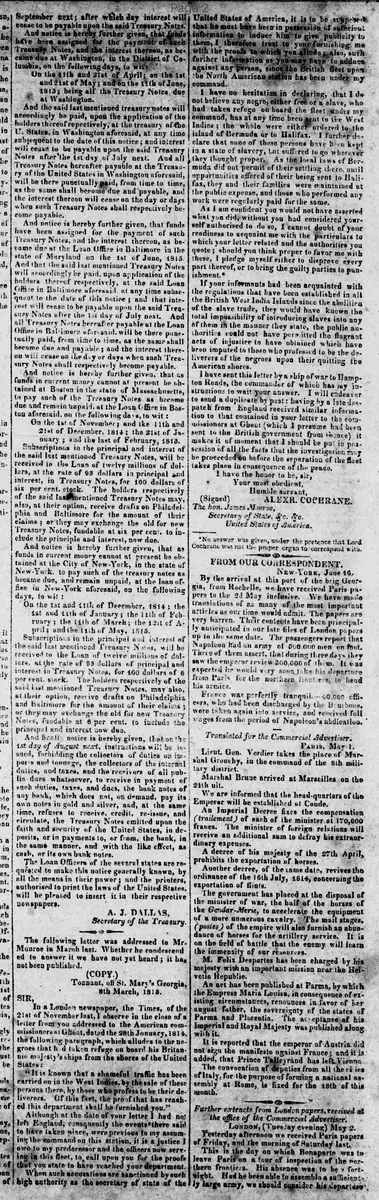
(COPY.)
Tonnant, off St. Mary's Georgia,
8th March, 1815.
SIR,
In a London newspaper, the Times, of the 21st of November last, I observe in the close of a letter from you addressed to the American commissioners at Ghent, dated the 28th January, 1814. the following paragraph, which alludes to the negroes that had taken refuge on board his Britannic majesty's ships from the shores of the United States:
"It is known that a shameful traffic has been carried on in the West Indies, by the sale of these persons there, by those who profess to be their deliverers. Of this fact, the proof that has reached this department shall be furnished you."
Although at the date of your letter I had not left England; consequently the events there said to have taken place, were previous to my assuming the command on this station, it is a justice I owe to my predecessor and the officers now serving in this fleet, to call upon you for the proofs that you state to have reached your department. When such accusations are sanctioned by such high authority as the secretary of state of the United States of America, it is to be supposed that he must have been in possession of sufficient information to induce him to give publicity to them, I therefore trust to your furnishing me with the proofs to which you allude: also, such further information as you may have to produce, against any person, since the British fleet upon the North American station has been under my command.
I have no hesitation in declaring, that I do not believe any negro, either free or a slave, who had taken refuge on board the fleet under my command, has at any time been sent to the West Indies; the whole were either ordered to the island of Bermuda or to Halifax. I further declare that none of these persons have been kept in a state of slavery, but suffered to go wherever they thought proper. As the local laws of Bermuda did not permit of their settling there, until opportunities offered of their being sent to Halifax, they and their families were maintained at the public expense, and those who performed any work were regularly paid for the same.
As I am confident you would not have asserted what you did, without you had considered yourself authorised to do so, I cannot doubt of your readiness to acquaint me with the particulars to which your letter related and the authorities you quote; should you think proper to favor me with these, I pledge myself either to disprove every part thereof, or to bring the guilty parties to punishment.*
If your informants had been acquainted with the regulations that have been established in all the British West India Islands since the abolition of the slave trade, they would have known the total impossibility of introducing slaves into any of them in the manner they state, the public authorities could not have permitted the flagrant acts of injustice to have obtained which have been imputed to those who professed to be the deliverers of the negroes upon their quitting the American shores.
I have sent this letter by a ship of war to Hampton Roads, the commander of which has my instructions to wait your answer. I will endeavor to send a duplicate by post: having by a late despatch from England received similar information to that contained in your letter to the commissioners at Ghent (which I presume had been sent to the British government from thence). it makes it of moment that I should be put in possession of all the facts that the investigation may be proceeded on before the separation of the fleet takes place in consequence of the peace.
I have the honor to be, sir,
Your most obedient,
Humble servant,
(Signed)
ALEXR. COCHRANE.
The hon. James Monroe,
Secretary of State, &c. &c.
United States of America.
*No answer was given, under the pretence that Lord Cochrane was not the proper organ to correspond with.
What sub-type of article is it?
What keywords are associated?
What entities or persons were involved?
Where did it happen?
Foreign News Details
Primary Location
St. Mary's Georgia
Event Date
8th March, 1815
Key Persons
Outcome
no answer was given, under the pretence that lord cochrane was not the proper organ to correspond with.
Event Details
British Admiral Alexander Cochrane writes to U.S. Secretary of State James Monroe demanding proofs of accusations that British forces sold escaped slaves in the West Indies. Cochrane denies the claims, stating that refugees were sent to Bermuda or Halifax, maintained at public expense, paid for work, and allowed freedom. He pledges to disprove or punish if evidence provided. The letter references Monroe's earlier statement from January 28, 1814, published in the Times on November 21, 1814.