Thank you for visiting SNEWPapers!
Sign up free
Daily National Intelligencer
Washington, District Of Columbia
What is this article about?
President James Monroe visited Lexington, Kentucky, in July 1819, receiving warm receptions, attending events at Transylvania University, an Independence Day celebration, and exchanging addresses with local citizens emphasizing national unity, internal improvements, and republican values.
Clipping
OCR Quality
Full Text
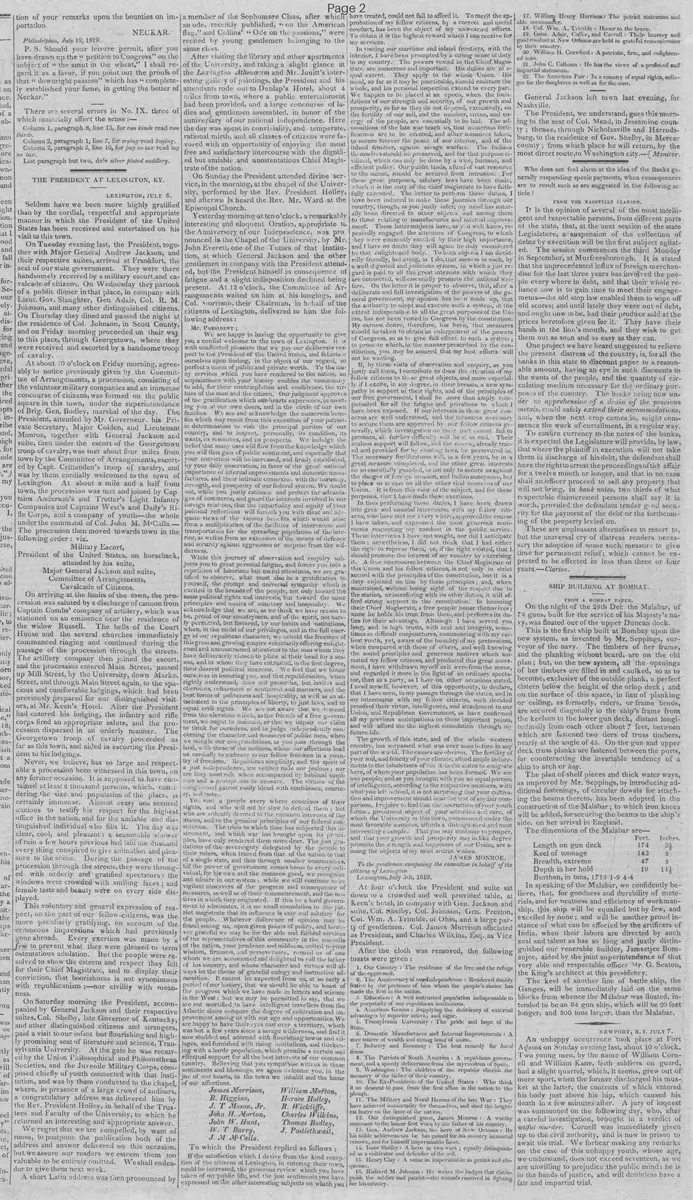
LEXINGTON, JULY 6.
Seldom have we been more highly gratified than by the cordial, respectful and appropriate manner in which the President of the United States has been received and entertained on his visit to this town.
On Tuesday evening last, the President, together with Major General Andrew Jackson, and their respective suites, arrived at Frankfort, the seat of our state government. They were there handsomely received by a military escort and cavalcade of citizens. On Wednesday they partook of a public dinner in that place, in company with Lieut. Gov. Slaughter, Gen Adair, Col. R. M. Johnson, and many other distinguished citizens.
On Thursday they dined and passed the night at the residence of Col. Johnson, in Scott County, and on Friday morning proceeded on their way to this place, through Georgetown, where they were received and escorted by a handsome troop of cavalry.
At about 10 o'clock on Friday morning, agreeably to notice previously given by the Committee of Arrangements, a procession, consisting of the volunteer military companies and an immense concourse of citizens, was formed on the public square in this town, under the superintendance of Brig. Gen. Bodley, marshal of the day. The President, attended by Mr. Gouverneur, his Private Secretary, Major Colden, and Lieutenant Monroe, together with General Jackson and suite, then under the escort of the Georgetown troop of cavalry, was met about four miles from town by the Committee of Arrangements, escorted by Capt. Crittenden's troop of cavalry, and was by them cordially welcomed to the town of Lexington. At about a mile and a half from town, the procession was met and joined by Captains Anderson's and Trotter's Light Infantry Companies and Captains West's and Daily's Rifle Corps, and a company of youth—the whole under the command of Col. John M. M'Calla.
The procession then moved towards town in the following order : viz.
Military Escort,
President of the United States, on horseback,
attended by his suite,
Major General Jackson and suite,
Committee of Arrangements,
Cavalcade of Citizens.
On arriving at the limits of the town, the procession was saluted by a discharge of cannon from Captain Combs' company of artillery, which was stationed on an eminence near the residence of the widow Russell. The bells of the Court House and the several churches immediately commenced ringing and continued during the passage of the procession through the streets. The artillery company then joined the escort, and the procession entered Main Street, passed up Mill Street, by the University, down Market Street, and through Main Street again, to the spacious and comfortable lodgings, which had been previously prepared for our distinguished visitors, at Mr. Keen's Hotel. After the President had entered his lodging, the infantry and rifle corps fired an appropriate salute, and the procession dispersed in an orderly manner. The Georgetown troop of cavalry proceeded as far as this town, and aided in escorting the President to his lodgings.
Never, we believe, has so large and respectable a procession been witnessed in this town, on any former occasion. It is supposed to have contained at least a thousand persons, which, considering the size and population of the place, is certainly immense. Almost every one seemed anxious to testify his respect for the highest office in the nation, and for the amiable and distinguished individual who fills it. The day was clear, cool, and pleasant: a seasonable shower of rain a few hours previous had laid the dust, and every thing conspired to give animation and pleasure to the scene. During the passage of the procession through the streets, they were thronged with orderly and gratified spectators: the windows were crowded with smiling faces; and female taste and beauty were on every side displayed.
This voluntary and general expression of respect, on the part of our fellow-citizens, was the more peculiarly gratifying, on account of the erroneous impressions which had previously gone abroad. Every exertion was made by a few to prevent what they were pleased to term ostentatious adulation. But the people were resolved to show the esteem and respect they felt for their Chief Magistrate, and to display their conviction, that boorishness is not synonomous with republicanism;—nor civility with meanness.
On Saturday morning the President, accompanied by General Jackson and their respective suites, Col. Shelby, late Governor of Kentucky, and other distinguished citizens and strangers, paid a visit to our infant but flourishing and highly promising seat of literature and science, Transylvania University. At the gate he was received by the Union Philosophical and Philomathean Societies, and the Juvenile Military Corps, composed chiefly of youth connected with that institution, and was by them conducted to the chapel, where, in presence of a large crowd of auditors, a congratulatory address was delivered him by the Rev. President Holley, in behalf of the Trustees and Faculty of the University, to which he returned an interesting and appropriate answer.
We regret that we are compelled, by want of room, to postpone the publication both of the address and answer delivered on this occasion, but we assure our readers we esteem them too valuable to be entirely omitted. We shall endeavor to give them next week.
A short Latin address was then pronounced by a member of the Sophomore Class, after which an ode, recently published, "on the American flag," and Collins' "Ode on the passions," were recited by young gentlemen belonging to the same class.
After visiting the library and other apartments of the University, and taking a slight glance at the Lexington Athenæum and Mr. Jouitt's interesting gallery of paintings, the President and his attendants rode out to Dunlap's Hotel, about 4 miles from town, where a public entertainment had been provided, and a large concourse of ladies and gentlemen assembled, in honor of the anniversary of our national independence. Here the day was spent in conviviality, and temperate, rational mirth, and all classes of citizens were favored with an opportunity of enjoying the most free and satisfactory intercourse with the dignified but amiable and unostentatious Chief Magistrate of the nation.
On Sunday the President attended divine service, in the morning, at the chapel of the University, performed by the Rev. President Holley. and afterwards heard the Rev. Mr. Ward at the Episcopal Church.
Yesterday morning at ten o'clock, a remarkably interesting and eloquent Oration, appropriate to the Anniversary of our Independence, was pronounced in the Chapel of the University, by Mr. John Everett, one of the Tutors of that Institution, at which General Jackson and the other gentlemen in company with the President attended, but the President himself in consequence of fatigue and a slight indisposition declined being present. At 12 o'clock, the Committee of Arrangements waited on him at his lodgings, and Col. Morrison, their Chairman, in behalf of the citizens of Lexington, delivered to him the following address :
Mr. PRESIDENT ;
We are happy in having the opportunity to give you a cordial welcome to the town of Lexington. It is with unaffected pleasure that we pay our deliberate respect to the President of the United States, and felicitate ourselves upon finding, in the object of our regard, so perfect a union of public and private worth. To the many services which you have rendered to the nation, an acquaintance with your history enables the community to add, for their contemplation and confidence, the virtues of the man and the citizen. Our judgment approves of the gratification which our hearts experience, in meeting you at our own doors, and in the circle of our own families. We see and acknowledge the numerous benefits which may result from this execution of your patriotic determination to visit the principal portion of our country, and to inspect, personally, its condition, its wants, its resources, and its prospects. We indulge the belief that many uses will flow from the knowledge which you will thus gain of public sentiment, and especially that your conviction will be increased, and firmly established, by your daily observation, in favor of the great national importance of internal improvements and domestic manufactures, and their intimate connexion with the harmony, strength, and prosperity of our federal system. We doubt not, while you justly estimate and protect the advantages of commerce, and guard the interests involved in our foreign relations, that the impartiality and equity of your political reflections will furnish you with clear and adequate views of the various benefits which would arise from a multiplication of the facilities of intercourse and transportation for the spreading population of the interior, as well as from an extension of the means of defence and security against aggression or surprise from the wilderness.
While this journey of observation and enquiry subjects you to great personal fatigue, and forces you into a repetition of laborious but useful attentions, we are gratified to observe, what must also be a gratification to yourself, the prompt and universal sympathy which is excited in the breasts of the people, not only toward the same political rights and interests, but toward the same principles and modes of courtesy and hospitality. We acknowledge that we are, as we think we have reason to be, proud of our countrymen, and of the spirit, not barely permitted, but fostered, by our habits and institutions, when, in the midst of our privileges, and in the full energy of our republican character, we behold the freemen of this great and growing empire voluntarily offering enlightened and unconstrained attentions to the man whom they have deliberately chosen to place at their head for a season, and to whom they have entrusted, in the first degree, their dearest political interests. We feel that we honor ourselves in honoring you, and that republicanisin, when rightly understood, does not proscribe, but invites and cherishes, refinement of sentiment and manners, and the best forms of politeness and hospitality, as well as an attachment to the principles of liberty, to just laws, and to equal civil rights. We are not aware that we descend from the elevation which, as the friends of a free government, we ought to maintain, or that we impair our claim to think for ourselves, and to judge independently concerning the character and measures of public men, when we mingle our congratulations, as you pass through the land, with those of the millions, whose affections lead us cordially to embrace as our fellow freemen in a country of freedom. Republican simplicity, and the spirit of a just independence, are neither rude nor jealous ; nor are they most safe when accompanied by habitual suspicion and a promptness to censure. The virtues of the enlightened patriot easily blend with confidence, courtesy, and taste.
You visit a people every where conscious of their rights, and who will not be slow to defend them ; but who are ardently devoted to the common interests of the States, and to the genuine principles of our federal constitution. The trials to which time has subjected this instrument, and which war has brought upon its principles, have only rendered them more dear. The just gradations of the sovereignty delegated by the people to their rulers, when traced from that of the nation to that of a single state, and thus through smaller communities, till the power of government comes home to every individual, for his own and the common good, we recognize and admire in our system ; while we still continue to be vigilant observers of the progress and consequence of measures, as well as of their commencement, and the motives in which they originated. If this be a hard government to administer, it is no small consolation to the patriot magistrate that its influence is easy and salutary for the people. Whatever difference of opinion may be found among us, upon given points of policy, and however grateful we may be for the able and faithful services of the representatives of this community in the councils of the nation, your prudence and mildness, united to your wisdom, firmness, and perseverance, remind us of one whom we are accustomed and delighted to call the father of his country, and whose character and virtues will always be the theme of grateful eulogy and instructive admonition. It cannot be expected from us, at so early a period of our history, that we should be able to boast of the progress which we have made in letters and science in the West; but we may be permitted to say, that we are not mortified to have intelligent travellers from the Atlantic shore compare the degree of cultivation and improvement among us with our age and opportunities. We are happy to have their eyes cast over a territory, which was but a few years since a savage wilderness, and find it now studded and adorned with flourishing towns and villages, and furnished with rising institutions, and thickening with a hardy population, which promise a certain and effectual support for all the best interests of our common country. Believing that you sympathise with us in these sentiments and blessings, we again welcome you, in the joy of our hearts, to the town we inhabit and the home of our affections.
James Morrison,
William Morton,
R. Higgins,
Horace Holley,
J. T. Mason, Jr.
R. Wickliffe,
John H. Morton,
Charles Wilkins,
John W. Hunt,
Thomas Bodley,
W. T. Barry,
J. Postlethwait,
J. M. M'Calla.
To which the President replied as follows :
If the satisfaction which I derive from the kind reception of the citizens of Lexington, in entering their town, could be increased, the generous review which you have taken of my public life, and the just sentiments you have expressed on the other interesting subjects on which you have treated, could not fail to afford it. To merit the approbation of my fellow citizens, by a correct and useful conduct, has been the object of my unwearied efforts. To obtain it is the highest reward which I can receive for my services.
In visiting our maritime and inland frontiers, with the interior, I have been prompted by a strong sense of duty to my country. The powers vested in the Chief Magistrate are numerous and important. His duties are of equal extent. They apply to the whole Union. His mind, so far as it may be practicable, should embrace the whole, and his personal inspection extend to every part.
We happen to be placed at an epoch, when the foundations of our strength and security, of our growth and prosperity, so far as they do not depend, exclusively, on the fertility of our soil, and the number, virtue, and energy of the people, are essentially to be laid. The admonitions of the late war teach us, that numerous fortifications are to be erected, and other measures taken, to secure forever the peace of our interior, and of the inland frontier, against savage warfare. The Indians themselves should be preserved, and for that purpose civilized, which can only be done by a wise, humane, and efficient policy. Our public lands, a fund of vast resource to the nation, should be secured from intrusion. For these great purposes, salutary laws have been made, which it is the duty of the chief magistrate to have faithfully executed. The better to perform these duties, I have been induced to make these journies through our country, though, as you justly infer, my mind has naturally been directed to other objects and among them to those relating to manufactures and internal improvement. These latter subjects have, as you well know, repeatedly engaged the attention of Congress, to which they were eminently entitled by their high importance, and I have no doubt they will again be duly considered by that enlightened body. To both objects I am decidedly friendly, believing, as I do, that success in each, by a well digested and judicious system, in which a just regard is paid to all the great interests with which they are connected, will essentially promote the national welfare. On the latter it is proper to observe, that, after a deliberate and full investigation of the powers of the general government, my opinion has been made up, that the authority to adopt and execute such a system, in the extent indispensable to all the great purposes of the Union, has not been vested in Congress by the constitution. My earnest desire, therefore, has been, that measures should be taken to obtain an enlargement of the powers of Congress, so as to give full effect to such a system; to promote which, in the manner prescribed by the constitution, you may be assured that my best efforts will not be wanting.
If, by these visits of observation and enquiry, as you justly call them, I contribute to draw the attention of my fellow citizens to these great objects, and more especially if I excite, in any degree, in their breasts, a new sympathy in support of their rights, and of the principles of our free government, I shall be more than amply compensated for all the fatigue and privations to which I have been exposed. If our interests in these great concerns are well understood, and the measures necessary to secure them are approved by our fellow citizens generally, which investigation on their part cannot fail to promote, all further difficulty will be at an end. Their zealous support will follow, and the course, already traced and provided for by existing laws, be persevered in. The necessary fortifications will, in a few years, be in a great measure completed, and the other great interests be so essentially guarded, as not only to secure us against the danger of foreign invasion, and Indian annoyance, but to place us at ease on all the other vital concerns of our Union. It is from this view of the subject, and for these purposes, that I have made these exertions.
In thus performing these duties, I have been drawn into great and unusual intercourse with my fellow citizens, who have met me every where, approved the course I have taken, and expressed the most generous sentiments respecting my conduct in the public service. These interviews I have not sought, nor did I anticipate them; nevertheless, I did not think that I had either the right to repress them, or, if the right existed, that I should promote the interest of my country by exercising it. A free intercourse between the Chief Magistrate of this Union and his fellow citizens, is not only in strict accord with the principles of the constitution, but it is a duty enjoined on him by these principles; and, when maintained, without losing sight of the respect due to the station, or interfering with its other duties, it will afford strong support to the constitution. In honoring their Chief Magistrate, a free people honor themselves; since he holds his trust from them, and performs its duties for their advantage. Although I have served you long, and in high trusts, with zeal and integrity, sometimes in difficult conjunctures, commencing with my earliest youth, yet, aware of the humility of my pretensions, when compared with those of others, and well knowing the sound principles and generous motives which animated my fellow citizens, and produced this great movement, I have withdrawn myself as it were from the scene, and regarded it more in the light of an ordinary spectator, than as a party, as I have on other occasions stated.
I avail myself, however, of this opportunity, to declare, that I have seen, in my passage through the states, and in my intercourse with my fellow citizens, such decided proofs of their virtue, intelligence, and attachment to our Union, and Republican Government, as have confirmed all my previous anticipations on these important points. and will afford me the highest consolation through my future life.
The growth of this state, and of the whole western country, has surpassed what was ever seen before in any part of the world. The causes are obvious. The fertility of your soil, and felicity of your climate, afford ample inducements to the inhabitants of the Atlantic states to emigrate here, of whom your population has been formed. We are one people; and as you brought with you an equal portion of intelligence, according to the respective numbers, with what you left behind, it is not surprising that your cultivation and improvement should bear the test of any fair comparison. I rejoice to find that the instruction of your youth forms a prominent object of your attention and care, of which the University in this town, commenced under the most favorable auspices, affords a distinguished and most interesting example. That you may continue to prosper, and that your growth and prosperity may in like degree promote the strength and happiness of our Union, are among the objects of my most ardent wishes.
JAMES MONROE.
To the gentlemen composing the committee in behalf of the citizens of Lexington
Lexington, July 5th, 1819.
At four o'clock the President and suite sat down to a crowded and well provided table, at Keen's hotel, in company with Gen. Jackson and suite, Col. Shelby, Col. Johnson, Gen. Preston, Col. Wm. A. Trimble, of Ohio, and a large party of gentlemen. Col. James Morrison officiated as President, and Charles Wilkins, Esq. as Vice President.
After the cloth was removed, the following toasts were given :
1. Our Country : The residence of the free and the refuge of the oppressed.
2. The Anniversary of our Independence : Rendered doubly festive by the presence of him whom the people's choice has made the first in the nation.
3. Education: A well instructed population indispensable to the perpetuity of our republican institutions,
4. American Genius : Supplying the deficiency of external advantages by superior activity and vigor.
5. Transylvania University : The pride and hope of the State.
6. Domestic Manufactures and Internal Improvements : A sure source of wealth and strong bond of union.
7. Industry and Economy : The best remedy for hard times.
8. The Patriots of South America : A republican government, and a speedy deliverance from the myrmidons of Spain.
9. Washington: The children of the republic cherish the memory of the father of their country.
10. The Ex-Presidents of the United States : Who think it no descent to pass from the first office in the nation to the plough.
11. The Military and Naval Heroes of the late War : They have achieved immortality for themselves, and shed the brightest lustre on the fame of the nation.
12. Our distinguished guest, James Monroe : A worthy successor to the honor first worn by the father of his country.
13. Gen. Andrew Jackson, the hero of New Orleans : By his noble achievements he has gained for his country immortal renown, and for himself imperishable fame.
14. Isaac Shelby: A hero in two wars ; equally distinguished as a cultivator and defender of the soil
15. Henry Clay : A name as imperishable as genius and eloquence.
16. Richard M. Johnson: He wears the badges that distinguish the soldier and patriot—the wounds received in fighting for his country.
17. William Henry Harrison: The patriot statesman and able commander.
18. Col. Wm. A. Trimble : Honor to the brave.
19. Gens. Adair, Coffee, and Carroll : Their bravery and good conduct at New Orleans are held in grateful remembrance by their country.
20. William H. Crawford : A patriotic, firm, and enlightened man.
21. John C. Calhoun : He has the views of a profound and impartial statesman.
22. The American Fair : In a country of equal rights, colleges for the daughters as well as for the sons.
General Jackson left town last evening, for Nashville.
The President, we understand, goes this morning to the seat of Col. Mead, in Jessamine county ; thence, through Nicholasville and Harrodsburg, to the residence of Gov. Shelby, in Mercer county ; from which place he will return, by the most direct route, to Washington city.—Monitor.
What sub-type of article is it?
What keywords are associated?
What entities or persons were involved?
Where did it happen?
Domestic News Details
Primary Location
Lexington, Ky
Event Date
July 1819
Key Persons
Outcome
warm reception by citizens; successful visit with addresses, university event, independence day celebration, and toasts; president slightly indisposed but overall positive.
Event Details
President Monroe arrived in Lexington with General Jackson, met by military escort and citizens' procession; visited Transylvania University, received addresses from university and citizens; attended Independence Day events, dinner with toasts; emphasized national unity, internal improvements, and republican values.