Thank you for visiting SNEWPapers!
Sign up free
Phenix Gazette
Alexandria, Virginia
What is this article about?
Letter from Washington dated January 19, 1828, reports dissensions in the committee of the Jackson convention in Columbus, Ohio, on the 8th, over drafting an address accusing Adams and Clay of corruption. Clay's pamphlet led to dropping the charge, but internal divisions persist, threatening Jackson's prospects in Ohio.
Clipping
OCR Quality
Full Text
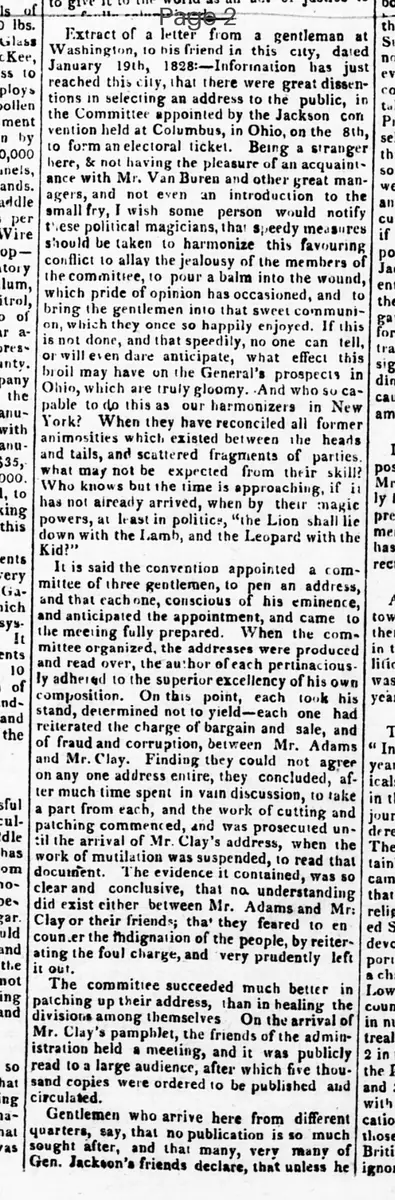
Being a stranger here, & not having the pleasure of an acquaintance with Mr. Van Buren and other great managers, and not even an introduction to the small fry, I wish some person would notify these political magicians, that speedy measures should be taken to harmonize this favoring conflict to allay the jealousy of the members of the committee, to pour a balm into the wound, which pride of opinion has occasioned, and to bring the gentlemen into that sweet communion, which they once so happily enjoyed. If this is not done, and that speedily, no one can tell, or will even dare anticipate, what effect this broil may have on the General's prospects in Ohio, which are truly gloomy. And who so capable to do this as our harmonizers in New York? When they have reconciled all former animosities which existed between the heads and tails, and scattered fragments of parties. what may not be expected from their skill?
Who knows but the time is approaching, if it has not already arrived, when by their magic powers, at least in politics the Lion shall lie down with the Lamb, and the Leopard with the Kid?
It is said the convention appointed a committee of three gentlemen, to pen an address, and that each one, conscious of his eminence, and anticipated the appointment, and came to the meeting fully prepared.
When the committee organized, the addresses were produced and read over, the author of each pertinaciously adhered to the superior excellency of his own composition. On this point, each took his stand, determined not to yield—each one had reiterated the charge of bargain and sale, and of fraud and corruption, between Mr. Adams and Mr. Clay.
Finding they could not agree on any one address entire, they concluded, after much time spent in vain discussion, to take a part from each, and the work of cutting and patching commenced, and was prosecuted until the arrival of Mr. Clay's address, when the work of mutilation was suspended, to read that document. The evidence it contained, was so clear and conclusive, that no understanding did exist either between Mr. Adams and Mr. Clay or their friends; that they feared to encounter the indignation of the people, by reiterating the foul charge, and very prudently left it out.
The committee succeeded much better in patching up their address, than in healing the divisions among themselves.
On the arrival of Mr. Clay's pamphlet, the friends of the administration held a meeting, and it was publicly read to a large audience, after which five thousand copies were ordered to be published and circulated.
Gentlemen who arrive here from different quarters, say, that no publication is so much sought after, and that many, very many of Gen. Jackson's friends declare, that unless he acknowledges the falsity of the charge, and makes suitable amends, or maintains it by proof they will abandon him to his fate.
What sub-type of article is it?
What keywords are associated?
What entities or persons were involved?
Where did it happen?
Domestic News Details
Primary Location
Columbus, Ohio
Event Date
On The 8th
Key Persons
Outcome
internal divisions in the committee persist despite patching the address; gloomy prospects for jackson in ohio; many jackson supporters may abandon him unless he addresses the falsity of the corruption charge against adams and clay.
Event Details
Great dissensions arose in the committee appointed by the Jackson convention to form an electoral ticket and draft an address accusing Adams and Clay of bargain, sale, fraud, and corruption. Three members each submitted pre-prepared addresses and refused to yield. They compromised by combining parts but suspended upon arrival of Clay's pamphlet disproving the charges, leading them to omit it. Administration friends read the pamphlet publicly and ordered 5,000 copies circulated.