Thank you for visiting SNEWPapers!
Sign up free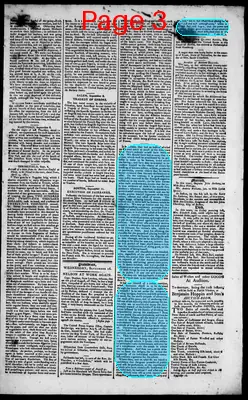
Editorial
September 16, 1801
The Providence Journal, And Town And Country Advertiser
Providence, Providence County, Rhode Island
What is this article about?
This editorial lambasts the Democratic party for self-proclaimed virtue without corresponding actions, portraying their boasts as evidence of hypocrisy and vice masked as patriotism. It argues that party members pursue personal gains through intrigue, disturbing national peace and harmony under their 'just and wise' administration.
Clipping
OCR Quality
98%
Excellent
Full Text
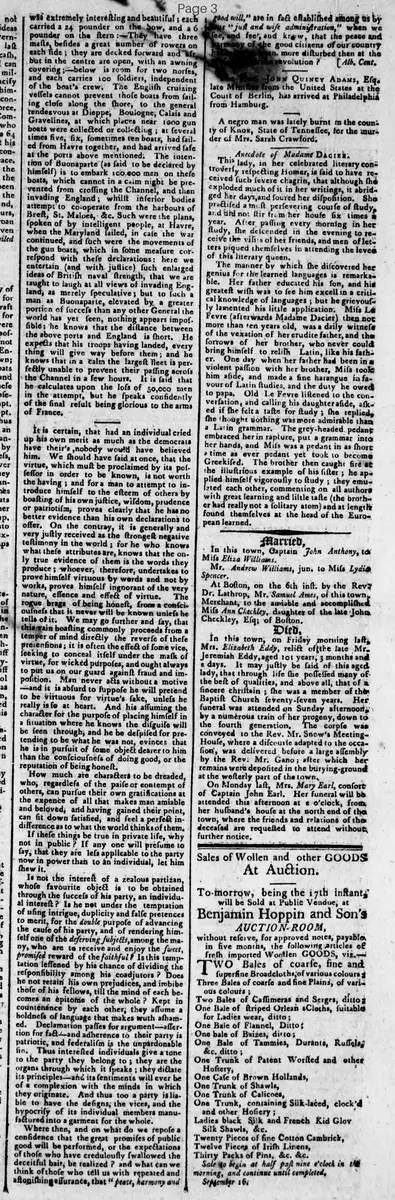
It is certain: that had an individual cried up his own merit as much as the democrats have theirs, nobody would have believed him. We should have said at once, that the virtue, which must be proclaimed by its possessor in order to be known, is not worth the having; and for a man to attempt to introduce himself to the esteem of others by boasting of his own justice, wisdom, prudence or patriotism, proves clearly that he has no better evidence than his own declarations to offer. On the contrary, it is generally and very justly received as the strongest negative testimony in the world; for he who knows what these attributes are, knows that the only true evidence of them is the works they produce; whoever, therefore, undertakes to prove himself virtuous by words and not by works, proves himself ignorant of the very nature, essence and effect of virtue.
The rogue brags of being honest, from a consciousness that it never will be known unless he tells of it: We may go further and say, that this vain boasting commonly proceeds from a temper of mind directly the reverse of these pretensions; it is often the effect of some vice, seeking to conceal itself under the mask of virtue, for wicked purposes, and ought always to put us on our guard against fraud and imposition: Man never acts without a motive and it is absurd to suppose he will pretend to be virtuous for virtue's sake, unless he really is so at heart. And his assuming the character for the purpose of placing himself in a situation where he knows the disguise will be seen through; and he be despised for pretending to be what he was not, evinces that he is in pursuit of some object dearer to him than the consciousness of doing good, or the reputation of being honest.
How much are characters to be dreaded, who; regardless of the praise or contempt of others, can pursue their own gratifications at the expense of all that makes man amiable and beloved; and having gained their point, can sit down satisfied. and feel a perfect indifference as to what the world thinks of them. If these things be true in private life, why not in public? If any one will presume to say, that they are less applicable to the party now in power than to an individual, let him show it.
Is not the interest of a zealous partizan, whose favourite object is to be obtained through the success of his party, an individual interest? Is he not under the temptation of using intrigue, duplicity and false pretences to merit; for the double purpose of advancing the cause of his party, and of rendering himself one of the deserving subjects, among the many, who are to receive and enjoy the sweet, promised reward of the faithful? Is this temptation lessened by his chance of dividing the responsibility among his coadjutors? Does he not retain his own prejudices, and imbibe those of his fellows. till the mind of each becomes an epitome of the whole? Kept in countenance by each other; they assume a boldness of language that makes truth ashamed. Declamation passes for argument—assertion for fact—and adherence to their party is patriotic; and federalism is the unpardonable sin. Thus interested individuals give a tone to the party they belong to; they are the organs through which it speaks; they dictate its principles—and its sentiments will ever be of a complexion with the minds in which they originate. And thus too a party is liable to have the designs; the vices, and the hypocrisy of its individual members manufactured into a garment for the whole.
Where then, and on what do we repose a confidence that the great promises of public good will be performed, or the expectations of those who have credulously swallowed the deceitful bait; be realized? and what can we think of those who tell us with repeated and astonishing assurance, that "peace, harmony and good will," are in fact established among us by our "just and wise administration," when we see, and feel; and know, that the peace and harmony of the good citizens of our country are more disturbed than at the revolution?
The rogue brags of being honest, from a consciousness that it never will be known unless he tells of it: We may go further and say, that this vain boasting commonly proceeds from a temper of mind directly the reverse of these pretensions; it is often the effect of some vice, seeking to conceal itself under the mask of virtue, for wicked purposes, and ought always to put us on our guard against fraud and imposition: Man never acts without a motive and it is absurd to suppose he will pretend to be virtuous for virtue's sake, unless he really is so at heart. And his assuming the character for the purpose of placing himself in a situation where he knows the disguise will be seen through; and he be despised for pretending to be what he was not, evinces that he is in pursuit of some object dearer to him than the consciousness of doing good, or the reputation of being honest.
How much are characters to be dreaded, who; regardless of the praise or contempt of others, can pursue their own gratifications at the expense of all that makes man amiable and beloved; and having gained their point, can sit down satisfied. and feel a perfect indifference as to what the world thinks of them. If these things be true in private life, why not in public? If any one will presume to say, that they are less applicable to the party now in power than to an individual, let him show it.
Is not the interest of a zealous partizan, whose favourite object is to be obtained through the success of his party, an individual interest? Is he not under the temptation of using intrigue, duplicity and false pretences to merit; for the double purpose of advancing the cause of his party, and of rendering himself one of the deserving subjects, among the many, who are to receive and enjoy the sweet, promised reward of the faithful? Is this temptation lessened by his chance of dividing the responsibility among his coadjutors? Does he not retain his own prejudices, and imbibe those of his fellows. till the mind of each becomes an epitome of the whole? Kept in countenance by each other; they assume a boldness of language that makes truth ashamed. Declamation passes for argument—assertion for fact—and adherence to their party is patriotic; and federalism is the unpardonable sin. Thus interested individuals give a tone to the party they belong to; they are the organs through which it speaks; they dictate its principles—and its sentiments will ever be of a complexion with the minds in which they originate. And thus too a party is liable to have the designs; the vices, and the hypocrisy of its individual members manufactured into a garment for the whole.
Where then, and on what do we repose a confidence that the great promises of public good will be performed, or the expectations of those who have credulously swallowed the deceitful bait; be realized? and what can we think of those who tell us with repeated and astonishing assurance, that "peace, harmony and good will," are in fact established among us by our "just and wise administration," when we see, and feel; and know, that the peace and harmony of the good citizens of our country are more disturbed than at the revolution?
What sub-type of article is it?
Partisan Politics
Moral Or Religious
What keywords are associated?
Democratic Hypocrisy
Political Virtue
Party Intrigue
Federalism Criticism
Public Morality
What entities or persons were involved?
Democrats
Party Now In Power
Federalism
Editorial Details
Primary Topic
Hypocrisy Of The Democratic Party In Boasting Virtue
Stance / Tone
Strongly Critical Of Democrats' Hypocrisy
Key Figures
Democrats
Party Now In Power
Federalism
Key Arguments
Virtue Must Be Shown Through Works, Not Words; Boasting Indicates Its Absence.
Party Members Use Intrigue And False Pretenses For Personal Gain Under Guise Of Patriotism.
Adherence To Party Is Equated With Patriotism, While Federalism Is Vilified.
Promises Of Peace And Harmony Under The Administration Are False, As National Discord Exceeds Revolutionary Times.