Thank you for visiting SNEWPapers!
Sign up free
Editorial
May 28, 1816
Norfolk Gazette And Publick Ledger
Norfolk, Virginia
What is this article about?
This editorial critiques the subservience of American 'official' newspapers to government directives via the National Intelligencer, contrasting their praise for William Cobbett's exposures of British corruption with their silence on similar American scandals, such as treasury note sales and post-office frauds.
Clipping
OCR Quality
95%
Excellent
Full Text
THE AMERICAN PRESS.
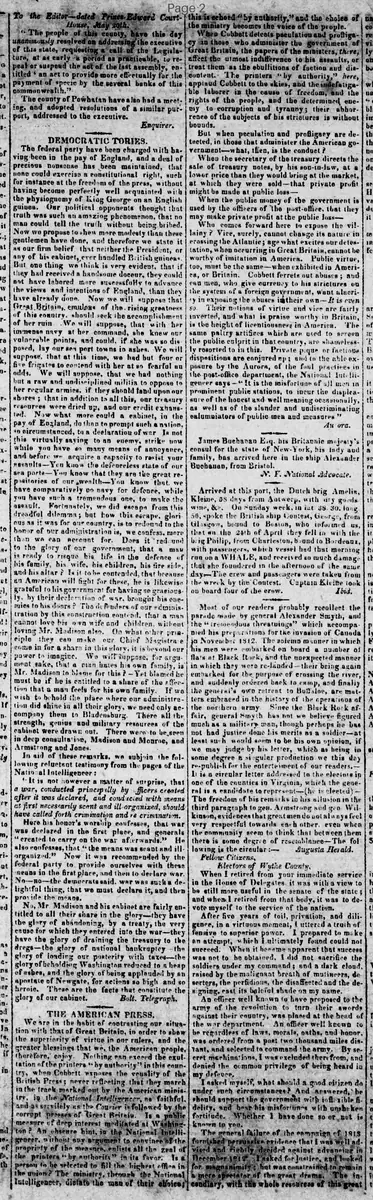
We are in the habit of contrasting our situation with that of Great Britain, in order to shew the superiority of virtue in our rulers, and the greater blessings that we, the American people, therefore, enjoy. Nothing can exceed the exultation of the printers "by authority" in this country, when Cobbett exposes the venality of the British Press; never reflecting that they march in the track marked out by the American ministers, in the National Intelligencer, as faithfully, and as servilely as the Courier is followed by the corrupt presses of Great Britain. Is a public measure of deep interest meditated at Washington? An obscure hint in the National Intelligencer, without any argument to convince of the propriety of the measure, enlists all the zeal of the printers "by authority" in its favor. Is a person to be selected to fill the highest office in the union? The ministry, through the National Intelligencer, dictate the man of their choice; this is echoed "by authority" and the choice of the ministry becomes the voice of the people.
When Cobbett detects peculation and profligacy in those who administer the government of Great Britain, the papers of the ministers, there, affect the utmost indifference to his assaults, or treat them as the ebullitions of faction and discontent. The printers "by authority," here, applaud Cobbett to the skies, and the indefatigable laborer in the cause of freedom, and the rights of the people, and the determined enemy to corruption and tyranny; their abhorrence of the objects of his strictures is without bounds.
But when peculation and profligacy are detected, in those that administer the American government---what, then, is the conduct? When the secretary of the treasury directs the sale of treasury notes, by his son-in-law, at a lower price than they would bring at the market, at which they were sold-that private profit might be made at public loss-- When the public money of the government is used by the officers of The post-office, that they may make private profit at the public loss-- Who comes forward here to expose the villainy? Vice, surely, cannot change its nature in crossing the Atlantic; and what excites our detestation, when occurring in Great Britain, cannot be worthy of imitation in America. Public virtue, too, must be the same-when exhibited in America, or Britain. Cobbett ferrets out abuses; and can men, who give currency to his strictures on the system of a foreign government, want alacrity in exposing the abuses in their own-It is even so. Their notions of virtue and vice are fairly inverted, and what is praise worthy in Britain, is the height of licentiousness in America. The same paltry artifices which are used to screen the public culprit in that country, are shamelessly resorted to in this. Private pique or factious dispositions are conjured up; and to the able exposure by the Aurora, of the fraud practices in the post-office department, the National Intelligencer says -" It is the misfortune of all men in prominent public stations, to incur the dispraise of the honest and well meaning occasionally, as well as of the slander and undiscriminating calumniators of public men and measures "
Aurora.
We are in the habit of contrasting our situation with that of Great Britain, in order to shew the superiority of virtue in our rulers, and the greater blessings that we, the American people, therefore, enjoy. Nothing can exceed the exultation of the printers "by authority" in this country, when Cobbett exposes the venality of the British Press; never reflecting that they march in the track marked out by the American ministers, in the National Intelligencer, as faithfully, and as servilely as the Courier is followed by the corrupt presses of Great Britain. Is a public measure of deep interest meditated at Washington? An obscure hint in the National Intelligencer, without any argument to convince of the propriety of the measure, enlists all the zeal of the printers "by authority" in its favor. Is a person to be selected to fill the highest office in the union? The ministry, through the National Intelligencer, dictate the man of their choice; this is echoed "by authority" and the choice of the ministry becomes the voice of the people.
When Cobbett detects peculation and profligacy in those who administer the government of Great Britain, the papers of the ministers, there, affect the utmost indifference to his assaults, or treat them as the ebullitions of faction and discontent. The printers "by authority," here, applaud Cobbett to the skies, and the indefatigable laborer in the cause of freedom, and the rights of the people, and the determined enemy to corruption and tyranny; their abhorrence of the objects of his strictures is without bounds.
But when peculation and profligacy are detected, in those that administer the American government---what, then, is the conduct? When the secretary of the treasury directs the sale of treasury notes, by his son-in-law, at a lower price than they would bring at the market, at which they were sold-that private profit might be made at public loss-- When the public money of the government is used by the officers of The post-office, that they may make private profit at the public loss-- Who comes forward here to expose the villainy? Vice, surely, cannot change its nature in crossing the Atlantic; and what excites our detestation, when occurring in Great Britain, cannot be worthy of imitation in America. Public virtue, too, must be the same-when exhibited in America, or Britain. Cobbett ferrets out abuses; and can men, who give currency to his strictures on the system of a foreign government, want alacrity in exposing the abuses in their own-It is even so. Their notions of virtue and vice are fairly inverted, and what is praise worthy in Britain, is the height of licentiousness in America. The same paltry artifices which are used to screen the public culprit in that country, are shamelessly resorted to in this. Private pique or factious dispositions are conjured up; and to the able exposure by the Aurora, of the fraud practices in the post-office department, the National Intelligencer says -" It is the misfortune of all men in prominent public stations, to incur the dispraise of the honest and well meaning occasionally, as well as of the slander and undiscriminating calumniators of public men and measures "
Aurora.
What sub-type of article is it?
Press Freedom
Partisan Politics
Moral Or Religious
What keywords are associated?
American Press
Press Freedom
Government Corruption
Cobbett
National Intelligencer
Post Office Fraud
Treasury Notes
What entities or persons were involved?
National Intelligencer
Cobbett
Aurora
Secretary Of The Treasury
Post Office Department
British Press
Courier
Editorial Details
Primary Topic
Critique Of Subservient American Press And Government Corruption
Stance / Tone
Strongly Critical Of Official Press Hypocrisy And Corruption
Key Figures
National Intelligencer
Cobbett
Aurora
Secretary Of The Treasury
Post Office Department
British Press
Courier
Key Arguments
American 'By Authority' Printers Blindly Follow Government Hints From National Intelligencer Without Independent Judgment
They Praise Cobbett's Exposures Of British Corruption But Ignore Similar American Scandals
Hypocrisy In Detesting Vice Abroad But Imitating It At Home
Specific Frauds: Treasury Notes Sold Below Market By Secretary's Son In Law; Post Office Officers Using Public Money For Private Profit
Official Responses Dismiss Criticisms As Factional Or Slanderous