Thank you for visiting SNEWPapers!
Sign up free
Editorial
July 6, 1937
The Times News
Hendersonville, Henderson County, North Carolina
What is this article about?
Rodney Dutcher analyzes President Roosevelt's recent statement criticizing extremists in industry and labor, aimed at appeasing conservative Southern Democrats amid CIO's southern expansion and steel strikes. Discusses tensions between Roosevelt and John Lewis, strike setbacks, and CIO gains in unions.
Clipping
OCR Quality
98%
Excellent
Full Text
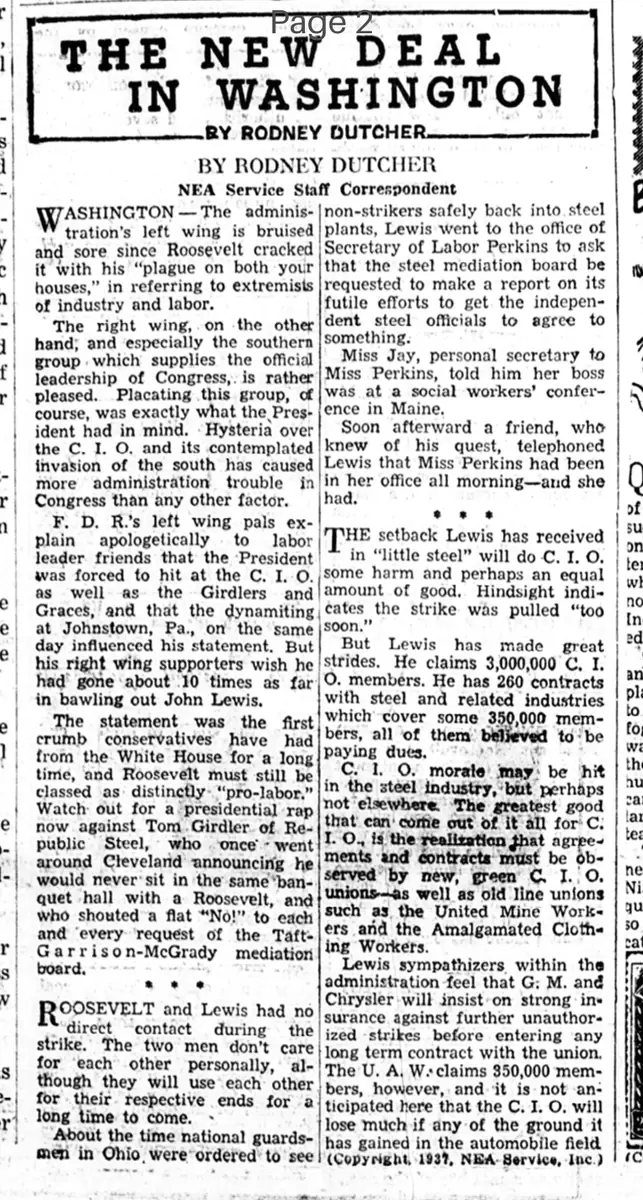
THE NEW DEAL IN WASHINGTON
BY RODNEY DUTCHER
NEA Service Staff Correspondent
WASHINGTON— The administration's left wing is bruised and sore since Roosevelt cracked it with his "plague on both your houses," in referring to extremists of industry and labor.
The right wing, on the other hand, and especially the southern group, which supplies the official leadership of Congress, is rather pleased. Placating this group, of course, was exactly what the President had in mind. Hysteria over the C. I. O. and its contemplated invasion of the south has caused more administration trouble in Congress than any other factor.
F. D. R.'s left wing pals explain apologetically to labor leader friends that the President was forced to hit at the C. I. O. as well as the Girdlers and Graces, and that the dynamiting at Johnstown, Pa., on the same day influenced his statement. But his right wing supporters wish he had gone about 10 times as far in bawling out John Lewis.
The statement was the first crumb conservatives have had from the White House for a long time, and Roosevelt must still be classed as distinctly "pro-labor."
Watch out for a presidential rap now against Tom Girdler of Republic Steel, who once went around Cleveland announcing he would never sit in the same banquet hall with a Roosevelt, and who shouted a flat "No!" to each and every request of the Taft-Garrison-McGrady mediation board.
ROOSEVELT and Lewis had no direct contact during the strike. The two men don't care for each other personally, although they will use each other for their respective ends for a long time to come.
About the time national guardsmen in Ohio were ordered to see non-strikers safely back into steel plants, Lewis went to the office of Secretary of Labor Perkins to ask that the steel mediation board be requested to make a report on its futile efforts to get the independent steel officials to agree to something.
Miss Jay, personal secretary to Miss Perkins, told him her boss was at a social workers' conference in Maine.
Soon afterward a friend, who knew of his quest, telephoned Lewis that Miss Perkins had been in her office all morning—and she had.
THE setback Lewis has received in "little steel" will do C. I. O. some harm and perhaps an equal amount of good. Hindsight indicates the strike was pulled "too soon."
But Lewis has made great strides. He claims 3,000,000 C. I. O. members. He has 260 contracts with steel and related industries which cover some 350,000 members, all of them believed to be paying dues.
C. I. O. morale may be hit in the steel industry, but perhaps not elsewhere. The greatest good that can come out of it all for C. I. O., is the realization that agreements and contracts must be observed by new, green C. I. O. unions as well as old-line unions such as the United Mine Workers and the Amalgamated Clothing Workers.
Lewis sympathizers within the administration feel that G. M. and Chrysler will insist on strong insurance against further unauthorized strikes before entering any long term contract with the union.
The U. A. W. claims 350,000 members, however, and it is not anticipated here that the C. I. O. will lose much if any of the ground it has gained in the automobile field
(Copyright, 1937, NEA Service, Inc.)
BY RODNEY DUTCHER
NEA Service Staff Correspondent
WASHINGTON— The administration's left wing is bruised and sore since Roosevelt cracked it with his "plague on both your houses," in referring to extremists of industry and labor.
The right wing, on the other hand, and especially the southern group, which supplies the official leadership of Congress, is rather pleased. Placating this group, of course, was exactly what the President had in mind. Hysteria over the C. I. O. and its contemplated invasion of the south has caused more administration trouble in Congress than any other factor.
F. D. R.'s left wing pals explain apologetically to labor leader friends that the President was forced to hit at the C. I. O. as well as the Girdlers and Graces, and that the dynamiting at Johnstown, Pa., on the same day influenced his statement. But his right wing supporters wish he had gone about 10 times as far in bawling out John Lewis.
The statement was the first crumb conservatives have had from the White House for a long time, and Roosevelt must still be classed as distinctly "pro-labor."
Watch out for a presidential rap now against Tom Girdler of Republic Steel, who once went around Cleveland announcing he would never sit in the same banquet hall with a Roosevelt, and who shouted a flat "No!" to each and every request of the Taft-Garrison-McGrady mediation board.
ROOSEVELT and Lewis had no direct contact during the strike. The two men don't care for each other personally, although they will use each other for their respective ends for a long time to come.
About the time national guardsmen in Ohio were ordered to see non-strikers safely back into steel plants, Lewis went to the office of Secretary of Labor Perkins to ask that the steel mediation board be requested to make a report on its futile efforts to get the independent steel officials to agree to something.
Miss Jay, personal secretary to Miss Perkins, told him her boss was at a social workers' conference in Maine.
Soon afterward a friend, who knew of his quest, telephoned Lewis that Miss Perkins had been in her office all morning—and she had.
THE setback Lewis has received in "little steel" will do C. I. O. some harm and perhaps an equal amount of good. Hindsight indicates the strike was pulled "too soon."
But Lewis has made great strides. He claims 3,000,000 C. I. O. members. He has 260 contracts with steel and related industries which cover some 350,000 members, all of them believed to be paying dues.
C. I. O. morale may be hit in the steel industry, but perhaps not elsewhere. The greatest good that can come out of it all for C. I. O., is the realization that agreements and contracts must be observed by new, green C. I. O. unions as well as old-line unions such as the United Mine Workers and the Amalgamated Clothing Workers.
Lewis sympathizers within the administration feel that G. M. and Chrysler will insist on strong insurance against further unauthorized strikes before entering any long term contract with the union.
The U. A. W. claims 350,000 members, however, and it is not anticipated here that the C. I. O. will lose much if any of the ground it has gained in the automobile field
(Copyright, 1937, NEA Service, Inc.)
What sub-type of article is it?
Labor
Economic Policy
Partisan Politics
What keywords are associated?
New Deal
Roosevelt
Cio
John Lewis
Steel Strike
Little Steel
Labor Unions
Administration Politics
What entities or persons were involved?
Roosevelt
John Lewis
Tom Girdler
C.I.O.
Secretary Of Labor Perkins
Southern Democrats
Republic Steel
Editorial Details
Primary Topic
Roosevelt's Criticism Of Labor And Industry Extremists Amid Steel Strikes And Cio Expansion
Stance / Tone
Analytical And Balanced, Highlighting Administration Divisions And Cio Progress
Key Figures
Roosevelt
John Lewis
Tom Girdler
C.I.O.
Secretary Of Labor Perkins
Southern Democrats
Republic Steel
Key Arguments
Roosevelt's Statement Appeases Conservative Southerners Worried About Cio In The South
Left Wing Feels Forced To Criticize Cio Due To Events Like Johnstown Dynamiting
Right Wing Wants Stronger Rebuke Of Lewis
Roosevelt Remains Pro Labor Overall
Anticipate Criticism Of Girdler For Intransigence
Roosevelt And Lewis Have No Personal Rapport But Mutual Utility
Perkins' Office Misled Lewis On Mediation Board Report
Steel Strike Setback For Cio But Overall Gains In Membership And Contracts
Cio Must Enforce Contract Observance In New Unions
Uaw Holds Strong In Auto Industry Despite Strike Issues