Thank you for visiting SNEWPapers!
Sign up free
Phenix Gazette
Alexandria, Virginia
What is this article about?
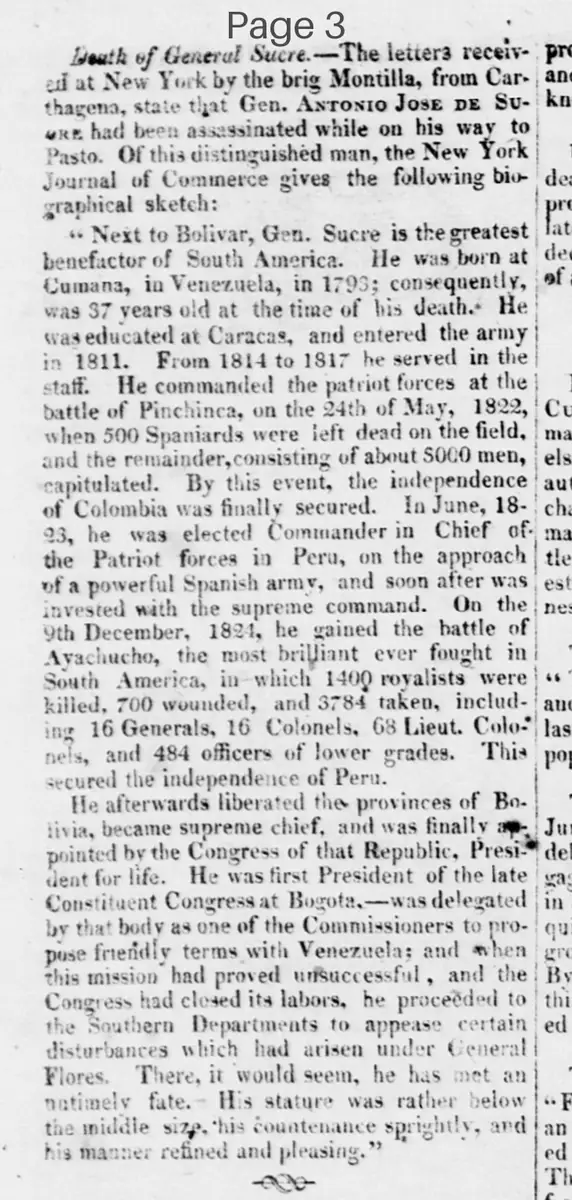
Letters from Carthagena report the assassination of Gen. Antonio Jose de Sucre while traveling to Pasto. Biographical sketch details his birth in 1795, military career, key victories at Pichincha (1822) and Ayacucho (1824), and roles in liberating Colombia, Peru, and Bolivia, where he became President for life.
Clipping
OCR Quality
Full Text
"Next to Bolivar, Gen. Sucre is the greatest benefactor of South America. He was born at Cumana, in Venezuela, in 1795; consequently, was 37 years old at the time of his death. He was educated at Caracas, and entered the army in 1811. From 1814 to 1817 he served in the staff. He commanded the patriot forces at the battle of Pichincha, on the 24th of May, 1822, when 500 Spaniards were left dead on the field, and the remainder, consisting of about 3000 men, capitulated. By this event, the independence of Colombia was finally secured. In June, 1823, he was elected Commander in Chief of the Patriot forces in Peru, on the approach of a powerful Spanish army, and soon after was invested with the supreme command. On the 9th December, 1824, he gained the battle of Ayacucho, the most brilliant ever fought in South America, in which 1400 royalists were killed, 700 wounded, and 3784 taken, including 16 Generals, 16 Colonels, 68 Lieut. Colonels, and 484 officers of lower grades. This secured the independence of Peru.
He afterwards liberated the provinces of Bolivia, became supreme chief, and was finally appointed by the Congress of that Republic, President for life. He was first President of the late Constituent Congress at Bogota,—was delegated by that body as one of the Commissioners to propose friendly terms with Venezuela; and when this mission had proved unsuccessful, and the Congress had closed its labors, he proceeded to the Southern Departments to appease certain disturbances which had arisen under General Flores. There, it would seem, he has met an untimely fate. His stature was rather below the middle size, his countenance sprightly, and his manner refined and pleasing."
What sub-type of article is it?
What keywords are associated?
What entities or persons were involved?
Where did it happen?
Foreign News Details
Primary Location
Pasto
Key Persons
Outcome
assassinated; historical battles: 500 spaniards dead at pichincha, 3000 capitulated; at ayacucho, 1400 royalists killed, 700 wounded, 3784 taken including high-ranking officers.
Event Details
Gen. Sucre assassinated en route to Pasto. Born 1795 in Cumana, Venezuela; entered army 1811; commanded at Pichincha battle May 24, 1822, securing Colombia's independence; Commander in Peru 1823, won Ayacucho December 9, 1824, securing Peru's independence; liberated Bolivia, appointed President for life; President of Constituent Congress at Bogota, mission to Venezuela failed, went to Southern Departments to address disturbances under General Flores.