Thank you for visiting SNEWPapers!
Sign up free
Story
February 2, 1950
The Potters Herald
East Liverpool, Columbiana County, Ohio
What is this article about?
Textile Workers Union members from eastern seaboard mills attend six-week series of three-day institutes in Washington to learn congressional procedures, meet politicians, and observe sessions, fostering political leadership for southern progressivism. (198 characters)
Clipping
OCR Quality
98%
Excellent
Full Text
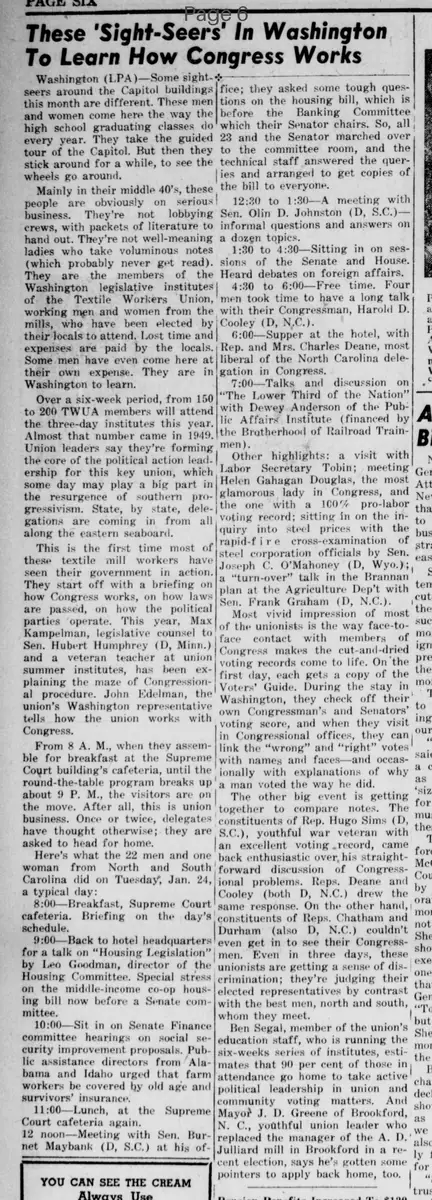
These 'Sight-Seers' In Washington To Learn How Congress Works
Washington (LPA)—Some sight-seers around the Capitol buildings this month are different. These men and women come here the way the high school graduating classes do every year. They take the guided tour of the Capitol. But then they stick around for a while, to see the wheels go around.
Mainly in their middle 40's, these people are obviously on serious business. They're not lobbying crews with packets of literature to hand out. They're not well-meaning ladies who take voluminous notes (which probably never get read). They are the members of the Washington legislative institutes of the Textile Workers Union, working men and women from the mills, who have been elected by their locals to attend. Lost time and expenses are paid by the locals. Some men have even come here at their own expense. They are in Washington to learn.
Over a six-week period, from 150 to 200 TWUA members will attend the three-day institutes this year. Almost that number came in 1949. Union leaders say they're forming the core of the political action leadership for this key union, which some day may play a big part in the resurgence of southern progressivism. State by state, delegations are coming in from all along the eastern seaboard.
This is the first time most of these textile mill workers have seen their government in action. They start off with a briefing on how Congress works, on how laws are passed, on how the political parties operate. This year, Max Kampelman, legislative counsel to Sen. Hubert Humphrey (D, Minn.) and a veteran teacher at union summer institutes, has been explaining the maze of Congressional procedure. John Edelman, the union's Washington representative tells how the union works with Congress.
From 8 A. M., when they assemble for breakfast at the Supreme Court building's cafeteria, until the round-the-table program breaks up about 9 P. M., the visitors are on the move. After all, this is union business. Once or twice delegates have thought otherwise; they are asked to head for home.
Here's what the 22 men and one woman from North and South Carolina did on Tuesday, Jan. 24, a typical day:
8:00 Breakfast, Supreme Court cafeteria. Briefing on the day's schedule.
9:00 Back to hotel headquarters for a talk on "Housing Legislation" by Leo Goodman, director of the Housing Committee. Special stress on the middle-income co-op housing bill now before a Senate committee.
10:00—Sit in on Senate Finance committee hearings on social security improvement proposals. Public assistance directors from Alabama and Idaho urged that farm workers be covered by old age and survivors' insurance.
11:00 Lunch, at the Supreme Court cafeteria again.
12 noon—Meeting with Sen. Burnet Maybank (D, S.C.) at his office; they asked some tough questions on the housing bill, which is before the Banking Committee which their Senator chairs. So, all 23 and the Senator marched over to the committee room, and the technical staff answered the queries and arranged to get copies of the bill to everyone.
12:30 to 1:30—A meeting with Sen. Olin D. Johnston (D, S.C.)—informal questions and answers on a dozen topics.
1:30 to 4:30—Sitting in on sessions of the Senate and House. Heard debates on foreign affairs.
4:30 to 6:00—Free time. Four men took time to have a long talk with their Congressman, Harold D. Cooley (D, N.C.).
6:00—Supper at the hotel, with Rep. and Mrs. Charles Deane, most liberal of the North Carolina delegation in Congress.
7:00—Talks and discussion on "The Lower Third of the Nation" with Dewey Anderson of the Public Affairs Institute (financed by the Brotherhood of Railroad Trainmen).
Other highlights: a visit with Labor Secretary Tobin; meeting Helen Gahagan Douglas, the most glamorous lady in Congress, and the one with a 100% pro-labor voting record; sitting in on the inquiry into steel prices with the rapid-fire cross-examination of steel corporation officials by Sen. Joseph C. O'Mahoney (D, Wyo.); a "turn-over" talk in the Brannan plan at the Agriculture Dep't with Sen. Frank Graham (D, N.C.).
Most vivid impression of most of the unionists is the way face-to-face contact with members of Congress makes the cut-and-dried voting records come to life. On the first day, each gets a copy of the Voters' Guide. During the stay in Washington, they check off their own Congressman's and Senators' voting score, and when they visit in Congressional offices, they can link the "wrong" and "right" votes with names and faces—and occasionally with explanations of why a man voted the way he did.
The other big event is getting together to compare notes. The constituents of Rep. Hugo Sims (D, S.C.), youthful war veteran with an excellent voting record, came back enthusiastic over his straightforward discussion of Congressional problems. Reps. Deane and Cooley (both D, N.C.) drew the same response. On the other hand, constituents of Reps. Chatham and Durham (also D, N.C.) couldn't even get in to see their Congressmen. Even in three days, these unionists are getting a sense of discrimination; they're judging their elected representatives by contrast with the best men, north and south, whom they meet.
Ben Segal, member of the union's education staff, who is running the six-weeks series of institutes, estimates that 90 per cent of those in attendance go home to take active political leadership in union and community voting matters. And Mayor J. D. Greene of Brookford, N. C., youthful union leader who replaced the manager of the A. D. Julliard mill in Brookford in a recent election, says he's gotten some pointers to apply back home, too.
Washington (LPA)—Some sight-seers around the Capitol buildings this month are different. These men and women come here the way the high school graduating classes do every year. They take the guided tour of the Capitol. But then they stick around for a while, to see the wheels go around.
Mainly in their middle 40's, these people are obviously on serious business. They're not lobbying crews with packets of literature to hand out. They're not well-meaning ladies who take voluminous notes (which probably never get read). They are the members of the Washington legislative institutes of the Textile Workers Union, working men and women from the mills, who have been elected by their locals to attend. Lost time and expenses are paid by the locals. Some men have even come here at their own expense. They are in Washington to learn.
Over a six-week period, from 150 to 200 TWUA members will attend the three-day institutes this year. Almost that number came in 1949. Union leaders say they're forming the core of the political action leadership for this key union, which some day may play a big part in the resurgence of southern progressivism. State by state, delegations are coming in from all along the eastern seaboard.
This is the first time most of these textile mill workers have seen their government in action. They start off with a briefing on how Congress works, on how laws are passed, on how the political parties operate. This year, Max Kampelman, legislative counsel to Sen. Hubert Humphrey (D, Minn.) and a veteran teacher at union summer institutes, has been explaining the maze of Congressional procedure. John Edelman, the union's Washington representative tells how the union works with Congress.
From 8 A. M., when they assemble for breakfast at the Supreme Court building's cafeteria, until the round-the-table program breaks up about 9 P. M., the visitors are on the move. After all, this is union business. Once or twice delegates have thought otherwise; they are asked to head for home.
Here's what the 22 men and one woman from North and South Carolina did on Tuesday, Jan. 24, a typical day:
8:00 Breakfast, Supreme Court cafeteria. Briefing on the day's schedule.
9:00 Back to hotel headquarters for a talk on "Housing Legislation" by Leo Goodman, director of the Housing Committee. Special stress on the middle-income co-op housing bill now before a Senate committee.
10:00—Sit in on Senate Finance committee hearings on social security improvement proposals. Public assistance directors from Alabama and Idaho urged that farm workers be covered by old age and survivors' insurance.
11:00 Lunch, at the Supreme Court cafeteria again.
12 noon—Meeting with Sen. Burnet Maybank (D, S.C.) at his office; they asked some tough questions on the housing bill, which is before the Banking Committee which their Senator chairs. So, all 23 and the Senator marched over to the committee room, and the technical staff answered the queries and arranged to get copies of the bill to everyone.
12:30 to 1:30—A meeting with Sen. Olin D. Johnston (D, S.C.)—informal questions and answers on a dozen topics.
1:30 to 4:30—Sitting in on sessions of the Senate and House. Heard debates on foreign affairs.
4:30 to 6:00—Free time. Four men took time to have a long talk with their Congressman, Harold D. Cooley (D, N.C.).
6:00—Supper at the hotel, with Rep. and Mrs. Charles Deane, most liberal of the North Carolina delegation in Congress.
7:00—Talks and discussion on "The Lower Third of the Nation" with Dewey Anderson of the Public Affairs Institute (financed by the Brotherhood of Railroad Trainmen).
Other highlights: a visit with Labor Secretary Tobin; meeting Helen Gahagan Douglas, the most glamorous lady in Congress, and the one with a 100% pro-labor voting record; sitting in on the inquiry into steel prices with the rapid-fire cross-examination of steel corporation officials by Sen. Joseph C. O'Mahoney (D, Wyo.); a "turn-over" talk in the Brannan plan at the Agriculture Dep't with Sen. Frank Graham (D, N.C.).
Most vivid impression of most of the unionists is the way face-to-face contact with members of Congress makes the cut-and-dried voting records come to life. On the first day, each gets a copy of the Voters' Guide. During the stay in Washington, they check off their own Congressman's and Senators' voting score, and when they visit in Congressional offices, they can link the "wrong" and "right" votes with names and faces—and occasionally with explanations of why a man voted the way he did.
The other big event is getting together to compare notes. The constituents of Rep. Hugo Sims (D, S.C.), youthful war veteran with an excellent voting record, came back enthusiastic over his straightforward discussion of Congressional problems. Reps. Deane and Cooley (both D, N.C.) drew the same response. On the other hand, constituents of Reps. Chatham and Durham (also D, N.C.) couldn't even get in to see their Congressmen. Even in three days, these unionists are getting a sense of discrimination; they're judging their elected representatives by contrast with the best men, north and south, whom they meet.
Ben Segal, member of the union's education staff, who is running the six-weeks series of institutes, estimates that 90 per cent of those in attendance go home to take active political leadership in union and community voting matters. And Mayor J. D. Greene of Brookford, N. C., youthful union leader who replaced the manager of the A. D. Julliard mill in Brookford in a recent election, says he's gotten some pointers to apply back home, too.
What sub-type of article is it?
Historical Event
What themes does it cover?
Moral Virtue
Justice
What keywords are associated?
Textile Workers Union
Legislative Institute
Congress Education
Political Leadership
Labor Issues
What entities or persons were involved?
Textile Workers Union Members
Max Kampelman
John Edelman
Sen. Burnet Maybank
Sen. Olin D. Johnston
Harold D. Cooley
Rep. Charles Deane
Dewey Anderson
Labor Secretary Tobin
Helen Gahagan Douglas
Sen. Joseph C. O'mahoney
Sen. Frank Graham
Rep. Hugo Sims
Reps. Chatham
Reps. Durham
Ben Segal
Mayor J. D. Greene
Where did it happen?
Washington, Capitol Buildings
Story Details
Key Persons
Textile Workers Union Members
Max Kampelman
John Edelman
Sen. Burnet Maybank
Sen. Olin D. Johnston
Harold D. Cooley
Rep. Charles Deane
Dewey Anderson
Labor Secretary Tobin
Helen Gahagan Douglas
Sen. Joseph C. O'mahoney
Sen. Frank Graham
Rep. Hugo Sims
Reps. Chatham
Reps. Durham
Ben Segal
Mayor J. D. Greene
Location
Washington, Capitol Buildings
Event Date
January 1950, Tuesday, Jan. 24
Story Details
Members of the Textile Workers Union attend three-day legislative institutes in Washington to learn how Congress works, including briefings, meetings with senators and representatives, and observing sessions, aiming to build political action leadership.