Thank you for visiting SNEWPapers!
Sign up free
Editorial
August 1, 1833
The Daily Cincinnati Republican, And Commercial Register
Cincinnati, Hamilton County, Ohio
What is this article about?
Editorial from the Pennsylvanian criticizes a Fourth of July celebration in South Carolina near John C. Calhoun's residence, accusing nullifiers of breaking tariff compromise pledges, plotting to disrupt the Union through ambition and violence, and drawing parallels to historical conspiracies like Catiline and Burr.
Clipping
OCR Quality
95%
Excellent
Full Text
From the Pennsylvanian.
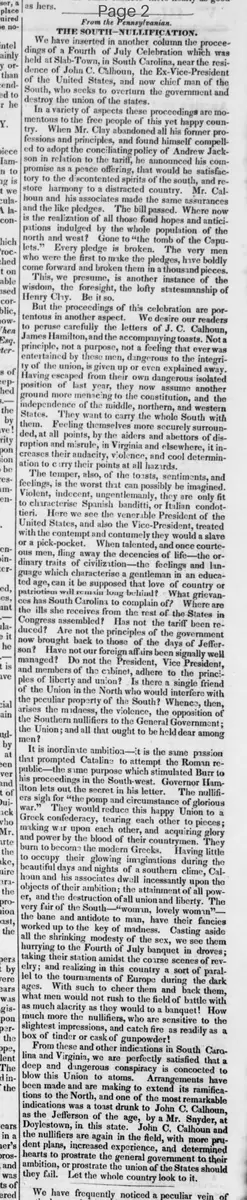
THE SOUTH—NULLIFICATION.
We have inserted in another column the proceedings of a Fourth of July Celebration which was held at Slab-Town, in South Carolina, near the residence of John C. Calhoun, the Ex-Vice-President of the United States, and now chief man of the South, who seeks to overturn the government and destroy the union of the states.
In a variety of aspects these proceedings are momentous to the free people of this yet happy country. When Mr. Clay abandoned all his former professions and principles, and found himself compelled to adopt the conciliating policy of Andrew Jackson in relation to the tariff, he announced his compromise as a peace offering, that would be satisfactory to the discontented spirits of the south, and restore harmony to a distracted country. Mr. Calhoun and his associates made the same assurances and the like pledges. The bill passed. Where now is the realization of all those fond hopes and anticipations indulged by the whole population of the north and west? Gone to "the tomb of the Capulets." Every pledge is broken. The very men who were the first to make the pledges, have boldly come forward and broken them in a thousand pieces. This, we presume, is another instance of the wisdom, the foresight, the lofty statesmanship of Henry Clay. Be it so.
But the proceedings of this celebration are portentous in another aspect. We desire our readers to peruse carefully the letters of J. C. Calhoun, James Hamilton, and the accompanying toasts. Not a principle, not a purpose, not a feeling that ever was entertained by these men, dangerous to the integrity of the union, is given up or even explained away. Having escaped from their own dangerous isolated position of last year, they now assume another ground more menacing to the constitution, and the independence of the middle, northern, and western States. They want to carry the whole South with them. Feeling themselves more securely surrounded, at all points, by the aiders and abettors of disruption and misrule, in Virginia and elsewhere, it increases their audacity, violence, and cool determination to carry their points at all hazards.
The temper, also, of the toasts, sentiments, and feelings, is the worst that can possibly be imagined. Violent, indecent, ungentlemanly, they are only fit to characterise Spanish banditti, or Italian condottieri. Here we see the venerable President of the United States, and also the Vice-President, treated with the contempt and contumely they would a slave or a pick-pocket. When talented, and once courteous men, fling away the decencies of life—the ordinary traits of civilization—the feelings and language which characterise a gentleman in an educated age, can it be supposed that love of country or patriotism will remain long behind? What grievances has South Carolina to complain of? Where are the ills she receives from the rest of the States in Congress assembled? Has not the tariff been reduced? Are not the principles of the government now brought back to those of the days of Jefferson? Have not our foreign affairs been signally well managed? Do not the President, Vice President, and members of the cabinet, adhere to the principles of liberty and union? Is there a single friend of the Union in the North who would interfere with the peculiar property of the South? Whence, then, arises the madness, the violence, the opposition of the Southern nullifiers to the General Government; the Union; and all that ought to be held dear among men?
It is inordinate ambition—it is the same passion that prompted Cataline to attempt the Roman republic—the same purpose which stimulated Burr to his proceedings in the South-west. Governor Hamilton lets out the secret in his letter. The nullifiers sigh for "the pomp and circumstance of glorious war." They would reduce this happy Union to a Greek confederacy, tearing each other to pieces; making war upon each other, and acquiring glory and power by the blood of their countrymen. They burn to become the modern Greeks. Having little to occupy their glowing imaginations during the beautiful days and nights of a southern clime, Calhoun and his associates dwell incessantly upon the objects of their ambition; the attainment of all power, and the destruction of all union and liberty. The very fair of the South—"woman, lovely woman"— the bane and antidote to man, have their fancies worked up to the key of madness. Casting aside all the shrinking modesty of the sex, we see them hurrying to the Fourth of July banquet in droves; taking their station amidst the coarse scenes of revelry; and realizing in this country a sort of parallel to the tournaments of Europe during the dark ages. With such to cheer them and back them, what men would not rush to the field of battle with as much alacrity as they would to a banquet! How much more the nullifiers, who are sensitive to the slightest impressions, and catch fire as readily as a box of tinder or cask of gunpowder!
From these and other indications in South Carolina and Virginia, we are perfectly satisfied that a deep and dangerous conspiracy is concocted to blow this Union to atoms. Arrangements have been made and are making to extend its ramifications to the North, and one of the most remarkable indications was a toast drunk to John C. Calhoun, as the Jefferson of the age, by a Mr. Snyder, at Doylestown, in this state. John C, Calhoun and the nullifiers are again in the field, with more prudent plans, increased experience, and determined hearts to prostrate the general government to their ambition, or prostrate the union of the States should they fail. Let the whole country look to it.
THE SOUTH—NULLIFICATION.
We have inserted in another column the proceedings of a Fourth of July Celebration which was held at Slab-Town, in South Carolina, near the residence of John C. Calhoun, the Ex-Vice-President of the United States, and now chief man of the South, who seeks to overturn the government and destroy the union of the states.
In a variety of aspects these proceedings are momentous to the free people of this yet happy country. When Mr. Clay abandoned all his former professions and principles, and found himself compelled to adopt the conciliating policy of Andrew Jackson in relation to the tariff, he announced his compromise as a peace offering, that would be satisfactory to the discontented spirits of the south, and restore harmony to a distracted country. Mr. Calhoun and his associates made the same assurances and the like pledges. The bill passed. Where now is the realization of all those fond hopes and anticipations indulged by the whole population of the north and west? Gone to "the tomb of the Capulets." Every pledge is broken. The very men who were the first to make the pledges, have boldly come forward and broken them in a thousand pieces. This, we presume, is another instance of the wisdom, the foresight, the lofty statesmanship of Henry Clay. Be it so.
But the proceedings of this celebration are portentous in another aspect. We desire our readers to peruse carefully the letters of J. C. Calhoun, James Hamilton, and the accompanying toasts. Not a principle, not a purpose, not a feeling that ever was entertained by these men, dangerous to the integrity of the union, is given up or even explained away. Having escaped from their own dangerous isolated position of last year, they now assume another ground more menacing to the constitution, and the independence of the middle, northern, and western States. They want to carry the whole South with them. Feeling themselves more securely surrounded, at all points, by the aiders and abettors of disruption and misrule, in Virginia and elsewhere, it increases their audacity, violence, and cool determination to carry their points at all hazards.
The temper, also, of the toasts, sentiments, and feelings, is the worst that can possibly be imagined. Violent, indecent, ungentlemanly, they are only fit to characterise Spanish banditti, or Italian condottieri. Here we see the venerable President of the United States, and also the Vice-President, treated with the contempt and contumely they would a slave or a pick-pocket. When talented, and once courteous men, fling away the decencies of life—the ordinary traits of civilization—the feelings and language which characterise a gentleman in an educated age, can it be supposed that love of country or patriotism will remain long behind? What grievances has South Carolina to complain of? Where are the ills she receives from the rest of the States in Congress assembled? Has not the tariff been reduced? Are not the principles of the government now brought back to those of the days of Jefferson? Have not our foreign affairs been signally well managed? Do not the President, Vice President, and members of the cabinet, adhere to the principles of liberty and union? Is there a single friend of the Union in the North who would interfere with the peculiar property of the South? Whence, then, arises the madness, the violence, the opposition of the Southern nullifiers to the General Government; the Union; and all that ought to be held dear among men?
It is inordinate ambition—it is the same passion that prompted Cataline to attempt the Roman republic—the same purpose which stimulated Burr to his proceedings in the South-west. Governor Hamilton lets out the secret in his letter. The nullifiers sigh for "the pomp and circumstance of glorious war." They would reduce this happy Union to a Greek confederacy, tearing each other to pieces; making war upon each other, and acquiring glory and power by the blood of their countrymen. They burn to become the modern Greeks. Having little to occupy their glowing imaginations during the beautiful days and nights of a southern clime, Calhoun and his associates dwell incessantly upon the objects of their ambition; the attainment of all power, and the destruction of all union and liberty. The very fair of the South—"woman, lovely woman"— the bane and antidote to man, have their fancies worked up to the key of madness. Casting aside all the shrinking modesty of the sex, we see them hurrying to the Fourth of July banquet in droves; taking their station amidst the coarse scenes of revelry; and realizing in this country a sort of parallel to the tournaments of Europe during the dark ages. With such to cheer them and back them, what men would not rush to the field of battle with as much alacrity as they would to a banquet! How much more the nullifiers, who are sensitive to the slightest impressions, and catch fire as readily as a box of tinder or cask of gunpowder!
From these and other indications in South Carolina and Virginia, we are perfectly satisfied that a deep and dangerous conspiracy is concocted to blow this Union to atoms. Arrangements have been made and are making to extend its ramifications to the North, and one of the most remarkable indications was a toast drunk to John C. Calhoun, as the Jefferson of the age, by a Mr. Snyder, at Doylestown, in this state. John C, Calhoun and the nullifiers are again in the field, with more prudent plans, increased experience, and determined hearts to prostrate the general government to their ambition, or prostrate the union of the States should they fail. Let the whole country look to it.
What sub-type of article is it?
Constitutional
Partisan Politics
What keywords are associated?
Nullification
John C Calhoun
Tariff Compromise
Union Disruption
Southern Ambition
Fourth Of July Celebration
South Carolina
What entities or persons were involved?
John C. Calhoun
Henry Clay
Andrew Jackson
James Hamilton
President Of The United States
Vice President
Editorial Details
Primary Topic
Opposition To Southern Nullification And Union Disruption
Stance / Tone
Strongly Anti Nullification And Pro Union
Key Figures
John C. Calhoun
Henry Clay
Andrew Jackson
James Hamilton
President Of The United States
Vice President
Key Arguments
Nullifiers Broke Tariff Compromise Pledges Made By Calhoun And Associates.
Proceedings Show No Abandonment Of Anti Union Principles, Now More Menacing To The Constitution.
Southern Toasts And Sentiments Are Violent And Indecent, Lacking Patriotism.
Nullification Stems From Inordinate Ambition, Akin To Catiline And Burr's Conspiracies.
Nullifiers Desire War And Power, Aiming To Fragment The Union Like Ancient Greeks.
Conspiracy Extends To North, Evidenced By Toasts In Pennsylvania.