Thank you for visiting SNEWPapers!
Sign up free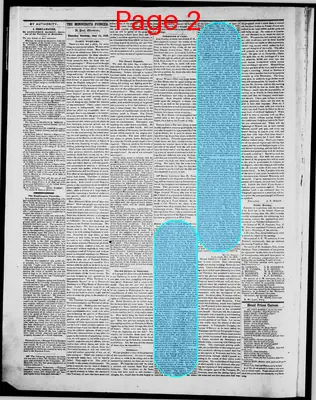
Letter to Editor
June 14, 1849
The Minnesota Pioneer
Saint Paul, Ramsey County, Minnesota
What is this article about?
A Sioux provides a detailed historical account of the 1840 battles at Stillwater and Rum River between Sioux and Chippewas, triggered by a treaty violation that led to a massacre with 99 scalps taken by the Sioux.
Clipping
OCR Quality
98%
Excellent
Full Text
For the Pioneer.
Battle of Stillwater and Rum River,
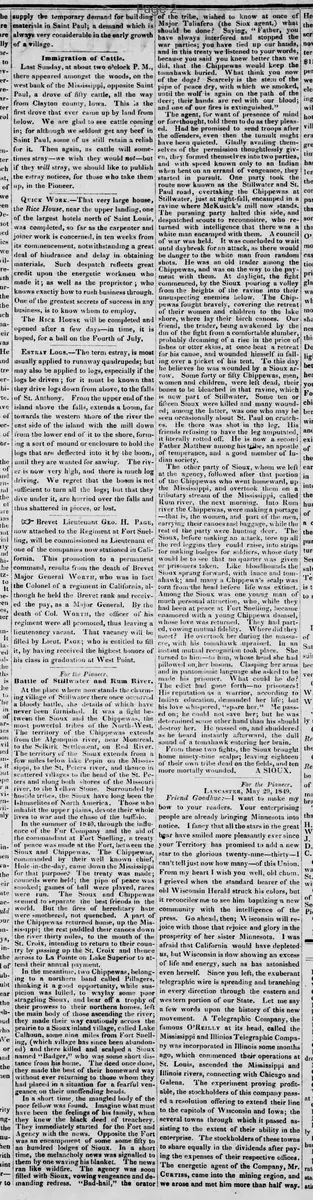
At the place where now stands the charming village of Stillwater there once occurred a bloody battle, the details of which have never been furnished. It was a fight between the Sioux and the Chippewas, the most powerful tribes of the North-West. The territory of the Chippewas extends from the Algonquin river, near Montreal, to the Selkirk Settlement, on Red River. The territory of the Sioux extends from a few miles below lake Pepin on the Mississippi, to the St. Peters river, and thence in scattered villages to the head of the St. Peters and along both shores of the Missouri river. to the Yellow Stone, Surrounded by hostile tribes, the Sioux have long been the Ishmaelites of North America. Those who inhabit the upper plains, devote their whole lives to war and the chase of the buffalo.
In the summer of 1840, through the influence of the Fur Company and the aid of the commandant at Fort Snelling, a treaty of peace was made at the Fort, between the Sioux and Chippewas. The Chippewas, commanded by their well known chief. Hole-in-the-day, came down the Mississippi for that purpose? The treaty was made; councils were held; the pipe of peace was smoked; games of ball were played, races were run. The Sioux and Chippewas seemed to separate the best friends in the world. But the fires of hereditary hate were smothered, not quenched. Apart of the Chippewas returned home, up the Mississippi; the rest paddled their canoes down the river thirty miles, to the mouth of the St. Croix, intending to return to their country by passing up the St. Croix and thence across to La Pointe on Lake Superior to attend their annual payment.
In the meantime, two Chippewas, belonging to a northern band called Pillagers. thinking it a good opportunity, while suspicion was lulled, to waylay some poor straggling Sioux, and bear off a trophy of their prowess to their northern homes, left the main body of those ascending the river: they made their way cautiously across the prairie to a Sioux inland village, called Lake Calhoun, some nine miles from Fort Snelling, (which village has since been abandoned and there killed and scalped a Sioux named "Badger," who was some short distance from his home. The deed once done, they made the best of their homeward way without ever returning to those whom they had placed in a situation for a fearful vengeance on their unoffending heads.
In a short time, the mangled body of the poor fellow was found. Imagine what must have been the feelings of his family, when they knew 'the black deed of treachery. They immediately started for the Fort and Agency with the news. Opposite the Fort was an encampment of some fifty to an hundred lodges of Sioux. In a short time, the melancholy news was signalled to them by one waving his blanket. The news ran like wildfire. The agency was soon filled with Sioux, vowing vengeance and demanding redress. "Bad-hail," the orator of the tribe, wished to know at once of Major Taliaferro (the Sioux agent,) what should be done? Saying, "Father, you have always interfered and stopped the war parties; you have tied up our hands, and in this treaty we listened to your words, because you said you knew better than we did, that the Chippewas would keep the tomahawk buried. What think you now of the dogs? Scarcely is the stem of the pipe of peace dry, with which we smoked, until the wolf is again on the path of the deer; their hands are red with our blood: and one of our fires is extinguished."
The agent, for want of presence of mind or forethought, told them to do as they pleased. Had he promised to send troops after the offenders, even then the tumult might have been quieted, Gladly availing themselves of the permission thoughtlessly given, they formed themselves into two parties, and with speed known only to an Indian when bent on an errand of vengeance, they started in pursuit. One party took the route now known as the Stillwater and St. Paul road, overtaking the Chippewas at Stillwater, just at night-fall, encamped in a ravine where McKusick's mill now stands. The pursuing party halted this side, and despatched scouts to reconnoitre, who returned with intelligence that there was a white man encamped with them. A council of war was held." It was concluded to wait until daybreak for an attack, as there would be danger to the white man from random shots. He was an old trader among the Chippewas, and was on the way to the payment with them. At daylight, the fight commenced, by the Sioux pouring a volley from the heights of the ravine into their unsuspecting enemies below. 'The Chippewas fought bravely, covering the retreat of their women and children to the lake shore, where lay their birch canoes. Our friend, the trader, being awakened by the din of the fight from a comfortable slumber, probably dreaming of a rise in the price of fishes or otter skins, at once beat a retreat for his canoe, and wounded himself in falling over a picket of his tent. 'To this day he believes he was wounded by a Sioux arrow. Some forty or fifty Chippewas, men, women and children, were left dead, their bones to be bleached in that ravine, which is now part of Stillwater, Some ten or fifteen Sioux were killed and many wounded; among the latter, was one who may be seen occasionally about St. Paul on crutches. He there was shot in the leg, His friends refusing to have the leg amputated, it literally rotted off. He is now a second Father Matthew among his tribe, an apostle of temperance, and a good member of Indian society.
The other party of Sioux, whom we left at the agency, followed after that portion of the Chippewas who went homeward, up the Mississippi, and overtook them on a tributary stream of the Mississippi, called Rum river, the next morning. Into Rum river the Chippewas, were making a portage --that is, the women, and part of the men, carrying their canoes and baggage, while the rest of the party were hunting deer. The Sioux, before making an attack, tore up all the red leggins they could raise, into strips for making badges for soldiers, whose duty would be to see that no quarter was given or prisoners taken. Like bloodhounds the Sioux sprang forward, with lance and tomahawk; and many a Chippewa's scalp was torn from the head before life was extinct. Among the Sioux was one young man of much personal attraction, who, while they had been at peace at Fort Snelling, became enamored with a young Chippewa damsel, whose love was returned, They had parted, vowing mutual fidelity. Where did they meet? He overtook her during the massacre, with his tomahawk upraised, In an instant mutual recognition took place. She turned to him--to him, whose head she had pillowed on her bosom, Clasping her arms and in pantomimic language she asked to be made his prisoner. What could he do? The edict had gone forth--no prisoners! His reputation as a warrior, according to Indian education, demanded her life; but his love whispered, "spare her." He passed on: he could not save her; but he was determined some other hand than his should destroy her. He passed on, and shuddered as he heard instantly afterward. the dull sound of a tomahawk entering her brain.
From these two fights, the Sioux brought home ninety-nine scalps; leaving eighteen of their own tribe dead on the fields, and ten more mortally wounded.
A SIOUX.
Battle of Stillwater and Rum River,
At the place where now stands the charming village of Stillwater there once occurred a bloody battle, the details of which have never been furnished. It was a fight between the Sioux and the Chippewas, the most powerful tribes of the North-West. The territory of the Chippewas extends from the Algonquin river, near Montreal, to the Selkirk Settlement, on Red River. The territory of the Sioux extends from a few miles below lake Pepin on the Mississippi, to the St. Peters river, and thence in scattered villages to the head of the St. Peters and along both shores of the Missouri river. to the Yellow Stone, Surrounded by hostile tribes, the Sioux have long been the Ishmaelites of North America. Those who inhabit the upper plains, devote their whole lives to war and the chase of the buffalo.
In the summer of 1840, through the influence of the Fur Company and the aid of the commandant at Fort Snelling, a treaty of peace was made at the Fort, between the Sioux and Chippewas. The Chippewas, commanded by their well known chief. Hole-in-the-day, came down the Mississippi for that purpose? The treaty was made; councils were held; the pipe of peace was smoked; games of ball were played, races were run. The Sioux and Chippewas seemed to separate the best friends in the world. But the fires of hereditary hate were smothered, not quenched. Apart of the Chippewas returned home, up the Mississippi; the rest paddled their canoes down the river thirty miles, to the mouth of the St. Croix, intending to return to their country by passing up the St. Croix and thence across to La Pointe on Lake Superior to attend their annual payment.
In the meantime, two Chippewas, belonging to a northern band called Pillagers. thinking it a good opportunity, while suspicion was lulled, to waylay some poor straggling Sioux, and bear off a trophy of their prowess to their northern homes, left the main body of those ascending the river: they made their way cautiously across the prairie to a Sioux inland village, called Lake Calhoun, some nine miles from Fort Snelling, (which village has since been abandoned and there killed and scalped a Sioux named "Badger," who was some short distance from his home. The deed once done, they made the best of their homeward way without ever returning to those whom they had placed in a situation for a fearful vengeance on their unoffending heads.
In a short time, the mangled body of the poor fellow was found. Imagine what must have been the feelings of his family, when they knew 'the black deed of treachery. They immediately started for the Fort and Agency with the news. Opposite the Fort was an encampment of some fifty to an hundred lodges of Sioux. In a short time, the melancholy news was signalled to them by one waving his blanket. The news ran like wildfire. The agency was soon filled with Sioux, vowing vengeance and demanding redress. "Bad-hail," the orator of the tribe, wished to know at once of Major Taliaferro (the Sioux agent,) what should be done? Saying, "Father, you have always interfered and stopped the war parties; you have tied up our hands, and in this treaty we listened to your words, because you said you knew better than we did, that the Chippewas would keep the tomahawk buried. What think you now of the dogs? Scarcely is the stem of the pipe of peace dry, with which we smoked, until the wolf is again on the path of the deer; their hands are red with our blood: and one of our fires is extinguished."
The agent, for want of presence of mind or forethought, told them to do as they pleased. Had he promised to send troops after the offenders, even then the tumult might have been quieted, Gladly availing themselves of the permission thoughtlessly given, they formed themselves into two parties, and with speed known only to an Indian when bent on an errand of vengeance, they started in pursuit. One party took the route now known as the Stillwater and St. Paul road, overtaking the Chippewas at Stillwater, just at night-fall, encamped in a ravine where McKusick's mill now stands. The pursuing party halted this side, and despatched scouts to reconnoitre, who returned with intelligence that there was a white man encamped with them. A council of war was held." It was concluded to wait until daybreak for an attack, as there would be danger to the white man from random shots. He was an old trader among the Chippewas, and was on the way to the payment with them. At daylight, the fight commenced, by the Sioux pouring a volley from the heights of the ravine into their unsuspecting enemies below. 'The Chippewas fought bravely, covering the retreat of their women and children to the lake shore, where lay their birch canoes. Our friend, the trader, being awakened by the din of the fight from a comfortable slumber, probably dreaming of a rise in the price of fishes or otter skins, at once beat a retreat for his canoe, and wounded himself in falling over a picket of his tent. 'To this day he believes he was wounded by a Sioux arrow. Some forty or fifty Chippewas, men, women and children, were left dead, their bones to be bleached in that ravine, which is now part of Stillwater, Some ten or fifteen Sioux were killed and many wounded; among the latter, was one who may be seen occasionally about St. Paul on crutches. He there was shot in the leg, His friends refusing to have the leg amputated, it literally rotted off. He is now a second Father Matthew among his tribe, an apostle of temperance, and a good member of Indian society.
The other party of Sioux, whom we left at the agency, followed after that portion of the Chippewas who went homeward, up the Mississippi, and overtook them on a tributary stream of the Mississippi, called Rum river, the next morning. Into Rum river the Chippewas, were making a portage --that is, the women, and part of the men, carrying their canoes and baggage, while the rest of the party were hunting deer. The Sioux, before making an attack, tore up all the red leggins they could raise, into strips for making badges for soldiers, whose duty would be to see that no quarter was given or prisoners taken. Like bloodhounds the Sioux sprang forward, with lance and tomahawk; and many a Chippewa's scalp was torn from the head before life was extinct. Among the Sioux was one young man of much personal attraction, who, while they had been at peace at Fort Snelling, became enamored with a young Chippewa damsel, whose love was returned, They had parted, vowing mutual fidelity. Where did they meet? He overtook her during the massacre, with his tomahawk upraised, In an instant mutual recognition took place. She turned to him--to him, whose head she had pillowed on her bosom, Clasping her arms and in pantomimic language she asked to be made his prisoner. What could he do? The edict had gone forth--no prisoners! His reputation as a warrior, according to Indian education, demanded her life; but his love whispered, "spare her." He passed on: he could not save her; but he was determined some other hand than his should destroy her. He passed on, and shuddered as he heard instantly afterward. the dull sound of a tomahawk entering her brain.
From these two fights, the Sioux brought home ninety-nine scalps; leaving eighteen of their own tribe dead on the fields, and ten more mortally wounded.
A SIOUX.
What sub-type of article is it?
Historical
Informative
Reflective
What themes does it cover?
Military War
What keywords are associated?
Sioux Chippewa Battles
Stillwater Fight
Rum River Massacre
1840 Treaty Violation
Fort Snelling
Hole In The Day
Major Taliaferro
Native American Warfare
Scalping
Peace Treaty
What entities or persons were involved?
A Sioux
For The Pioneer
Letter to Editor Details
Author
A Sioux
Recipient
For The Pioneer
Main Argument
recounts the details of the 1840 battles at stillwater and rum river between sioux and chippewas, initiated by a chippewa killing of a sioux man shortly after a peace treaty, leading to retaliatory massacres.
Notable Details
Peace Treaty At Fort Snelling In Summer 1840
Chippewa Chief Hole In The Day
Sioux Agent Major Taliaferro
Killing Of Sioux Named Badger At Lake Calhoun
Trader Wounded In The Leg At Stillwater
Tragic Encounter Of Young Sioux And Chippewa Lovers During Rum River Massacre
Sioux Took 99 Scalps
18 Sioux Dead, 10 Mortally Wounded