Thank you for visiting SNEWPapers!
Sign up free
The Daily Alaska Empire
Juneau, Juneau County, Alaska
What is this article about?
Guglielmo Marconi, the Italian radio pioneer, is experimenting with ultra-short waves in London and Italy, noting their light-like properties for short-range uses like fog navigation for ships, though limited by distance and not yet viable for transatlantic communication.
Merged-components note: Continuation of Marconi radio mystery story from page 1 to page 6.
Clippings
1 of 2
OCR Quality
Full Text
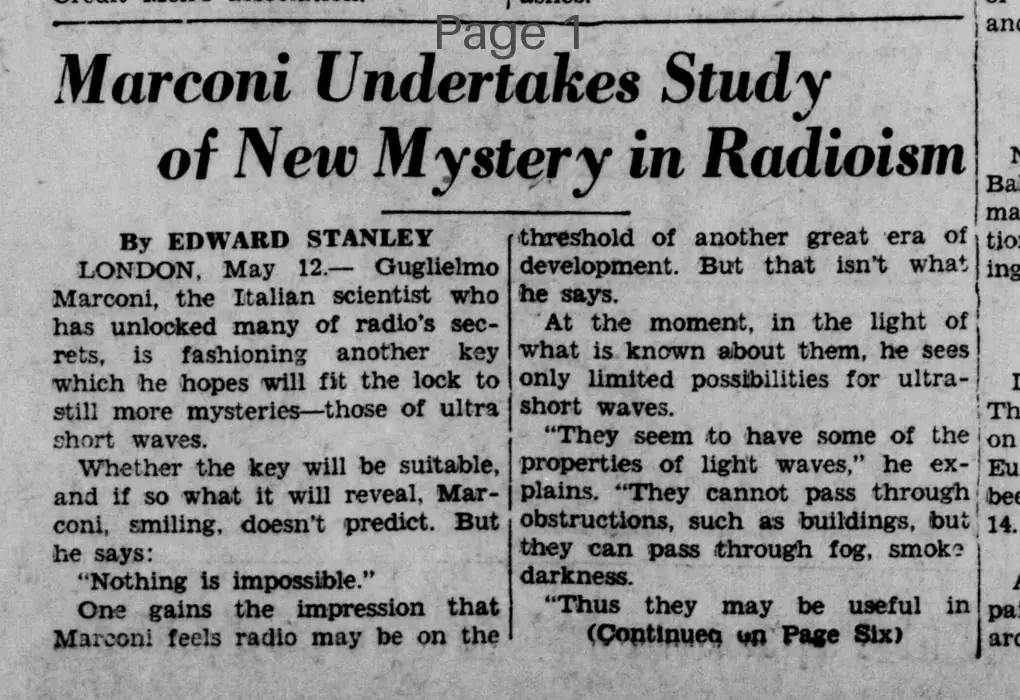
By EDWARD STANLEY
LONDON, May 12.—Guglielmo Marconi, the Italian scientist who has unlocked many of radio's secrets, is fashioning another key which he hopes will fit the lock to still more mysteries—those of ultra shortwaves.
Whether the key will be suitable, and if so what it will reveal, Marconi, smiling, doesn't predict. But he says:
"Nothing is impossible."
One gains the impression that Marconi feels radio may be on the threshold of another great era of development. But that isn't what he says.
At the moment, in the light of what is known about them, he sees only limited possibilities for ultra-short waves.
"They seem to have some of the properties of light waves," he explains. "They cannot pass through obstructions, such as buildings, but they can pass through fog, smoke, darkness.
"Thus they may be useful in guiding ships and trains—tasks of that nature. In a fog a ship could put a short-wave belt about itself, warning all other ships that come within that belt.
"The great obstacle is that they can be sent only for comparatively short distances. They do not seem practicable for commercial use over long distances. Certainly not from here to America, for example."
He sees some hope for the future in that some way may be found to "bend" them.
Like Radio's Early Days
"We seem to be in something of the same situation we were in early wireless," he says.
"The first wireless telegraphy—about 35 years ago—could only operate over about the same distances.
Many people thought that would be its limit."
Incidentally Marconi used short waves in some of his early work sending about two miles.
Just how far he has gotten with his experiments Marconi doesn't say. He has a laboratory in London, but most of his work is done in his laboratory in Italy.
"We are just working ahead quietly," he says.
Marconi is quiet, soft-voiced and patient. He is of medium build, wears blue and is of fair complexion.
Some time in the fall he plans to visit the United States again, partly to see his friends there and partly "to see what's doing, in radio."
What sub-type of article is it?
What keywords are associated?
What entities or persons were involved?
Where did it happen?
Foreign News Details
Primary Location
London
Event Date
May 12
Key Persons
Event Details
Guglielmo Marconi is conducting experiments on ultra-short waves, which have properties similar to light waves, allowing passage through fog and smoke but not buildings, with potential for short-distance applications like guiding ships and trains in fog, though limited by short range and not suitable for long-distance commercial use such as transatlantic communication; he hopes to find ways to bend them and compares the current situation to early wireless days about 35 years ago.