Thank you for visiting SNEWPapers!
Sign up free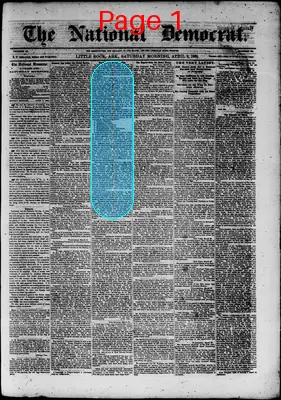
Editorial
April 8, 1865
National Democrat
Little Rock, Pulaski County, Arkansas
What is this article about?
The editorial, referencing the New York Tribune, urges President Lincoln to issue a conciliatory proclamation offering terms to Confederate rebels on union, amnesty, emancipation, reconstruction, and representation to secure a magnanimous peace and end the Civil War without vengeance.
Clipping
OCR Quality
88%
Good
Full Text
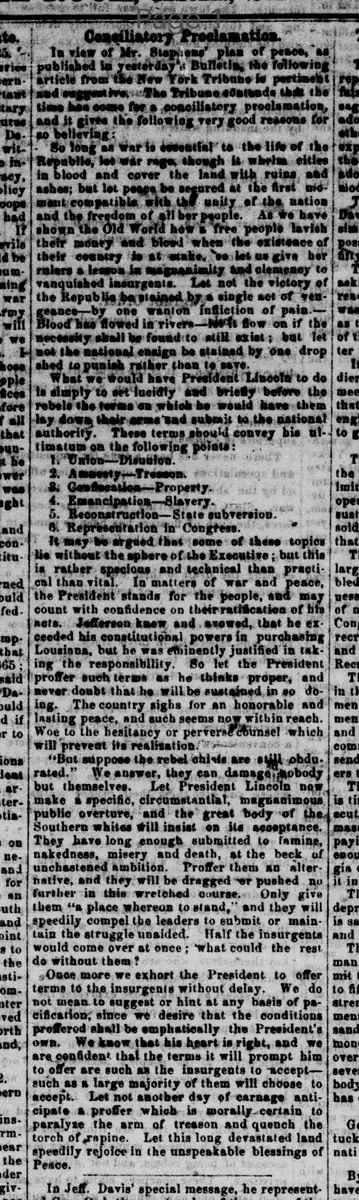
Conciliatory Proclamation
In view of Mr. Stephens published in yesterday's Bulletin, the following article from the New York Tribune is pertinent and suggestive. The Tribune concludes that the time has come for a conciliatory proclamation, and it gives the following very good reasons for so believing.
So long as war is essential to the life of the Republic, let war rage though it whirl cities in blood and cover the land with ruins and ashes; but let peace be secured at the first moment compatible with the unity of the nation and the freedom of all her people. As we have shown the Old World how free people lavish their money and blood when the existence of their country is at stake, so let us give her rulers a lesson in magnanimity and clemency to vanquished insurgents. Let not the victory of the Republic be gained by a single act of vengeance—by one wanton infliction of pain.— Blood has flowed in rivers—let it flow on if the necessity shall be found to still exist; but let not the national ensign be stained by one drop shed to punish rather than to save.
What we would have President Lincoln to do is simply to set lucidly and briefly before the rebels the terms on which he would have them lay down their arms and submit to the national authority. These terms should convey his ultimatum on the following points:
1. Union—Disunion.
2. Amnesty—Treason.
3. Confiscation—Property.
4. Emancipation—Slavery.
5. Reconstruction—State subversion.
6. Representation in Congress.
It may be argued that some of these topics lie without the sphere of the Executive; but this is rather specious and technical than practical and vital. In matters of war and peace, the President stands for the people, and may count with confidence on their ratification of his acts. Jefferson knew and avowed, that he exceeded his constitutional powers in purchasing Louisiana, but he was eminently justified in taking the responsibility.
So let the President proffer such terms as he thinks proper, and never doubt that he will be sustained in so doing. The country sighs for an honorable and lasting peace, and such seems now within reach. Woe to the hesitancy or perverse counsel which will prevent its realization.
But suppose the rebel chiefs are still obdurate. We answer, they can damage nobody but themselves. Let President Lincoln now make specific, circumstantial, magnanimous public overture, and the great body of the Southern whites will insist on its acceptance. They have long enough submitted to famine, nakedness, misery and death, at the beck of unchastened ambition.
Proffer them an alternative, and they will be dragged or pushed no further in this wretched course. Only give them a place whereon to stand, and they will speedily compel the leaders to submit or maintain the struggle unaided.
Half the insurgents would come over at once; what could the rest do without them?
Once more we exhort the President to offer terms to the insurgents without delay. We do not mean to suggest or hint at any basis of pacification, since we desire that the conditions proffered shall be emphatically the President's own. We know that his heart is right, and we are confident that the terms it will prompt him to offer are such as the insurgents to accept—such as a large majority of them will choose to accept. Let not another day of carnage anticipate a proffer which is morally certain to paralyze the arm of treason and quench the torch of rapine. Let this long devastated land speedily rejoice in the unspeakable blessings of Peace.
In view of Mr. Stephens published in yesterday's Bulletin, the following article from the New York Tribune is pertinent and suggestive. The Tribune concludes that the time has come for a conciliatory proclamation, and it gives the following very good reasons for so believing.
So long as war is essential to the life of the Republic, let war rage though it whirl cities in blood and cover the land with ruins and ashes; but let peace be secured at the first moment compatible with the unity of the nation and the freedom of all her people. As we have shown the Old World how free people lavish their money and blood when the existence of their country is at stake, so let us give her rulers a lesson in magnanimity and clemency to vanquished insurgents. Let not the victory of the Republic be gained by a single act of vengeance—by one wanton infliction of pain.— Blood has flowed in rivers—let it flow on if the necessity shall be found to still exist; but let not the national ensign be stained by one drop shed to punish rather than to save.
What we would have President Lincoln to do is simply to set lucidly and briefly before the rebels the terms on which he would have them lay down their arms and submit to the national authority. These terms should convey his ultimatum on the following points:
1. Union—Disunion.
2. Amnesty—Treason.
3. Confiscation—Property.
4. Emancipation—Slavery.
5. Reconstruction—State subversion.
6. Representation in Congress.
It may be argued that some of these topics lie without the sphere of the Executive; but this is rather specious and technical than practical and vital. In matters of war and peace, the President stands for the people, and may count with confidence on their ratification of his acts. Jefferson knew and avowed, that he exceeded his constitutional powers in purchasing Louisiana, but he was eminently justified in taking the responsibility.
So let the President proffer such terms as he thinks proper, and never doubt that he will be sustained in so doing. The country sighs for an honorable and lasting peace, and such seems now within reach. Woe to the hesitancy or perverse counsel which will prevent its realization.
But suppose the rebel chiefs are still obdurate. We answer, they can damage nobody but themselves. Let President Lincoln now make specific, circumstantial, magnanimous public overture, and the great body of the Southern whites will insist on its acceptance. They have long enough submitted to famine, nakedness, misery and death, at the beck of unchastened ambition.
Proffer them an alternative, and they will be dragged or pushed no further in this wretched course. Only give them a place whereon to stand, and they will speedily compel the leaders to submit or maintain the struggle unaided.
Half the insurgents would come over at once; what could the rest do without them?
Once more we exhort the President to offer terms to the insurgents without delay. We do not mean to suggest or hint at any basis of pacification, since we desire that the conditions proffered shall be emphatically the President's own. We know that his heart is right, and we are confident that the terms it will prompt him to offer are such as the insurgents to accept—such as a large majority of them will choose to accept. Let not another day of carnage anticipate a proffer which is morally certain to paralyze the arm of treason and quench the torch of rapine. Let this long devastated land speedily rejoice in the unspeakable blessings of Peace.
What sub-type of article is it?
War Or Peace
Slavery Abolition
Constitutional
What keywords are associated?
Conciliatory Proclamation
Civil War Peace
Lincoln Terms
Emancipation
Reconstruction
Amnesty
Union
What entities or persons were involved?
President Lincoln
Rebels
Southern Whites
Insurgents
Jefferson
Editorial Details
Primary Topic
Call For Conciliatory Proclamation To End Civil War
Stance / Tone
Strongly Advocating Magnanimous Peace Terms
Key Figures
President Lincoln
Rebels
Southern Whites
Insurgents
Jefferson
Key Arguments
War Should End At First Moment Compatible With National Unity And Freedom
Demonstrate Magnanimity And Clemency To Vanquished Insurgents
Avoid Any Acts Of Vengeance Or Punishment
Offer Specific Terms On Union, Amnesty, Confiscation, Emancipation, Reconstruction, And Congressional Representation
President Can Exceed Constitutional Powers In War And Peace Matters As Jefferson Did With Louisiana
Southern Whites Will Compel Leaders To Accept Terms
Exhort Immediate Proffer To Prevent Further Carnage