Thank you for visiting SNEWPapers!
Sign up free
Editorial
December 17, 1812
The Rhode Island Republican
Newport, Newport County, Rhode Island
What is this article about?
Editorial from Newport, RI, on Dec. 17, 1812, denounces De Witt Clinton's alleged secret negotiations with Federalists for 1812 presidential support, contrasting it with his anti-Burr pamphlet. Praises Republican voters' choice of Madison as principled rejection of intrigue.
Clipping
OCR Quality
95%
Excellent
Full Text
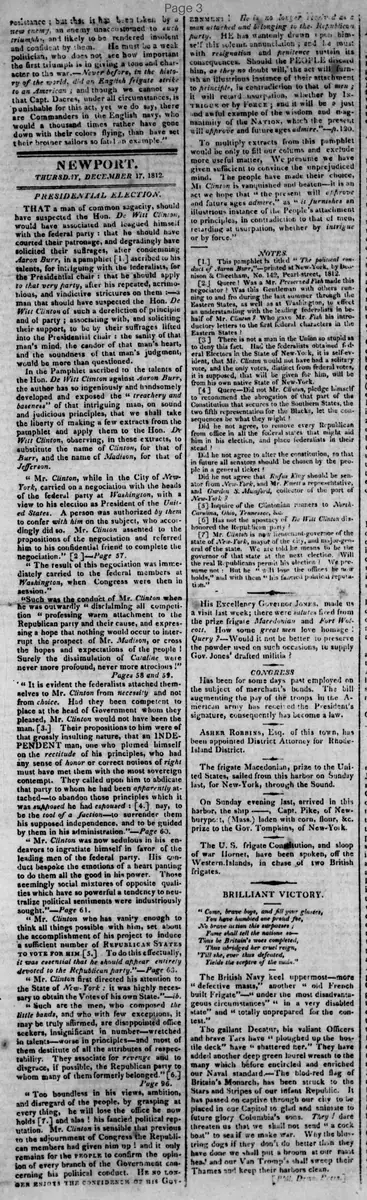
NEWPORT, THURSDAY, DECEMBER 17, 1812.
PRESIDENTIAL ELECTION.
That a man of common sagacity, should have suspected the Hon. De Witt Clinton, would have associated and leagued himself with the federal party: that he should have courted their patronage, and degradingly have solicited their suffrages, after condemning Aaron Burr, in a pamphlet [1.] ascribed to his talents, for intriguing with the federalists, for the Presidential chair: that he should apply to that very party, after his repeated, acrimonious, and vindictive strictures on them:--a man that should have suspected the Hon. De Witt Clinton of such a dereliction of principle and of party; associating with, and soliciting their support, to be by their suffrages lifted into the Presidential chair: the sanity of that man's mind, the candor of that man's heart, and the soundness of that man's judgment, would be more than questioned.
In the Pamphlet ascribed to the talents of the Hon. De Witt Clinton against Aaron Burr, the author has so ingeniously and handsomely developed and exposed the "treachery and baseness" of that intriguing man, on sound and judicious principles, that we shall take the liberty of making a few extracts from the pamphlet and apply them to the Hon. De Witt Clinton, observing, in these extracts, to substitute the name of Clinton, or that of Burr, and the name of Madison, for that of Jefferson.
"Mr. Clinton, while in the City of New-York, carried on a negociation with the heads of the federal party at Washington, with a view to his election as President of the United States. A person was authorized by them to confer with him on the subject, who accordingly did so. Mr. Clinton assented to the propositions of the negociation and referred him to his confidential friend to complete the negociation." [2.]--Page 57.
"The result of this negociation was immediately carried to the federal members at Washington, when Congress were then in session."
"Such was the conduct of Mr. Clinton when he was outwardly "disclaiming all competition" professing warm attachment to the Republican party and their cause, and expressing a hope that nothing would occur to interrupt the prospect of Mr. Madison, or cross the hopes and expectations of the people! Surely the dissimulation of Cataline were never more profound, never more atrocious!" Pages 58 and 59.
"It is evident the federalists attached themselves to Mr. Clinton from necessity and not from choice. Had they been competent to place at the head of Government whom they pleased, Mr. Clinton would not have been the man. [3.] Their propositions to him were of that grossly insulting nature, that an INDEPENDENT man, one who plumed himself on the rectitude of his principles, who had any sense of honor or correct notions of right must have met them with the most sovereign contempt. They called upon him to abdicate that party to whom he had been apparently attached--to abandon those principles which it was supposed he had espoused: [4.] nay, to be the tool of a faction--to surrender to them his supposed independence, and to be guided by them in his administration." Page 60.
"Mr. Clinton was now sedulous in his endeavors to ingratiate himself in favor of the leading men of the federal party. His conduct bespoke the emotions of a heart panting to do them all the good in his power. Those seemingly social mixtures of opposite qualities which have so powerful a tendency to neutralize political sentiments were industriously sought."--Page 61.
"Mr. Clinton who has vanity enough to think all things possible with him, set about the accomplishment of his project to induce a sufficient number of Republican States TO VOTE FOR HIM. [5.] To do this effectually, it was essential that he should appear entirely devoted to the Republican party."--Page 63.
"Mr. Clinton first directed his attention to the State of New-York: it was highly necessary to obtain the Votes of his own State." ib.
"Such are the men, who composed the little band, and who with few exceptions, it may be truly affirmed, are disappointed office seekers, insignificant in number--wretched in talents--worse in principles--and most of them destitute of all the attributes of respectability. They associate for revenge and to disgrace, if possible, the Republican party to whom many of them formerly belonged." [6.]
Page 96.
"Too boundless in his views, ambition, and disregard of the people, by grasping at every thing, he will lose the office he now holds [7.] and alas! his fancied political reputation. Mr. Clinton is sensible that previous to the adjournment of Congress the Republican members had given him up! and it only remains for the people to confirm the opinion of every branch of the Government concerning his political conduct. HE NO LONGER ENJOYS THE CONFIDENCE OF HIS GOVERNMENT! He is no longer received as a man attached and belonging to the Republican party. HE has wantonly drawn upon himself this solemn annunciation; and he must with resignation and penitence sustain its consequences. Should the PEOPLE discard him, as they no doubt will, the act will furnish an illustrious instance of their attachment to principle, in contradiction to that of men; it will retard usurpation, whether by INTRIGUE or by FORCE; and it will be a just and awful example of the wisdom and magnanimity of the Nation, which the present will approve and future ages admire."--p. 120.
To multiply extracts from this pamphlet would be only to fill our columns and exclude more useful matter, I presume we have given sufficient to convince the unprejudiced mind. The people have made their choice, Mr. Clinton is vanquished and beaten--it is an act we hope that "the present will approve and future ages admire," as "it furnishes an illustrious instance of the People's attachment to principles, in contradiction to that of men, retarding at usurpation, whether by intrigue or by force."
NOTES.
[1.] This pamphlet is titled "The political conduct of Aaron Burr,"--printed at New-York, by Dennison & Cheetham, No. 142, Pearl-street, 1812.
[2.] Quere! Was a Mr. Preserved Fish made this negociator? Was this Gentleman with others running to and fro during the last summer through the Eastern States, as well as at Washington, to effect an understanding with the leading federalists in behalf of Mr. Clinton? Who gave Mr. Fish his introductory letters to the first federal characters in the Eastern States?
[3.] There is not a man in the Union so stupid as to deny this fact. Had the federalists obtained federal Electors in the State of New-York, it is self-evident, that Mr. Clinton would not have had a solitary vote, and the only votes, distinct from federal votes, it is supposed, that will be given for him, will be from his own native State of New-York.
[4.] Quere--Did not Mr. Clinton, pledge himself to recommend the abrogation of that part of the Constitution that secures to the Southern States, the two fifth representation for the Blacks, let the consequences be what they might? Did he not agree, to remove every Republican from office in all the federal states that might aid him in his election, and place federalists in their stead? Did he not agree to alter the constitution, so that in future all senators should be chosen by the people in a general ticket! Did he not agree that Rufus King should be senator from New-York, and Mr. Emmett a representative, and Gurdon S. Munford, collector of the port of New-York?
[5.] Inquire of the Clintonian runners to North Carolina, Ohio, Tennessee, &c.
[6.] Has not the apostacy of De Witt Clinton dishonored the Republican party?
[7.] Mr. Clinton is now lieutenant-governor of the state of New-York, mayor of the city, and major-general of the state. We are told he means to be the governor of that state at the next election. Will the real Republicans permit his election? We presume not: But he "will lose the offices he now holds," and with them "his fancied political reputation."
PRESIDENTIAL ELECTION.
That a man of common sagacity, should have suspected the Hon. De Witt Clinton, would have associated and leagued himself with the federal party: that he should have courted their patronage, and degradingly have solicited their suffrages, after condemning Aaron Burr, in a pamphlet [1.] ascribed to his talents, for intriguing with the federalists, for the Presidential chair: that he should apply to that very party, after his repeated, acrimonious, and vindictive strictures on them:--a man that should have suspected the Hon. De Witt Clinton of such a dereliction of principle and of party; associating with, and soliciting their support, to be by their suffrages lifted into the Presidential chair: the sanity of that man's mind, the candor of that man's heart, and the soundness of that man's judgment, would be more than questioned.
In the Pamphlet ascribed to the talents of the Hon. De Witt Clinton against Aaron Burr, the author has so ingeniously and handsomely developed and exposed the "treachery and baseness" of that intriguing man, on sound and judicious principles, that we shall take the liberty of making a few extracts from the pamphlet and apply them to the Hon. De Witt Clinton, observing, in these extracts, to substitute the name of Clinton, or that of Burr, and the name of Madison, for that of Jefferson.
"Mr. Clinton, while in the City of New-York, carried on a negociation with the heads of the federal party at Washington, with a view to his election as President of the United States. A person was authorized by them to confer with him on the subject, who accordingly did so. Mr. Clinton assented to the propositions of the negociation and referred him to his confidential friend to complete the negociation." [2.]--Page 57.
"The result of this negociation was immediately carried to the federal members at Washington, when Congress were then in session."
"Such was the conduct of Mr. Clinton when he was outwardly "disclaiming all competition" professing warm attachment to the Republican party and their cause, and expressing a hope that nothing would occur to interrupt the prospect of Mr. Madison, or cross the hopes and expectations of the people! Surely the dissimulation of Cataline were never more profound, never more atrocious!" Pages 58 and 59.
"It is evident the federalists attached themselves to Mr. Clinton from necessity and not from choice. Had they been competent to place at the head of Government whom they pleased, Mr. Clinton would not have been the man. [3.] Their propositions to him were of that grossly insulting nature, that an INDEPENDENT man, one who plumed himself on the rectitude of his principles, who had any sense of honor or correct notions of right must have met them with the most sovereign contempt. They called upon him to abdicate that party to whom he had been apparently attached--to abandon those principles which it was supposed he had espoused: [4.] nay, to be the tool of a faction--to surrender to them his supposed independence, and to be guided by them in his administration." Page 60.
"Mr. Clinton was now sedulous in his endeavors to ingratiate himself in favor of the leading men of the federal party. His conduct bespoke the emotions of a heart panting to do them all the good in his power. Those seemingly social mixtures of opposite qualities which have so powerful a tendency to neutralize political sentiments were industriously sought."--Page 61.
"Mr. Clinton who has vanity enough to think all things possible with him, set about the accomplishment of his project to induce a sufficient number of Republican States TO VOTE FOR HIM. [5.] To do this effectually, it was essential that he should appear entirely devoted to the Republican party."--Page 63.
"Mr. Clinton first directed his attention to the State of New-York: it was highly necessary to obtain the Votes of his own State." ib.
"Such are the men, who composed the little band, and who with few exceptions, it may be truly affirmed, are disappointed office seekers, insignificant in number--wretched in talents--worse in principles--and most of them destitute of all the attributes of respectability. They associate for revenge and to disgrace, if possible, the Republican party to whom many of them formerly belonged." [6.]
Page 96.
"Too boundless in his views, ambition, and disregard of the people, by grasping at every thing, he will lose the office he now holds [7.] and alas! his fancied political reputation. Mr. Clinton is sensible that previous to the adjournment of Congress the Republican members had given him up! and it only remains for the people to confirm the opinion of every branch of the Government concerning his political conduct. HE NO LONGER ENJOYS THE CONFIDENCE OF HIS GOVERNMENT! He is no longer received as a man attached and belonging to the Republican party. HE has wantonly drawn upon himself this solemn annunciation; and he must with resignation and penitence sustain its consequences. Should the PEOPLE discard him, as they no doubt will, the act will furnish an illustrious instance of their attachment to principle, in contradiction to that of men; it will retard usurpation, whether by INTRIGUE or by FORCE; and it will be a just and awful example of the wisdom and magnanimity of the Nation, which the present will approve and future ages admire."--p. 120.
To multiply extracts from this pamphlet would be only to fill our columns and exclude more useful matter, I presume we have given sufficient to convince the unprejudiced mind. The people have made their choice, Mr. Clinton is vanquished and beaten--it is an act we hope that "the present will approve and future ages admire," as "it furnishes an illustrious instance of the People's attachment to principles, in contradiction to that of men, retarding at usurpation, whether by intrigue or by force."
NOTES.
[1.] This pamphlet is titled "The political conduct of Aaron Burr,"--printed at New-York, by Dennison & Cheetham, No. 142, Pearl-street, 1812.
[2.] Quere! Was a Mr. Preserved Fish made this negociator? Was this Gentleman with others running to and fro during the last summer through the Eastern States, as well as at Washington, to effect an understanding with the leading federalists in behalf of Mr. Clinton? Who gave Mr. Fish his introductory letters to the first federal characters in the Eastern States?
[3.] There is not a man in the Union so stupid as to deny this fact. Had the federalists obtained federal Electors in the State of New-York, it is self-evident, that Mr. Clinton would not have had a solitary vote, and the only votes, distinct from federal votes, it is supposed, that will be given for him, will be from his own native State of New-York.
[4.] Quere--Did not Mr. Clinton, pledge himself to recommend the abrogation of that part of the Constitution that secures to the Southern States, the two fifth representation for the Blacks, let the consequences be what they might? Did he not agree, to remove every Republican from office in all the federal states that might aid him in his election, and place federalists in their stead? Did he not agree to alter the constitution, so that in future all senators should be chosen by the people in a general ticket! Did he not agree that Rufus King should be senator from New-York, and Mr. Emmett a representative, and Gurdon S. Munford, collector of the port of New-York?
[5.] Inquire of the Clintonian runners to North Carolina, Ohio, Tennessee, &c.
[6.] Has not the apostacy of De Witt Clinton dishonored the Republican party?
[7.] Mr. Clinton is now lieutenant-governor of the state of New-York, mayor of the city, and major-general of the state. We are told he means to be the governor of that state at the next election. Will the real Republicans permit his election? We presume not: But he "will lose the offices he now holds," and with them "his fancied political reputation."
What sub-type of article is it?
Partisan Politics
What keywords are associated?
Presidential Election 1812
De Witt Clinton
Federalist Alliance
Republican Principles
Political Intrigue
Aaron Burr Pamphlet
Party Betrayal
What entities or persons were involved?
De Witt Clinton
Aaron Burr
James Madison
Federal Party
Republican Party
Rufus King
Preserved Fish
Editorial Details
Primary Topic
Criticism Of De Witt Clinton's Alleged Alliance With Federalists In 1812 Presidential Election
Stance / Tone
Strongly Anti Clinton, Pro Republican Principles
Key Figures
De Witt Clinton
Aaron Burr
James Madison
Federal Party
Republican Party
Rufus King
Preserved Fish
Key Arguments
Clinton Hypocritically Courted Federalist Support After Condemning Burr For Similar Intrigue
Clinton Negotiated With Federalists While Professing Republican Loyalty
Federalists Supported Clinton Out Of Necessity, Not Choice, With Insulting Propositions
Clinton Sought To Ingratiate Himself With Federalist Leaders
Clinton Aimed To Sway Republican States To Vote For Him While Appearing Devoted To The Party
Clinton's Supporters Are Described As Disappointed Office Seekers Lacking Respectability
Clinton Has Lost The Confidence Of His Party And Government
People's Rejection Of Clinton Upholds Attachment To Principles Over Men