Thank you for visiting SNEWPapers!
Sign up free
The Portland Gazette
Portland, Cumberland County, Maine
What is this article about?
Report on the ongoing Greek-Turkish civil war in Ottoman territories, detailing origins in Wallachia, Hetarist society, Turkish atrocities, Russian diplomatic tensions, Greek setbacks in Moldavia and Wallachia, and naval successes in Morea. Includes population census of European Turkey.
Merged-components note: The table provides the comparative census of European Turkey populations referenced directly in the Greek affairs article.
Clipping
OCR Quality
Full Text
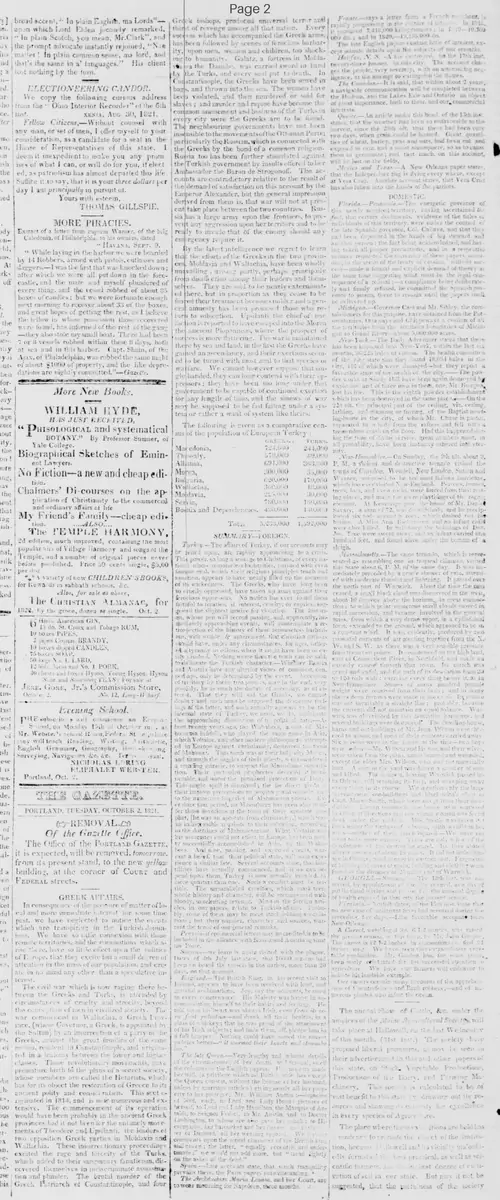
In consequence of the pressure of matter of local and more immediate interest for some time past, we have neglected to notice the events which are transpiring in the Turkish dominions. We have so little connexion with those remote territories, and the commotions which arise in them, have so little effect upon the politics of Europe, that they excite but a small degree of attention in the mass of our population, and create in no mind any other than a speculative interest.
The civil war which is now raging there between the Greeks and Turks, is attended by circumstances of cruelty and atrocity, beyond the endurance of men civilized society. The war commenced in Wallachia, a Greek Province, (whose Governor, a Greek, is appointed by the Sultan) by an insurrection of a party of the Greeks, against the great families of the same nation, resident in Constantinople, and originated in a jealousy between the lower and higher classes. These revolutionists prematurely gave birth to the plans of a secret society, whose members are called the Hetarists, which has for its object the restoration of Greece to its ancient polity and consideration. This sect originated in 1814, and is now numerous and extensive. The commencement of its operations would have been probably in the ancient Greek provinces, had it not been for the untimely movements of Theodore and Ypsilanti, the leaders of two opposition Greek parties in Moldavia and Wallachia. These insurrectionary proceedings excited the rage and ferocity of the Turks, which added to their sanguinary fanaticism, discovered themselves in indiscriminate assassination and plunder. The brutal murder of the Greek Patriarch of Constantinople, and four Greek bishops, produced universal terror and thirst of revenge among all that nation. Every success which has accompanied the Greek arms, has been followed by scenes of ferocious barbarity, upon men, women and children, too shocking to humanity. Galatz, a fortress in Moldavia on the Danube, was carried sword in hand by the Turks, and every soul put to death. In Constantinople, the Greeks have been sewed in bags, and thrown into the sea. The women have been violated, and then murdered or sold for slaves; and murder and rapine have become the common amusement and business of the Turks in every city where the Greeks are to be found.
The neighbouring governments have not been insensible to the movements of the Ottoman Porte; particularly the Russian, which is connected with the Greeks by the bond of a common religion. Russia too has been further stimulated against the Turkish government by insults offered to her Ambassador the Baron de Strogonoff. The accounts are contradictory relative to the result of the demand of satisfaction on this account by the Emperor Alexander, but the general impression derived from them is, that war will not at present take place between the two countries. Russia has a large army upon the frontier, to prevent any aggression upon her territory and to be ready to invade that of the enemy should any emergency require it.
By the latest intelligence we regret to learn that the efforts of the Greeks in the two countries, Moldavia and Wallachia, have been wholly unavailing; arising partly, perhaps principally from disaffection among their leaders and themselves. They are said to be nearly exterminated there, but in proportion as they cease to be feared their treatment becomes milder and a general amnesty has been promised those who return to subjection. Ypsilanti the chief of one party is reported to have escaped to the Morea the ancient Peloponnesus, where the prospect of success is more flattering. The war is maintained there by sea and land, in the first the Greeks have gained an ascendency, and their exertions seemed to be turned with most zeal to that species of warfare. We cannot however suppose that single handed, they can long contend with their oppressors; they have been too long under that government to be capable of continued exertion for any length of time, and the sinews of war may be supposed to be fast failing under a system or rather a want of system like theirs.
The following is given as a comparative census of the population of European Turkey:
Total 5,235,000
1,592,000
| GREEKS. | TURKS. | |
| Macedonia, | 724,000 | 244,000 |
| Thessaly, | 579,000 | 89,000 |
| Albania, | 691,000 | 363,000 |
| Morea, | 300,000 | 35,000 |
| Bulgaria, | 620,000 | 170,000 |
| Wallachia, | 360,000 | 18,000 |
| Moldavia, | 225,000 | 30,000 |
| Serbia, | 780,000 | 160,000 |
| Bosnia and Dependencies, | 420,000 | 140,000 |
What sub-type of article is it?
What keywords are associated?
What entities or persons were involved?
Where did it happen?
Foreign News Details
Primary Location
European Turkey
Key Persons
Outcome
greeks nearly exterminated in moldavia and wallachia; general amnesty promised; ypsilanti escaped to morea; greeks gaining ascendency in naval warfare there; turkish atrocities including massacres at galatz and in constantinople.
Event Details
Civil war between Greeks and Turks in Ottoman territories originated from Greek insurrection in Wallachia against great families, linked to Hetarists society founded in 1814 aiming to restore ancient Greece. Led by Theodore and Ypsilanti in Moldavia and Wallachia, it provoked Turkish rage resulting in brutal murders, including the Patriarch and bishops, massacres, rapes, and enslavements. Russia, sharing religion with Greeks and insulted via its ambassador, has army on frontier but war unlikely now. Latest: Greek efforts failed in Moldavia and Wallachia due to disaffection; war continues in Morea with Greek naval success.