Thank you for visiting SNEWPapers!
Sign up free
Literary
November 9, 1833
Richmond Palladium
Richmond, Wayne County, Indiana
What is this article about?
Fictional narrative of a British nighttime raid on Fort McHenry during the 1814 blockade of Baltimore in the War of 1812. An American soldier spots the approaching barges; hidden artillery and rifles ambush the attackers, shattering boats and leading to their drowning in the Patapsco River.
Merged-components note: Continuation of the serialized story 'The Blockade of Baltimore' across components on the same page.
Clipping
OCR Quality
95%
Excellent
Full Text
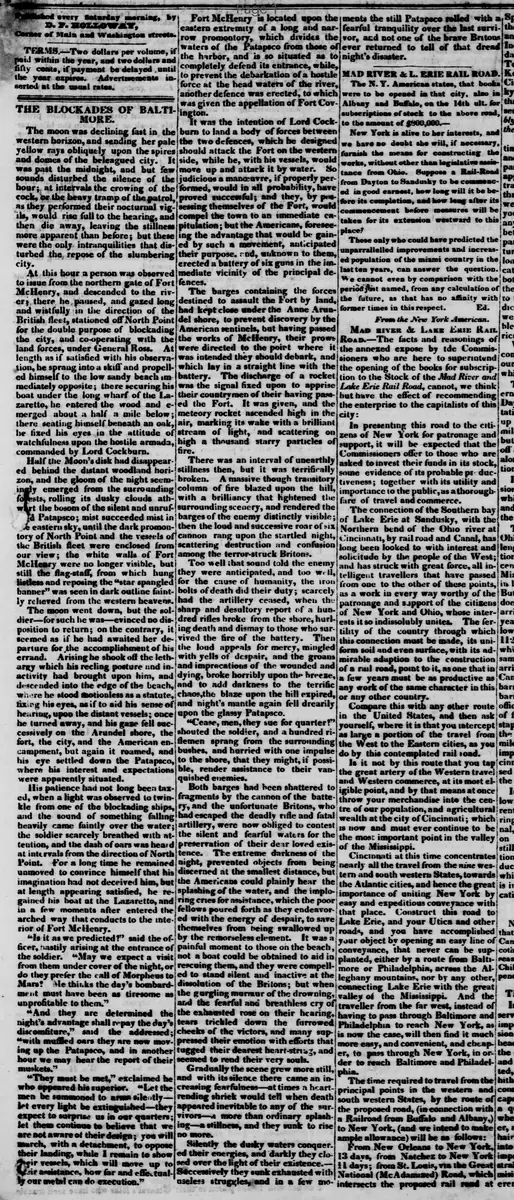
THE BLOCKADE OF BALTIMORE.
The moon was declining fast in the western horizon, and sending her pale yellow rays obliquely upon the spires and domes of the beleaguered city. It was past the midnight, and but few sounds disturbed the silence of the hour; at intervals the crowing of the cock, or the heavy tramp of the patrol, as they performed their nocturnal vigils, would rise full to the hearing, and then die away, leaving the stillness more apparent than before; but these were the only intranquilities that disturbed the repose of the slumbering city.
At this hour a person was observed to issue from the northern gate of Fort McHenry, and descended to the river; there he paused, and gazed long and wistfully in the direction of the British fleet, stationed off North Point for the double purpose of blockading the city, and co-operating with the land forces, under General Ross. At length as if satisfied with his observation, he sprang into a skiff and propelled himself to the low sandy beach immediately opposite; there securing his boat under the long wharf of the Lazaretto, he entered the wood and emerged about a half a mile below; there seating himself beneath an oak, he fixed his eyes in the attitude of watchfulness upon the hostile armada, commanded by Lord Cockburn.
Half the moon's disk had disappeared behind the distant woodland horizon, and the gloom of the night seemingly emerged from the surrounding forests, rolling its dusky clouds athwart the bosom of the silent and unruffled Patapsco; mist succeeded mist in the eastern sky, until the dark promontory of North Point and the vessels of the British fleet were enclosed from our view; the white walls of Fort McHenry were no longer visible, but still the flag-staff, from which hung listless and reposing the "star spangled banner" was seen in dark outline faintly relieved from the western heavens.
The moon went down, but the soldier--for such he was--evinced no disposition to return; on the contrary, it seemed as if he had awaited her departure for the accomplishment of his errand. Arising he shook off the lethargy which his reclining posture and inactivity had brought upon him, and descended into the edge of the beach, where he stood motionless as a statue, fixing his eyes, as if to aid his sense of hearing, upon the distant vessels; once he turned away, and his gaze fell successively on the Arundel shore, the fort, the city, and the American encampment, but again it roamed, and his eye settled down the Patapsco, where his interest and expectations were apparently situated.
His patience had not long been tasked, when a light was observed to twinkle from one of the blockading ships, and the sound of something falling heavily came faintly over the water; the soldier scarcely breathed with attention, and the dash of oars was heard at intervals from the direction of North Point. For a long time he remained unmoved to convince himself that his imagination had not deceived him, but at length appearing satisfied, he regained his boat at the Lazaretto, and in a few moments after entered the arched way that conducts to the interior of Fort McHenry.
"Is it as we predicted?" said the officer, hastily arising at the entrance of the soldier. "May we expect a visit from them under cover of the night, or do they prefer the call of Morpheus to Mars! Methinks the day's bombardment must have been as tiresome as unprofitable to them."
"And they are determined the night's advantage shall repay the day's discomfiture," said the addressed: "with muffled oars they are now moving up the Patapsco, and in another hour we may hear the report of their muskets."
"They must be met," exclaimed he who appeared his superior. "Let the men be summoned to arms silently-- let every light be extinguished--they expect to surprise us in our quarters; let them continue to believe that we are not aware of their design; you will march, with a detachment, to oppose their landing, while I remain to show their vessels, which will move up to their assistance, how far and effectually our metal can do execution."
Fort McHenry is located upon the eastern extremity of a long and narrow promontory, which divides the waters of the Patapsco from those of the harbor, and is so situated as to completely defend its entrance, while, to prevent the debarkation of a hostile force at the head waters of the river, another defence was erected, to which was given the appellation of Fort Covington.
It was the intention of Lord Cockburn to land a body of forces between the two defences, which he designed should attack the Fort on the western side, while he, with his vessels, would move up and attack it by water. So judicious a manoeuvre, if properly performed, would in all probability, have proved successful; and they, by possessing themselves of the Fort, would compel the town to an immediate capitulation; but the Americans, foreseeing the advantage that would be gained by such a movement, anticipated their purpose, and, unknown to them, erected a battery of six guns in the immediate vicinity of the principal defences.
The barges containing the forces destined to assault the Fort by land, had kept close under the Anne Arundel shore, to prevent discovery by the American sentinels, but having passed the works of McHenry, their prows were directed to the point where it was intended they should debark, and which lay in a straight line with the battery. The discharge of a rocket was the signal fixed upon to apprise their countrymen of their having passed the Fort. It was given, and the meteoric rocket ascended high in the air, marking its wake with a brilliant stream of light, and scattering on high a thousand starry particles of fire.
There was an interval of unearthly stillness then, but it was terrifically broken. A massive though transitory column of fire blazed upon the hill, with a brilliancy that heightened the surrounding scenery, and rendered the barges of the enemy distinctly visible; then the loud and successive roar of six cannon rang upon the startled night, scattering destruction and confusion among the terror-struck Britons.
Too well that sound told the enemy they were anticipated, and too well, for the cause of humanity, the iron bolts of death did their duty; scarcely had the artillery ceased, when the sharp and desultory report of a hundred rifles broke from the shore, hurling death and dismay to those who survived the fire of the battery. Then the loud appeals for mercy, mingled with yells of despair, and the groans and imprecations of the wounded and dying, broke horribly upon the breeze, and to add darkness to the terrific chaos, the blaze upon the hill expired, and night's mantle again fell drearily upon the glassy Patapsco.
"Cease, men, they sue for quarter?" shouted the soldier, and a hundred riflemen sprang from the surrounding bushes, and hurried with one impulse to the shore, that they might, if possible, render assistance to their vanquished enemies.
Both barges had been shattered to fragments by the cannon of the battery, and the unfortunate Britons, who had escaped the deadly rifle and fatal artillery, were now obliged to contest the silent and fearful waters for the preservation of their dear loved existence. The extreme darkness of the night, prevented objects from being discerned at the smallest distance, but the Americans could plainly hear the splashing of the water, and the imploring cries for assistance, which the poor fellows poured forth as they endeavored with the energy of despair, to save themselves from being swallowed up by the remorseless element. It was a painful moment to those on the beach, not a boat could be obtained to aid in rescuing them, and they were compelled to stand silent and inactive at the dissolution of the Britons; but when the gurgling murmur of the drowning, and the fearful and breathless cry of the exhausted rose on their hearing, tears trickled down the furrowed cheeks of the victors, and many suppressed their emotion with efforts that tugged their dearest heart-string, and seemed to rend their very souls.
Gradually the scene grew more still, and with its silence there came an increasing fearfulness--at times a heart-rending shriek would tell when death appeared inevitable to any of the survivors--a more than ordinary splashing--a stillness, and they sunk to rise no more.
Silently the dusky waters conquered their energies, and darkly they closed over the light of their existence. Successively they sunk exhausted with useless struggles and in a few moments the still Patapsco rolled with a fearful tranquility over the last survivor, and not one of the brave Britons ever returned to tell of that dread night's disaster.
The moon was declining fast in the western horizon, and sending her pale yellow rays obliquely upon the spires and domes of the beleaguered city. It was past the midnight, and but few sounds disturbed the silence of the hour; at intervals the crowing of the cock, or the heavy tramp of the patrol, as they performed their nocturnal vigils, would rise full to the hearing, and then die away, leaving the stillness more apparent than before; but these were the only intranquilities that disturbed the repose of the slumbering city.
At this hour a person was observed to issue from the northern gate of Fort McHenry, and descended to the river; there he paused, and gazed long and wistfully in the direction of the British fleet, stationed off North Point for the double purpose of blockading the city, and co-operating with the land forces, under General Ross. At length as if satisfied with his observation, he sprang into a skiff and propelled himself to the low sandy beach immediately opposite; there securing his boat under the long wharf of the Lazaretto, he entered the wood and emerged about a half a mile below; there seating himself beneath an oak, he fixed his eyes in the attitude of watchfulness upon the hostile armada, commanded by Lord Cockburn.
Half the moon's disk had disappeared behind the distant woodland horizon, and the gloom of the night seemingly emerged from the surrounding forests, rolling its dusky clouds athwart the bosom of the silent and unruffled Patapsco; mist succeeded mist in the eastern sky, until the dark promontory of North Point and the vessels of the British fleet were enclosed from our view; the white walls of Fort McHenry were no longer visible, but still the flag-staff, from which hung listless and reposing the "star spangled banner" was seen in dark outline faintly relieved from the western heavens.
The moon went down, but the soldier--for such he was--evinced no disposition to return; on the contrary, it seemed as if he had awaited her departure for the accomplishment of his errand. Arising he shook off the lethargy which his reclining posture and inactivity had brought upon him, and descended into the edge of the beach, where he stood motionless as a statue, fixing his eyes, as if to aid his sense of hearing, upon the distant vessels; once he turned away, and his gaze fell successively on the Arundel shore, the fort, the city, and the American encampment, but again it roamed, and his eye settled down the Patapsco, where his interest and expectations were apparently situated.
His patience had not long been tasked, when a light was observed to twinkle from one of the blockading ships, and the sound of something falling heavily came faintly over the water; the soldier scarcely breathed with attention, and the dash of oars was heard at intervals from the direction of North Point. For a long time he remained unmoved to convince himself that his imagination had not deceived him, but at length appearing satisfied, he regained his boat at the Lazaretto, and in a few moments after entered the arched way that conducts to the interior of Fort McHenry.
"Is it as we predicted?" said the officer, hastily arising at the entrance of the soldier. "May we expect a visit from them under cover of the night, or do they prefer the call of Morpheus to Mars! Methinks the day's bombardment must have been as tiresome as unprofitable to them."
"And they are determined the night's advantage shall repay the day's discomfiture," said the addressed: "with muffled oars they are now moving up the Patapsco, and in another hour we may hear the report of their muskets."
"They must be met," exclaimed he who appeared his superior. "Let the men be summoned to arms silently-- let every light be extinguished--they expect to surprise us in our quarters; let them continue to believe that we are not aware of their design; you will march, with a detachment, to oppose their landing, while I remain to show their vessels, which will move up to their assistance, how far and effectually our metal can do execution."
Fort McHenry is located upon the eastern extremity of a long and narrow promontory, which divides the waters of the Patapsco from those of the harbor, and is so situated as to completely defend its entrance, while, to prevent the debarkation of a hostile force at the head waters of the river, another defence was erected, to which was given the appellation of Fort Covington.
It was the intention of Lord Cockburn to land a body of forces between the two defences, which he designed should attack the Fort on the western side, while he, with his vessels, would move up and attack it by water. So judicious a manoeuvre, if properly performed, would in all probability, have proved successful; and they, by possessing themselves of the Fort, would compel the town to an immediate capitulation; but the Americans, foreseeing the advantage that would be gained by such a movement, anticipated their purpose, and, unknown to them, erected a battery of six guns in the immediate vicinity of the principal defences.
The barges containing the forces destined to assault the Fort by land, had kept close under the Anne Arundel shore, to prevent discovery by the American sentinels, but having passed the works of McHenry, their prows were directed to the point where it was intended they should debark, and which lay in a straight line with the battery. The discharge of a rocket was the signal fixed upon to apprise their countrymen of their having passed the Fort. It was given, and the meteoric rocket ascended high in the air, marking its wake with a brilliant stream of light, and scattering on high a thousand starry particles of fire.
There was an interval of unearthly stillness then, but it was terrifically broken. A massive though transitory column of fire blazed upon the hill, with a brilliancy that heightened the surrounding scenery, and rendered the barges of the enemy distinctly visible; then the loud and successive roar of six cannon rang upon the startled night, scattering destruction and confusion among the terror-struck Britons.
Too well that sound told the enemy they were anticipated, and too well, for the cause of humanity, the iron bolts of death did their duty; scarcely had the artillery ceased, when the sharp and desultory report of a hundred rifles broke from the shore, hurling death and dismay to those who survived the fire of the battery. Then the loud appeals for mercy, mingled with yells of despair, and the groans and imprecations of the wounded and dying, broke horribly upon the breeze, and to add darkness to the terrific chaos, the blaze upon the hill expired, and night's mantle again fell drearily upon the glassy Patapsco.
"Cease, men, they sue for quarter?" shouted the soldier, and a hundred riflemen sprang from the surrounding bushes, and hurried with one impulse to the shore, that they might, if possible, render assistance to their vanquished enemies.
Both barges had been shattered to fragments by the cannon of the battery, and the unfortunate Britons, who had escaped the deadly rifle and fatal artillery, were now obliged to contest the silent and fearful waters for the preservation of their dear loved existence. The extreme darkness of the night, prevented objects from being discerned at the smallest distance, but the Americans could plainly hear the splashing of the water, and the imploring cries for assistance, which the poor fellows poured forth as they endeavored with the energy of despair, to save themselves from being swallowed up by the remorseless element. It was a painful moment to those on the beach, not a boat could be obtained to aid in rescuing them, and they were compelled to stand silent and inactive at the dissolution of the Britons; but when the gurgling murmur of the drowning, and the fearful and breathless cry of the exhausted rose on their hearing, tears trickled down the furrowed cheeks of the victors, and many suppressed their emotion with efforts that tugged their dearest heart-string, and seemed to rend their very souls.
Gradually the scene grew more still, and with its silence there came an increasing fearfulness--at times a heart-rending shriek would tell when death appeared inevitable to any of the survivors--a more than ordinary splashing--a stillness, and they sunk to rise no more.
Silently the dusky waters conquered their energies, and darkly they closed over the light of their existence. Successively they sunk exhausted with useless struggles and in a few moments the still Patapsco rolled with a fearful tranquility over the last survivor, and not one of the brave Britons ever returned to tell of that dread night's disaster.
What sub-type of article is it?
Prose Fiction
What themes does it cover?
War Peace
Patriotism
Liberty Freedom
What keywords are associated?
Blockade Of Baltimore
Fort Mchenry
British Fleet
Night Raid
American Defense
Literary Details
Title
The Blockade Of Baltimore.
Key Lines
The Flag Staff, From Which Hung Listless And Reposing The "Star Spangled Banner" Was Seen In Dark Outline Faintly Relieved From The Western Heavens.
A Massive Though Transitory Column Of Fire Blazed Upon The Hill, With A Brilliancy That Heightened The Surrounding Scenery, And Rendered The Barges Of The Enemy Distinctly Visible; Then The Loud And Successive Roar Of Six Cannon Rang Upon The Startled Night, Scattering Destruction And Confusion Among The Terror Struck Britons.
Both Barges Had Been Shattered To Fragments By The Cannon Of The Battery, And The Unfortunate Britons, Who Had Escaped The Deadly Rifle And Fatal Artillery, Were Now Obliged To Contest The Silent And Fearful Waters For The Preservation Of Their Dear Loved Existence.