Thank you for visiting SNEWPapers!
Sign up free
The Daily Worker
Chicago, Cook County, Illinois
What is this article about?
Article by A. Peterson critiques the historical and current inadequacies of U.S. workmen's compensation laws for industrial accidents, comparing them unfavorably to earlier European implementations and highlighting limited coverage, low benefits, waiting periods, and legal hurdles that disadvantage workers.
Clipping
OCR Quality
Full Text
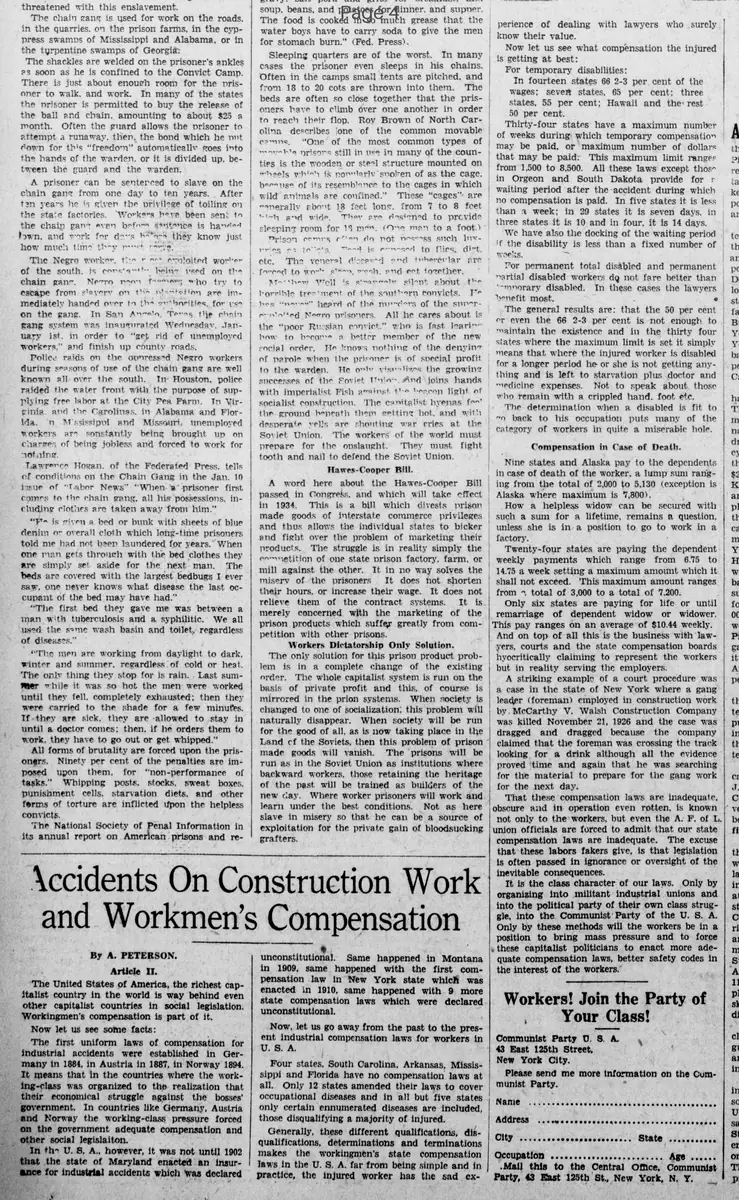
By A. PETERSON.
Article II.
The United States of America, the richest capitalist country in the world is way behind even other capitalist countries in social legislation. Workingmen's compensation is part of it.
Now let us see some facts:
The first uniform laws of compensation for industrial accidents were established in Germany in 1884, in Austria in 1887, in Norway 1894. It means that in the countries where the working-class was organized to the realization that their economical struggle against the bosses' government. In countries like Germany, Austria and Norway the working-class pressure forced on the government adequate compensation and other social legislation.
In the U. S. A., however, it was not until 1902 that the state of Maryland enacted an insurance for industrial accidents which was declared unconstitutional. Same happened in Montana in 1909. same happened with the first compensation law in New York state which was enacted in 1910. same happened with 9 more state compensation laws which were declared unconstitutional.
Now, let us go away from the past to the present industrial compensation laws for workers in U. S. A.
Four states, South Carolina, Arkansas, Mississippi and Florida have no compensation laws at all. Only 12 states amended their laws to cover occupational diseases and in all but five states only certain enumerated diseases are included, those disqualifying a majority of injured.
Generally, these different qualifications, disqualifications, determinations and terminations makes the workingmen's state compensation laws in the U. S. A. far from being simple and in practice, the injured worker has the sad experience of dealing with lawyers who surely know their value.
Now let us see what compensation the injured is getting at best:
For temporary disabilities:
In fourteen states 66 2-3 per cent of the wages; seven states, 65 per cent: three states, 55 per cent; Hawaii and the rest 50 per cent.
Thirty-four states have a maximum number of weeks during which temporary compensation may be paid, or maximum number of dollars that may be paid: This maximum limit ranges from 1,500 to 8,500. All these laws except those in Oregon and South Dakota provide for a waiting period after the accident during which no compensation is paid. In five states it is less than a week; in 29 states it is seven days, in three states it is 10 and in four, it is 14 days.
We have also the docking of the waiting period if the disability is less than a fixed number of weeks.
For permanent total disabled and permanent partial disabled workers do not fare better than temporary disabled. In these cases the lawyers benefit most.
The general results are: that the 50 per cent or even the 66 2-3 per cent is not enough to maintain the existence and in the thirty four states where the maximum limit is set it simply means that where the injured worker is disabled for a longer period he or she is not getting anything and is left to starvation plus doctor and medicine expenses. Not to speak about those who remain with a crippled hand, foot etc.
The determination when a disabled is fit to go back to his occupation puts many of the category of workers in quite a miserable hole.
Compensation in Case of Death.
Nine states and Alaska pay to the dependents in case of death of the worker, a lump sum ranging from the total of 2,000 to 5,130 (exception is Alaska where maximum is 7,800).
How a helpless widow can be secured with such a sum for a lifetime, remains a question, unless she is in a position to go to work in a factory.
Twenty-four states are paying the dependent weekly payments which range from 6.75 to 14.75 a week setting a maximum amount which it shall not exceed. This maximum amount ranges from a total of 3,000 to a total of 7,200.
Only six states are paying for life or until remarriage of dependent widow or widower. This pay ranges on an average of $10.44 weekly.
And on top of all this is the business with lawyers, courts and the state compensation boards hypocritically claiming to represent the workers but in reality serving the employers.
A striking example of a court procedure was a case in the state of New York where a gang leader (foreman) employed in construction work by McCarthy V. Walsh Construction Company was killed November 21, 1926 and the case was dragged and dragged because the company claimed that the foreman was crossing the track looking for a drink although all the evidence proved time and again that he was searching for the material to prepare for the gang work for the next day.
That these compensation laws are inadequate, obscure and in operation even rotten, is known not only to the workers, but even the A. F. of L union officials are forced to admit that our state compensation laws are inadequate. The excuse that these labor fakers give, is that legislation is often passed in ignorance or oversight of the inevitable consequences.
It is the class character of our laws. Only by organizing into militant industrial unions and into the political party of their own class struggle, into the Communist Party of the U. S. A. Only by these methods will the workers be in a position to bring mass pressure and to force these capitalist politicians to enact more adequate compensation laws, better safety codes in the interest of the workers.
What sub-type of article is it?
What themes does it cover?
What keywords are associated?
What entities or persons were involved?
Where did it happen?
Story Details
Key Persons
Location
United States Of America
Event Date
1884 To 1926
Story Details
The article discusses the delayed and inadequate development of workmen's compensation laws in the U.S. compared to Europe, detailing historical enactments, constitutional challenges, current state variations in coverage and benefits for temporary, permanent disabilities, and death, with criticisms of legal processes and calls for militant union action.