Thank you for visiting SNEWPapers!
Sign up free
Editorial
August 29, 1864
The Daily Confederate
Raleigh, Wake County, North Carolina
What is this article about?
Confederate editorial boosting morale amid Civil War reverses, highlighting Union military setbacks at Petersburg and elsewhere, rejecting Lincoln's peace terms involving reconstruction and abolition, and anticipating a peace-focused Democratic convention.
Merged-components note: Merged sequential components as continuation of the same editorial article discussing the state of the war, recent battles, and peace negotiations.
Clipping
OCR Quality
92%
Excellent
Full Text
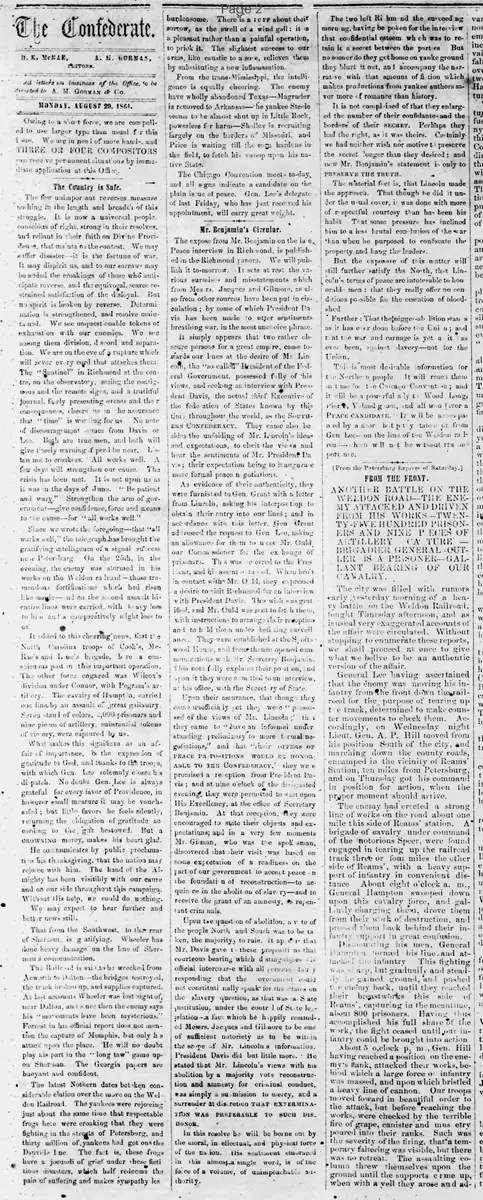
The Country is Safe.
The few unimportant reverses measure nothing in the length and breadth of this struggle. It is now a universal people, conscious of right, strong in their resolves, and reliant in their faith on Divine Providence, that maintains the contest. We may suffer disaster--it is the fortune of war. It may dispirit us, and to our sorrow may be added the croakings of those who anticipate reverse, and the equivocal, scarce restrained satisfaction of the disloyal. But no spirit is broken by reverse. Determination is strengthened, and resolve maintained. We see unquestionable tokens of exhaustion with our enemies. We see among them division, discord and separation. We are on the eve of a rupture which will sever every cord that attaches them. The "Sentinel" in Richmond at the centre, on the observatory, seeing the contiguous and the remote signs, and a truthful journal, fairly presenting events and their consequences, cheers us in the assurance that "time" is working for us. No note of discouragement comes from Davis or Lee. Both are true men, and both will give timely warning if peril be near. Listen not to croakers. "All works well. A few days will strengthen our cause. The crisis has been met. It is not upon us as it was in the days of June. " Be patient and wary." Strengthen the arm of government-give confidence, force and means for the cause-for " all works well."
Since we wrote the foregoing-that "all works well," the telegraph has brought the gratifying intelligence of a signal success near Petersburg On the 25th. in the evening, the enemy was stormed in his works on the Weldon railroad -those tremendous, fortifications which had risen like magic- and on the second assault his entire lines were carried, with heavy loss to him, and a comparatively slight loss to us. It added to this cheering news, that the North Carolina troops of Cooke's, McRae's and Lane's brigade, bore a conspicuous part in this important operation. The other forces engaged was Wilcox's division under Connor, with Pegram's artillery. The cavalry of Hampton, carried one line by an assault of great gallantry. Seven stands of colors, 2,000 prisoners and nine pieces of artillery, substantial tokens of victory, were captured by us.
What makes this significant as an affair of importance, is the expression of gratitude to God, and thanks to the troops, with which Gen. Lee solemnly closes his dispatch. No doubt Gen. Lee is always grateful for every favor of Providence, in however small measure it may be vouchsafed; but little favors he feels silently, returning the obligation of gratitude according to the gift bestowed. But a crowning mercy, makes his heart glad. He communicates by public proclamation his thanksgiving. that the nation may rejoice with him. The hand of the Almighty has been visibly with our cause and on our side throughout this campaign. Without this help, we could do nothing. We may expect to hear further and better news still.
That from the Southwest, to the rear of Sherman, is gratifying. Wheeler has done heavy damage on the line of Sherman's communication.
The railroad is said to be wrecked from Atlanta to Dalton--the bridges destroyed. the track broken up, and supplies captured. At last accounts Wheeler was lost sight of, near Dalton, and since then the enemy says his "movements have been mysterious:" Forrest in his official report does not mention the capture of Memphis, but only his attack upon the place. He will no doubt play this part in the "long run" upon Sherman. The Georgia papers are buoyant and confident,
The latest Northern dates betoken considerable elation over the move on the Weldon Railroad. The yankees were rejoicing just about the same time that respectable frogs here were croaking that they were fighting in the streets of Petersburg, and thirty million of yankees had got on the Danville line. The fact is, these frogs have a jocundity of grief under these fictitious disasters, which half redeems the pain of suffering and makes sympathy less burdensome. There is a puff about their sorrow, as the swell of a wind gall: it is a pleasant rather than a painful operation, to prick it. The slightest success to our arms, like caustic to a sore, relieves them by substituting a new inflammation.
From the trans-Mississippi, the intelligence is equally cheering. The enemy have wholly abandoned Texas-Magruder is removed to Arkansas- the yankee Steele seems to be almost shut up in Little Rock, powerless for harm-Shelby is recruiting largely on the borders of Missouri, and Price is waiting till the corn hardens in the field, to fetch his swoop upon his native State.
The Chicago Convention meets to-day and all signs indicate a candidate on the plain issue of peace. Gen. Lee's delegate of last Friday, who has just received his appointment, will carry great weight.
Mr. Benjamin's Circular.
The expose from Mr. Benjamin on the late, Peace interview in Richmond. is published in the Richmond papers. We will publish it to-morrow. It sets at rest the various surmises and misstatements which from Messrs. Jacques and Gilmore. as also from other sources, have been put in circulation ; by some of which President Davis has been made to utter sentiments breathing war, in the most unchoice phrase. It simply appears that two rather obscure persons for a great empire, came towards our lines at the desire of Mr Lincoln. the "so-called" President of the Federal Government, possessed fully of his views, and seeking an interview with President Davis. the actual chief Executive of the federation of States known by this time: throughout the world, as the SOUTHERN CONFEDERACY. They came also besides the unfolding of Mr. Lincoln's ideas and expectations, to elicit the views and hear the sentiments of Mr. President Davis; their expectation being to inaugurate more formal peace negotiations.
As evidence of their authenticity, they were furnished to Gen. Grant with a letter from Lincoln, asking his interposition to obtain their entry into our lines: and in accordance with this letter, Gen Grant addressed the request to Gen Lee, asking an allowance for them to meet Mr. Ould our Commissioner for the exchange of prisoners. This was referred to the President, and his assent obtained, When brought in contact with-Mr. Ould. they expressed a desire to visit Richmond for an interview with President Davis. This wish was gratified, and Mr. Ould was sent to fetch them, with instructions to arrange their reception and to hold them under befitting surveillance. They were established at the Spottswood House, and from thence opened communications with Mr. Secretary Benjamin. This note fully explains their position, and upon it they were admitted to an interview, at his office, with the Secretary of State. Upon their assurance, that though they came unofficially they were " possessed of the views of Mr. Lincoln;' that they came to " have an informal understanding preliminary to more formal negotiations,"' and that "their offers of PEACE PROPOSITIONS WOULD BE HONORABLE TO THE CONFEDERACY.' they were promised a reception from President Davis; and at nine o'clock of the designated evening, they were permitted to wait upon His Excellency, at the office of Secretary Benjamin. At that reception, they were encouraged to state their objects and expectations; and in a very few moments Mr. Gilmore, who was the spokesman, discovered that their visit was based on some expectation of a readiness on the part of our government to accept peace on the foundation of reconstruction-to acquiesce in the abolition of slavery-and to receive the grant of an amnesty, as rejuvenant criminals.
Upon the question of abolition, a vote of the people North and South was to be taken, the majority, to rule. It appears that Mr. Davis gave to these propositions that courteous bearing which distinguishes his official intercourse with all persons--fairly responding that the government could not constitutionally speak for the states on the slavery question, as that was a State institution, under the control of State legislatures--a fact which he happily reminded Messrs. Jacques and Gilmore to be one of sufficient notoriety as to be within the scope of Mr. Lincoln s information. President Davis did but little more. He stated that Mr. Lincoln's views with his abolition by a majority vote reconstruction and amnesty for criminal conduct, was simply a submission to mercy, and a Surrender at discretion THAT EXTERMINATION WAS PREFERABLE TO SUCH DISHONOR.
In this resolve he will be borne out by the moral, intellectual, and physical force of the nation. This sentiment embraced in this almost a single word, is of the force of a volume, of unimpeachable authority. The two left Richmond the succeeding morning, having bespoken for the interview that confidential esteem. which was to retain it a secret between the parties But no sooner do they get home on yankee ground they blurt it out, and accompany the narrative with that amount of fiction which makes productions from yankee authors savor more of romance than history.
It is not complained of that they enlarged the number of their confidantes and the borders of their secret. Perhaps they had the right, as it was theirs. Certainly we had neither wish nor motive to preserve the secret longer than they desired: and now Mr. Benjamin's statement is only to PRESERVE THE TRUTH.
The material fact is, that Lincoln made the approach. That though he did it under the usual cover, it was done with more of respectful courtesy than has been his habit That some pressure has inclined him to a less brutal conclusion of the war than when he purposed to confiscate the property and hang the leaders.
But the exposure of this matter will still further satisfy the North, that Lincoln's terms of peace are intolerable to honorable men : that they really offer no conditions possible for the cessation of bloodshed
Further: That the nigger-abolition stand as it has ever done before the Union; and that the war and carnage is yet as ever been, against slavery-not for the Union.
This is most desirable information for the Northern people It will reach them in time for the Chicago Convention; and it will be a powerful ally to Wood, Long Pier, Vallandigham, and all who favor a PEACE CANDIDATE. - It will be accompanied by a short but pithy statement from Gen Lee---on the line of the Weldon railroad-which will not be without its importance.
The few unimportant reverses measure nothing in the length and breadth of this struggle. It is now a universal people, conscious of right, strong in their resolves, and reliant in their faith on Divine Providence, that maintains the contest. We may suffer disaster--it is the fortune of war. It may dispirit us, and to our sorrow may be added the croakings of those who anticipate reverse, and the equivocal, scarce restrained satisfaction of the disloyal. But no spirit is broken by reverse. Determination is strengthened, and resolve maintained. We see unquestionable tokens of exhaustion with our enemies. We see among them division, discord and separation. We are on the eve of a rupture which will sever every cord that attaches them. The "Sentinel" in Richmond at the centre, on the observatory, seeing the contiguous and the remote signs, and a truthful journal, fairly presenting events and their consequences, cheers us in the assurance that "time" is working for us. No note of discouragement comes from Davis or Lee. Both are true men, and both will give timely warning if peril be near. Listen not to croakers. "All works well. A few days will strengthen our cause. The crisis has been met. It is not upon us as it was in the days of June. " Be patient and wary." Strengthen the arm of government-give confidence, force and means for the cause-for " all works well."
Since we wrote the foregoing-that "all works well," the telegraph has brought the gratifying intelligence of a signal success near Petersburg On the 25th. in the evening, the enemy was stormed in his works on the Weldon railroad -those tremendous, fortifications which had risen like magic- and on the second assault his entire lines were carried, with heavy loss to him, and a comparatively slight loss to us. It added to this cheering news, that the North Carolina troops of Cooke's, McRae's and Lane's brigade, bore a conspicuous part in this important operation. The other forces engaged was Wilcox's division under Connor, with Pegram's artillery. The cavalry of Hampton, carried one line by an assault of great gallantry. Seven stands of colors, 2,000 prisoners and nine pieces of artillery, substantial tokens of victory, were captured by us.
What makes this significant as an affair of importance, is the expression of gratitude to God, and thanks to the troops, with which Gen. Lee solemnly closes his dispatch. No doubt Gen. Lee is always grateful for every favor of Providence, in however small measure it may be vouchsafed; but little favors he feels silently, returning the obligation of gratitude according to the gift bestowed. But a crowning mercy, makes his heart glad. He communicates by public proclamation his thanksgiving. that the nation may rejoice with him. The hand of the Almighty has been visibly with our cause and on our side throughout this campaign. Without this help, we could do nothing. We may expect to hear further and better news still.
That from the Southwest, to the rear of Sherman, is gratifying. Wheeler has done heavy damage on the line of Sherman's communication.
The railroad is said to be wrecked from Atlanta to Dalton--the bridges destroyed. the track broken up, and supplies captured. At last accounts Wheeler was lost sight of, near Dalton, and since then the enemy says his "movements have been mysterious:" Forrest in his official report does not mention the capture of Memphis, but only his attack upon the place. He will no doubt play this part in the "long run" upon Sherman. The Georgia papers are buoyant and confident,
The latest Northern dates betoken considerable elation over the move on the Weldon Railroad. The yankees were rejoicing just about the same time that respectable frogs here were croaking that they were fighting in the streets of Petersburg, and thirty million of yankees had got on the Danville line. The fact is, these frogs have a jocundity of grief under these fictitious disasters, which half redeems the pain of suffering and makes sympathy less burdensome. There is a puff about their sorrow, as the swell of a wind gall: it is a pleasant rather than a painful operation, to prick it. The slightest success to our arms, like caustic to a sore, relieves them by substituting a new inflammation.
From the trans-Mississippi, the intelligence is equally cheering. The enemy have wholly abandoned Texas-Magruder is removed to Arkansas- the yankee Steele seems to be almost shut up in Little Rock, powerless for harm-Shelby is recruiting largely on the borders of Missouri, and Price is waiting till the corn hardens in the field, to fetch his swoop upon his native State.
The Chicago Convention meets to-day and all signs indicate a candidate on the plain issue of peace. Gen. Lee's delegate of last Friday, who has just received his appointment, will carry great weight.
Mr. Benjamin's Circular.
The expose from Mr. Benjamin on the late, Peace interview in Richmond. is published in the Richmond papers. We will publish it to-morrow. It sets at rest the various surmises and misstatements which from Messrs. Jacques and Gilmore. as also from other sources, have been put in circulation ; by some of which President Davis has been made to utter sentiments breathing war, in the most unchoice phrase. It simply appears that two rather obscure persons for a great empire, came towards our lines at the desire of Mr Lincoln. the "so-called" President of the Federal Government, possessed fully of his views, and seeking an interview with President Davis. the actual chief Executive of the federation of States known by this time: throughout the world, as the SOUTHERN CONFEDERACY. They came also besides the unfolding of Mr. Lincoln's ideas and expectations, to elicit the views and hear the sentiments of Mr. President Davis; their expectation being to inaugurate more formal peace negotiations.
As evidence of their authenticity, they were furnished to Gen. Grant with a letter from Lincoln, asking his interposition to obtain their entry into our lines: and in accordance with this letter, Gen Grant addressed the request to Gen Lee, asking an allowance for them to meet Mr. Ould our Commissioner for the exchange of prisoners. This was referred to the President, and his assent obtained, When brought in contact with-Mr. Ould. they expressed a desire to visit Richmond for an interview with President Davis. This wish was gratified, and Mr. Ould was sent to fetch them, with instructions to arrange their reception and to hold them under befitting surveillance. They were established at the Spottswood House, and from thence opened communications with Mr. Secretary Benjamin. This note fully explains their position, and upon it they were admitted to an interview, at his office, with the Secretary of State. Upon their assurance, that though they came unofficially they were " possessed of the views of Mr. Lincoln;' that they came to " have an informal understanding preliminary to more formal negotiations,"' and that "their offers of PEACE PROPOSITIONS WOULD BE HONORABLE TO THE CONFEDERACY.' they were promised a reception from President Davis; and at nine o'clock of the designated evening, they were permitted to wait upon His Excellency, at the office of Secretary Benjamin. At that reception, they were encouraged to state their objects and expectations; and in a very few moments Mr. Gilmore, who was the spokesman, discovered that their visit was based on some expectation of a readiness on the part of our government to accept peace on the foundation of reconstruction-to acquiesce in the abolition of slavery-and to receive the grant of an amnesty, as rejuvenant criminals.
Upon the question of abolition, a vote of the people North and South was to be taken, the majority, to rule. It appears that Mr. Davis gave to these propositions that courteous bearing which distinguishes his official intercourse with all persons--fairly responding that the government could not constitutionally speak for the states on the slavery question, as that was a State institution, under the control of State legislatures--a fact which he happily reminded Messrs. Jacques and Gilmore to be one of sufficient notoriety as to be within the scope of Mr. Lincoln s information. President Davis did but little more. He stated that Mr. Lincoln's views with his abolition by a majority vote reconstruction and amnesty for criminal conduct, was simply a submission to mercy, and a Surrender at discretion THAT EXTERMINATION WAS PREFERABLE TO SUCH DISHONOR.
In this resolve he will be borne out by the moral, intellectual, and physical force of the nation. This sentiment embraced in this almost a single word, is of the force of a volume, of unimpeachable authority. The two left Richmond the succeeding morning, having bespoken for the interview that confidential esteem. which was to retain it a secret between the parties But no sooner do they get home on yankee ground they blurt it out, and accompany the narrative with that amount of fiction which makes productions from yankee authors savor more of romance than history.
It is not complained of that they enlarged the number of their confidantes and the borders of their secret. Perhaps they had the right, as it was theirs. Certainly we had neither wish nor motive to preserve the secret longer than they desired: and now Mr. Benjamin's statement is only to PRESERVE THE TRUTH.
The material fact is, that Lincoln made the approach. That though he did it under the usual cover, it was done with more of respectful courtesy than has been his habit That some pressure has inclined him to a less brutal conclusion of the war than when he purposed to confiscate the property and hang the leaders.
But the exposure of this matter will still further satisfy the North, that Lincoln's terms of peace are intolerable to honorable men : that they really offer no conditions possible for the cessation of bloodshed
Further: That the nigger-abolition stand as it has ever done before the Union; and that the war and carnage is yet as ever been, against slavery-not for the Union.
This is most desirable information for the Northern people It will reach them in time for the Chicago Convention; and it will be a powerful ally to Wood, Long Pier, Vallandigham, and all who favor a PEACE CANDIDATE. - It will be accompanied by a short but pithy statement from Gen Lee---on the line of the Weldon railroad-which will not be without its importance.
What sub-type of article is it?
War Or Peace
Military Affairs
Partisan Politics
What keywords are associated?
Civil War
Confederacy
Petersburg Victory
Weldon Railroad
Peace Negotiations
Lincoln Terms
Davis Rejection
Chicago Convention
Military Successes
Divine Providence
What entities or persons were involved?
President Davis
Gen. Lee
Mr. Benjamin
Mr. Lincoln
Jacques
Gilmore
Gen. Grant
Gen. Sherman
Wheeler
Forrest
Magruder
Steele
Shelby
Price
Editorial Details
Primary Topic
Confederate Resolve Against Union Peace Terms And Military Optimism
Stance / Tone
Optimistic, Resolute, And Defiant
Key Figures
President Davis
Gen. Lee
Mr. Benjamin
Mr. Lincoln
Jacques
Gilmore
Gen. Grant
Gen. Sherman
Wheeler
Forrest
Magruder
Steele
Shelby
Price
Key Arguments
Reverses In War Are Minor And Strengthen Confederate Determination
Enemies Show Exhaustion, Division, And Impending Rupture
Signal Victory At Petersburg On Weldon Railroad With Captures And Low Losses
Divine Providence Aids The Confederate Cause
Wheeler Damages Sherman's Communications In Southwest
Positive Developments In Trans Mississippi
Chicago Convention Likely To Nominate Peace Candidate
Lincoln's Peace Proposals Involve Unacceptable Reconstruction, Abolition, And Amnesty
Davis Rejects Submission, Preferring Extermination To Dishonor
War Is Against Slavery, Not For Union
Benjamin's Circular Preserves Truth Of Peace Interview