Thank you for visiting SNEWPapers!
Sign up free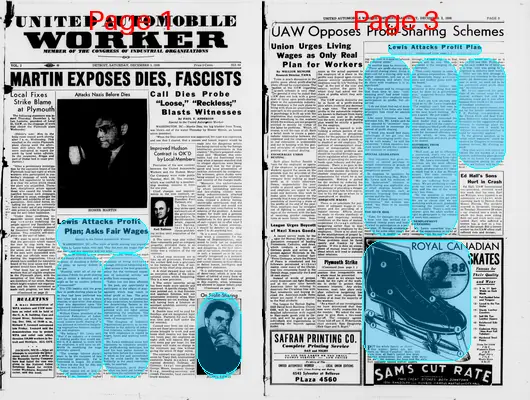
United Automobile Worker
Detroit, Wayne County, Michigan
What is this article about?
John L. Lewis, CIO leader, testifies before a congressional committee in Washington, D.C., criticizing profit-sharing plans as delusions that undermine collective bargaining and fair wages for workers, advocating instead for direct wage increases and union involvement.
Merged-components note: Merging the Lewis profit-sharing story with its continuation on page 3, the related caption, accompanying image of Lewis, and the image below the continuation likely related to the topic.
Clippings
1 of 2
OCR Quality
Full Text
Special to the United Automobile Worker
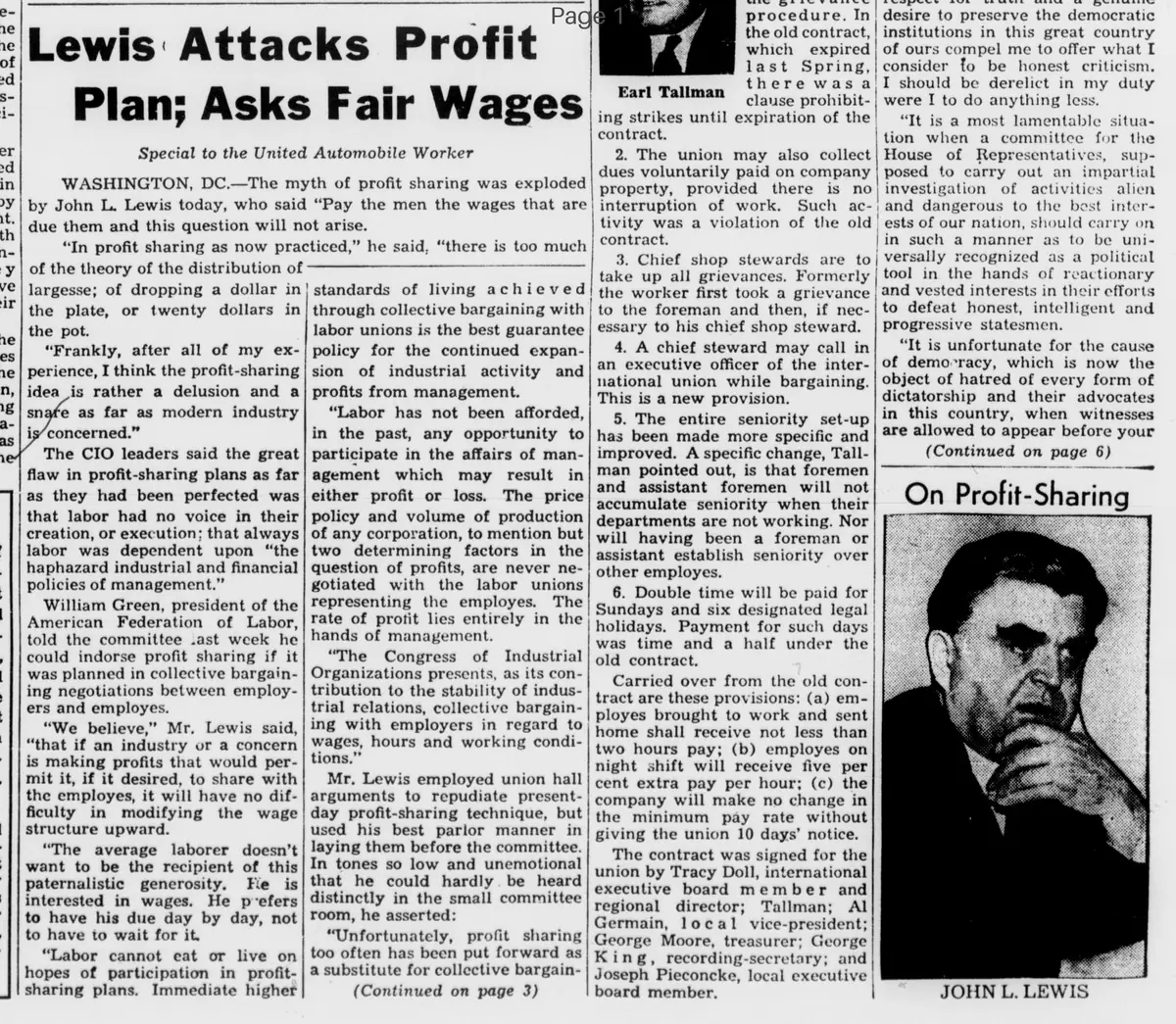
WASHINGTON, D.C.—The myth of profit sharing was exploded by John L. Lewis today, who said "Pay the men the wages that are due them and this question will not arise."
"In profit sharing as now practiced," he said, "there is too much of the theory of the distribution of largesse; of dropping a dollar in the plate, or twenty dollars in the pot.
"Frankly, after all of my experience, I think the profit-sharing idea is rather a delusion and a snare as far as modern industry is concerned."
The CIO leaders said the great flaw in profit-sharing plans as far as they had been perfected was that labor had no voice in their creation, or execution; that always labor was dependent upon "the haphazard industrial and financial policies of management."
William Green, president of the American Federation of Labor, told the committee last week he could endorse profit sharing if it was planned in collective bargaining negotiations between employers and employees.
"We believe," Mr. Lewis said, "that if an industry or a concern is making profits that would permit it, if it desired, to share with the employees, it will have no difficulty in modifying the wage structure upward.
"The average laborer doesn’t want to be the recipient of this paternalistic generosity. He is interested in wages. He prefers to have his due day by day, not to have to wait for it.
"Labor cannot eat or live on hopes of participation in profit-sharing plans. Immediate higher standards of living achieved through collective bargaining with labor unions is the best guarantee policy for the continued expansion of industrial activity and profits from management.
"Labor has not been afforded, in the past, any opportunity to participate in the affairs of management which may result in either profit or loss. The price policy and volume of production of any corporation, to mention but two determining factors in the question of profits, are never negotiated with the labor unions representing the employees. The rate of profit lies entirely in the hands of management.
"The Congress of Industrial Organizations presents, as its contribution to the stability of industrial relations, collective bargaining with employers in regard to wages, hours and working conditions."
Mr. Lewis employed union hall arguments to repudiate present-day profit-sharing technique, but used his best parlor manner in laying them before the committee. In tones so low and unemotional that he could hardly be heard distinctly in the small committee room, he asserted:
"Unfortunately, profit sharing too often has been put forward as a substitute for collective bargaining
On Profit-Sharing
JOHN L. LEWIS
Lewis Attacks Profit Plan
(Continued from page 1)
ing; too often it is used to bulwark the company union."
At another time he observed:
"There are profit-sharing plans and profit-sharing plans. Some of them call for a sharing only with higher executives, and not at all with employees, and where they do share with employees it is insignificant."
The witness said he recognized that from time to time well-meaning men had acted voluntarily to give their employees some participation in profits, but observed:
"I do not think that out of those experiments have come any basic principles that could be applied today."
Like many witnesses who had preceded him, Mr. Lewis said he was opposed to "incentive" taxation calculated to encourage the spread of profit sharing.
"I think you would find many subterfuges if we got into the realm of encouraging profit sharing by such means," he told the committee. "I think incentive taxation would disturb the competitive situation in industry.
SPECIAL LEGISLATION
"Any legislation that gives immunity or special privilege to certain corporations or groups of corporations disrupts the whole competitive system."
In response to questions by Senator Vandenberg (Rep., Mich.), Mr. Lewis said his criticism of the paternalism inherent in profit-sharing was applicable also to other employee benefits dispensed by employers, such as pensions, insurance, free medical service and the like.
"Some of these things are very meritorious," the witness conceded, "but there is no security about them.
TOO MUCH RISK
"Take, for example, the case of a man who has worked for a company twenty years and looks forward to participation in a pension plan. If, through mismanagement or for some other cause, the management is unable to carry through, the man's equity in that pension will be lost. The only guarantee is the integrity of the corporation.
"That could happen in some of our greatest corporations. During the depression many pension plans and medical plans went by the board."
"You seem to believe that whatever is done along that line must be done by a government plan," suggested Senator Herring (Dem., Iowa).
"I don't see how anybody else could do it," Mr. Lewis responded. "The employee can't feel sure as to what the executives may do at the next board meeting. He's just a pawn. He just hopes."
Senator Herring reminded the labor leader that a number of employers had told the committee their employees liked profit-sharing plans and that the arrangement made for increased efficiency and loyalty which, in turn, meant more production and more profits to be shared.
SUFFERING FROM EFFICIENCY
"Well now, as far as efficiency is concerned, that's one of the things we are suffering from right now," Mr. Lewis contended. "Our workmen are the most efficient in the world.
Our miners, for example, produce about five times as much coal in a day as British miners.
The same contrast is present in other industries.
"We are suffering from efficiency. We are producing so much goods our own country can't use them and the rest of the world won't buy them.
"So the question is whether American workmen can get jobs. We are so clever that we are abolishing work as such, gradually decreasing the number of man days available. There is only one answer: give the adult worker a right to participate in the volume of work that remains."
UNEMPLOYMENT INCREASING
Mr. Lewis remarked that for all of the experiments in relief of unemployment, the number of idle
today was about the same as it was in 1932 and 1933. Profit-sharing, he said, would be of little use to a man who was going to be displaced in industry next week.
"Until we can first arrange to stabilize our economy to the point where all Americans can participate in work, we need not to be too concerned about profit sharing," he continued.
Mr. Lewis approved the principle of the annual wage for industrial workers but said few industries could put it into effect because they could not be assured of constant production.
Answering a questionnaire sent out by the Senate subcommittee, F. E. Fusting, vice-president of the Crown Cork and Seal Company, Baltimore, today commented favorably on the suggestion of tax rewards to encourage plant expansion but said it would be "difficult to determine whether it could be equitably applied."
To the general question as to "what other measures" could be adopted by Congress to encourage business revival, Mr. Fusting replied:
"Any plan which will relieve or lighten the tax burden of a corporation, and thereby place greater funds in its hands for expansion or distribution among its stockholders, we believe will be beneficial."
What sub-type of article is it?
What themes does it cover?
What keywords are associated?
What entities or persons were involved?
Where did it happen?
Story Details
Key Persons
Location
Washington, D.C.
Story Details
John L. Lewis testifies against profit-sharing plans, calling them a delusion and substitute for collective bargaining, advocating for fair wages, union involvement in negotiations, and criticizing paternalistic benefits like pensions due to lack of security.