Thank you for visiting SNEWPapers!
Sign up free
Literary
November 19, 1922
Casper Daily Tribune
Casper, Natrona County, Wyoming
What is this article about?
In this detective story excerpt, French detective M. Jonquelle hears Lord Valleys recount his visit to uncle Lord Winton before the murder. Valleys describes seeking wine in the cellar during Winton's expected visitor, a fire breaking out, and discovering Winton stabbed to death upon escape. Valleys inherited the estate amid suspicion.
Clipping
OCR Quality
95%
Excellent
Full Text
Triumphs of M. Jonquelle
by MELVILLE DAVISSON POST
Begin Here Today.
M. JONQUELLE greatest of French detectives, was ushered into the presence of the strange and fear compelling Lord Valleys, the Englishman who had just inherited the title and estates of his murdered uncle, Lord Winton.
Three lives had stood between the Lord Valleys and the wealth of his uncle. But both of Lord Winton's sons were killed in the great war. Only one. He married an American left an heir and this heir, a daughter, was barred by English law from inheritance.
Then came the murder of Lord Winton and the inheritance of the estate by the strange, powerful and morose Lord Valleys.
Now Go on With the Story.
The Charge of Winton.
"They spared no effort to fix it upon me. That they were unable to do so is not, I think, attributable to this thing which you call Providence.
"It is attributable rather, I think, to the intelligence of my legal counsel and to myself."
He looked directly at Monsieur Jonquelle. His big, placid face lifted; his voice was even and unhurried.
"I am not embarrassed to discuss it, monsieur," he continued. "When the war had ended with the death of Lord Winton's sons, I was, by virtue of what you have so aptly called 'the accident of birth,' next in succession to the title. I thought it both advisable and courteous to present myself to Lord Winton and I went to England for that purpose.
"Lord Winton was an eccentric person. As he grew older and after the death of his sons, his eccentricity became more dominant. I did not find him on his estates at Raynescroft; he was at this time in London in a little old house which the family has always owned in a street toward Covent Garden.
"On the night that I called to see Lord Winton it was quite late. I found him alone in the house. He seemed disturbed to see me, but he was courteous and I cannot complain of his welcome. He seemed, however, not to realize that I had grown into a man. He seemed to regard me as a queer, foreign lad to whom he owed some obligation of hospitality."
Lord Valleys stopped. He leaned a little forward in the chair, and his voice took on a firmer note.
"Monsieur," he said, "I am saying to you now a thing to which I testified at the English trial, and which was not believed. Lord Winton told me that he expected a person to call on him within a very few minutes and to remain for perhaps an hour. He asked me to return at the end of an hour. I got up to go. As I went down the stairway, a hansom entering the street from the direction of the city, stopped before the door. The door was closed but the sound was clearly audible.
"Lord Winton, who was behind me, came also down the steps. On a console in the hall were several candles which the servants, according to custom, had placed there. An idea came to Lord Winton, for he stopped me as my hand was on the door to go out. He took up one of these candles in a tall brass candlestick, and touching me on the arm, handed it to me.
"'Instead of going out,' he said, 'suppose you go down into the wine-cellar. There should be some bottles of Burgundy of a famous year stored there by your grandfather. See if you can find them, and we shall have a glass of wine with our talk. I have a great deal to say to you, my nephew. The wine will sustain us.'
"You will see, monsieur, that this idea that I was merely a grown-up lad, come to visit an ancient relative, was quite fixed with Lord Winton. As the servants had gone out, he was sending me, as though I were a lad from Eton, to find the wine for our conversation. He gave me the key, a direction about the steps and doors. He even said there was a box of biscuit on the diningroom table which I could bring up. It was all, you see, monsieur, quite as though I were an undergraduate from some English public school."
The man looked down at his firm, placid hands resting upon and obscuring the arms of the chair in which he sat.
"This, monsieur," he said, "is a portion of my evidence which the English criminal court refused to believe. It was incredibly stupid!"
Monsieur Jonquelle looked up sharply at the sentence.
"The English criminal court," he said, "was even more stupid than you imagine. It was, as you have said, 'incredibly stupid'."
Lord Valleys made no comment.
"There was only my word for the statement," he said. "I could not prove it, and yet it was the truth."
The man was startled by Monsieur Jonquelle's reply.
"One knew that, although one would have been troubled to describe the evidence. It is precisely the truth," said Monsieur Jonquelle.
Lord Valleys looked steadily at the Prefect for a moment before he spoke.
"I regret, monsieur," he said, "that you were not present in that English court."
The man looked down again at his wonderful hands, steel strong and as supple as silk; then he went on:
"It happened, however, that this chance, which you question in human affairs, came to my aid. One of the Metropolitan police on duty on this night in the neighborhood of Covent Garden saw a hansom drive away from Lord Winton's door. The time, nearly as could be fixed, corresponded with the hour which I indicated in my testimony. And for the first time in the course of the criminal trial, the case for the crown was shaken. Neither my solicitors nor the crown were able to discover anything further. The driver of the hansom could not be located and the one who called that night upon Lord Winton remained a mystery."
Lord Valleys continued to speak deliberately and without emotion.
"I do not know who this person with whom Lord Winton had a midnight appointment could have been, and I do not know what occurred at that mysterious conference, except, of course, the resultant tragedy, which was afterward known to everyone.
I took the candle which Lord Winton gave me and went along the hall to the stairway, which descended into the basement of the house. I had in my hand the key to the wine-cellar.
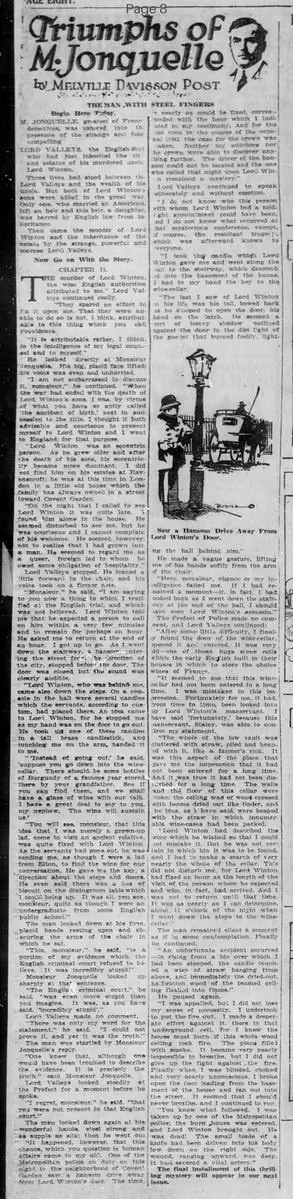
"The last I saw of Lord Winton in his life was his tall, bowed back as he stooped to open the door, his hand on the catch. He seemed a sort of heavy shadow outlined against the door in the dim light of the gas-jet that burned feebly, lighting the hall behind him."
He made a vague gesture, lifting one of his hands softly from the arm of the chair.
"Here, monsieur, chance or my intelligence failed me. If I had remained a moment longer, if, in fact, I had looked back as I went down the stairway at the end of the hall, I should have seen Lord Winton's assassin."
The Prefect of Police made no comment, and Lord Valleys continued:
"After some little difficulty, I finally found the door of the wine-cellar, opened it and entered. It was very old—one of those huge stone cells which the early English built in their houses in which to store the choice wines of France.
"It seemed to me that this wine-cellar had not been entered in a long time. I was mistaken in this impression. Fortunately for me, it had, from time to time, been looked into by Lord Winton's manservant. I have said 'fortunately,' because this manservant, Staley, was able to confirm my statement.
The whole of the low vault was cluttered with straw, piled and heaped with it, like a farmer's rick. It was this aspect of the place that gave me the impression that it had not been entered for a long time, and it was true it had not been disturbed for a long time. The walls and the floor of this cellar were stone: the ceiling was of wood crossed with beams dried out like tinder, and the bins, as I have said, were heaped with the straw in which innumerable wine-cases had been packed.
Lord Winton had described the wine which he wished so that I could not mistake it. But he was not certain in which bin it was to be found, and I had to make a search of very nearly the whole of the cellar. This did not disturb me, for Lord Winton had fixed an hour as the length of the visit of the person whom he expected and who, in fact, had arrived. And I was not to return until that time.
It was as nearly as I can determine, about 11 o'clock of the night when I went down the steps to the wine-cellar."
The man remained silent a moment as if in some contemplation. Finally he continued:
"An unfortunate accident occurred—in rising from a bin over which I had been stooped, the candle touched a wisp of straw hanging from above, and immediately the dried-out, half-rotten wood of the beamed ceiling flashed into flame."
He paused again.
"I was appalled, but I did not lose my sense of necessity. I undertook to put the fire out. I made a desperate effort against it, there in that underground cell, for I knew the house must burn if this whole wooden ceiling took fire. The place filled with smoke. It became very nearly impossible to breathe, but I did not give up the fight against the fire. Finally when I was blinded, choked and very nearly unconscious, I broke open the door leading from the basement of the house and ran out into the street. It seemed that I should never breathe, and I continued to run.
"You know what followed. I was taken up by one of the Metropolitan police; the burning house was entered, and Lord Winton brought out.
He was dead! The small blade of a knife had been driven into his body low down on the right side. The wound, ranging upward, was deep. It had severed a vital artery."
The final installment of this thrilling mystery will appear in our next issue.
by MELVILLE DAVISSON POST
Begin Here Today.
M. JONQUELLE greatest of French detectives, was ushered into the presence of the strange and fear compelling Lord Valleys, the Englishman who had just inherited the title and estates of his murdered uncle, Lord Winton.
Three lives had stood between the Lord Valleys and the wealth of his uncle. But both of Lord Winton's sons were killed in the great war. Only one. He married an American left an heir and this heir, a daughter, was barred by English law from inheritance.
Then came the murder of Lord Winton and the inheritance of the estate by the strange, powerful and morose Lord Valleys.
Now Go on With the Story.
The Charge of Winton.
"They spared no effort to fix it upon me. That they were unable to do so is not, I think, attributable to this thing which you call Providence.
"It is attributable rather, I think, to the intelligence of my legal counsel and to myself."
He looked directly at Monsieur Jonquelle. His big, placid face lifted; his voice was even and unhurried.
"I am not embarrassed to discuss it, monsieur," he continued. "When the war had ended with the death of Lord Winton's sons, I was, by virtue of what you have so aptly called 'the accident of birth,' next in succession to the title. I thought it both advisable and courteous to present myself to Lord Winton and I went to England for that purpose.
"Lord Winton was an eccentric person. As he grew older and after the death of his sons, his eccentricity became more dominant. I did not find him on his estates at Raynescroft; he was at this time in London in a little old house which the family has always owned in a street toward Covent Garden.
"On the night that I called to see Lord Winton it was quite late. I found him alone in the house. He seemed disturbed to see me, but he was courteous and I cannot complain of his welcome. He seemed, however, not to realize that I had grown into a man. He seemed to regard me as a queer, foreign lad to whom he owed some obligation of hospitality."
Lord Valleys stopped. He leaned a little forward in the chair, and his voice took on a firmer note.
"Monsieur," he said, "I am saying to you now a thing to which I testified at the English trial, and which was not believed. Lord Winton told me that he expected a person to call on him within a very few minutes and to remain for perhaps an hour. He asked me to return at the end of an hour. I got up to go. As I went down the stairway, a hansom entering the street from the direction of the city, stopped before the door. The door was closed but the sound was clearly audible.
"Lord Winton, who was behind me, came also down the steps. On a console in the hall were several candles which the servants, according to custom, had placed there. An idea came to Lord Winton, for he stopped me as my hand was on the door to go out. He took up one of these candles in a tall brass candlestick, and touching me on the arm, handed it to me.
"'Instead of going out,' he said, 'suppose you go down into the wine-cellar. There should be some bottles of Burgundy of a famous year stored there by your grandfather. See if you can find them, and we shall have a glass of wine with our talk. I have a great deal to say to you, my nephew. The wine will sustain us.'
"You will see, monsieur, that this idea that I was merely a grown-up lad, come to visit an ancient relative, was quite fixed with Lord Winton. As the servants had gone out, he was sending me, as though I were a lad from Eton, to find the wine for our conversation. He gave me the key, a direction about the steps and doors. He even said there was a box of biscuit on the diningroom table which I could bring up. It was all, you see, monsieur, quite as though I were an undergraduate from some English public school."
The man looked down at his firm, placid hands resting upon and obscuring the arms of the chair in which he sat.
"This, monsieur," he said, "is a portion of my evidence which the English criminal court refused to believe. It was incredibly stupid!"
Monsieur Jonquelle looked up sharply at the sentence.
"The English criminal court," he said, "was even more stupid than you imagine. It was, as you have said, 'incredibly stupid'."
Lord Valleys made no comment.
"There was only my word for the statement," he said. "I could not prove it, and yet it was the truth."
The man was startled by Monsieur Jonquelle's reply.
"One knew that, although one would have been troubled to describe the evidence. It is precisely the truth," said Monsieur Jonquelle.
Lord Valleys looked steadily at the Prefect for a moment before he spoke.
"I regret, monsieur," he said, "that you were not present in that English court."
The man looked down again at his wonderful hands, steel strong and as supple as silk; then he went on:
"It happened, however, that this chance, which you question in human affairs, came to my aid. One of the Metropolitan police on duty on this night in the neighborhood of Covent Garden saw a hansom drive away from Lord Winton's door. The time, nearly as could be fixed, corresponded with the hour which I indicated in my testimony. And for the first time in the course of the criminal trial, the case for the crown was shaken. Neither my solicitors nor the crown were able to discover anything further. The driver of the hansom could not be located and the one who called that night upon Lord Winton remained a mystery."
Lord Valleys continued to speak deliberately and without emotion.
"I do not know who this person with whom Lord Winton had a midnight appointment could have been, and I do not know what occurred at that mysterious conference, except, of course, the resultant tragedy, which was afterward known to everyone.
I took the candle which Lord Winton gave me and went along the hall to the stairway, which descended into the basement of the house. I had in my hand the key to the wine-cellar.
"The last I saw of Lord Winton in his life was his tall, bowed back as he stooped to open the door, his hand on the catch. He seemed a sort of heavy shadow outlined against the door in the dim light of the gas-jet that burned feebly, lighting the hall behind him."
He made a vague gesture, lifting one of his hands softly from the arm of the chair.
"Here, monsieur, chance or my intelligence failed me. If I had remained a moment longer, if, in fact, I had looked back as I went down the stairway at the end of the hall, I should have seen Lord Winton's assassin."
The Prefect of Police made no comment, and Lord Valleys continued:
"After some little difficulty, I finally found the door of the wine-cellar, opened it and entered. It was very old—one of those huge stone cells which the early English built in their houses in which to store the choice wines of France.
"It seemed to me that this wine-cellar had not been entered in a long time. I was mistaken in this impression. Fortunately for me, it had, from time to time, been looked into by Lord Winton's manservant. I have said 'fortunately,' because this manservant, Staley, was able to confirm my statement.
The whole of the low vault was cluttered with straw, piled and heaped with it, like a farmer's rick. It was this aspect of the place that gave me the impression that it had not been entered for a long time, and it was true it had not been disturbed for a long time. The walls and the floor of this cellar were stone: the ceiling was of wood crossed with beams dried out like tinder, and the bins, as I have said, were heaped with the straw in which innumerable wine-cases had been packed.
Lord Winton had described the wine which he wished so that I could not mistake it. But he was not certain in which bin it was to be found, and I had to make a search of very nearly the whole of the cellar. This did not disturb me, for Lord Winton had fixed an hour as the length of the visit of the person whom he expected and who, in fact, had arrived. And I was not to return until that time.
It was as nearly as I can determine, about 11 o'clock of the night when I went down the steps to the wine-cellar."
The man remained silent a moment as if in some contemplation. Finally he continued:
"An unfortunate accident occurred—in rising from a bin over which I had been stooped, the candle touched a wisp of straw hanging from above, and immediately the dried-out, half-rotten wood of the beamed ceiling flashed into flame."
He paused again.
"I was appalled, but I did not lose my sense of necessity. I undertook to put the fire out. I made a desperate effort against it, there in that underground cell, for I knew the house must burn if this whole wooden ceiling took fire. The place filled with smoke. It became very nearly impossible to breathe, but I did not give up the fight against the fire. Finally when I was blinded, choked and very nearly unconscious, I broke open the door leading from the basement of the house and ran out into the street. It seemed that I should never breathe, and I continued to run.
"You know what followed. I was taken up by one of the Metropolitan police; the burning house was entered, and Lord Winton brought out.
He was dead! The small blade of a knife had been driven into his body low down on the right side. The wound, ranging upward, was deep. It had severed a vital artery."
The final installment of this thrilling mystery will appear in our next issue.
What sub-type of article is it?
Prose Fiction
What themes does it cover?
Death Mortality
Political
War Peace
What keywords are associated?
Detective Story
Murder Mystery
Inheritance
Lord Winton
Wine Cellar
Fire Accident
English Trial
M Jonquelle
What entities or persons were involved?
By Melville Davisson Post
Literary Details
Title
Triumphs Of M. Jonquelle
Author
By Melville Davisson Post
Subject
Murder Of Lord Winton And Inheritance By Lord Valleys
Key Lines
"They Spared No Effort To Fix It Upon Me. That They Were Unable To Do So Is Not, I Think, Attributable To This Thing Which You Call Providence."
"The Last I Saw Of Lord Winton In His Life Was His Tall, Bowed Back As He Stooped To Open The Door, His Hand On The Catch."
"An Unfortunate Accident Occurred—In Rising From A Bin Over Which I Had Been Stooped, The Candle Touched A Wisp Of Straw Hanging From Above, And Immediately The Dried Out, Half Rotten Wood Of The Beamed Ceiling Flashed Into Flame."
He Was Dead! The Small Blade Of A Knife Had Been Driven Into His Body Low Down On The Right Side. The Wound, Ranging Upward, Was Deep. It Had Severed A Vital Artery.