Thank you for visiting SNEWPapers!
Sign up free
Alexandria Daily Gazette, Commercial & Political
Alexandria, Virginia
What is this article about?
In the U.S. House of Representatives on December 13, Mr. Gold proposed a resolution requesting presidential information on a conversation between U.S. Minister Pinkney and British Foreign Secretary Canning regarding trade disputes and a potential British naval role in U.S. enforcement. Debate with Messrs. Rhea, Bacon, and Gardenier questioned its relevance to a Senate resolution on diplomat F.J. Jackson.
Merged-components note: Continuation of Mr. Gardenier's speech in the House of Representatives debate on foreign relations and the concurrent resolution from the Senate, spanning across pages 2 and 3.
Clippings
1 of 2
OCR Quality
Full Text
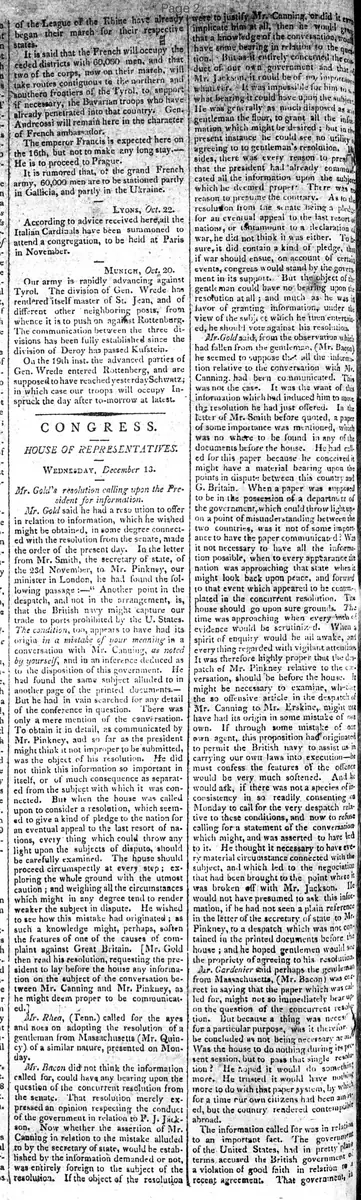
HOUSE OF REPRESENTATIVES.
Wednesday, December 13.
Mr. Gold's resolution calling upon the President for information.
Mr. Gold said he had a resolution to offer in relation to information, which he wished might be obtained, in some degree connected with the resolution from the senate, made the order of the present day. In the letter from Mr. Smith, the secretary of state, of the 23d November, to Mr. Pinkney, our minister in London, he had found the following passage: - "Another point in the despatch, and not in the arrangement, is, that the British navy might capture our trade to ports prohibited by the U. States. The condition, too, appears to have had its origin in a mistake of your meaning in a conversation with Mr. Canning, as noted by yourself, and in an inference deduced as to the disposition of this government." He had found the same subject alluded to in another page of the printed documents. But he had in vain searched for any detail of the conference in question. There was only a mere mention of the conversation. To obtain it in detail, as communicated by Mr. Pinkney, and so far as the president might think it not improper to be submitted, was the object of his resolution. He did not think this information so important in itself, or of much consequence as separated from the subject with which it was connected. But when the house was called upon to consider a resolution, which seemed to give a kind of pledge to the nation for an eventual appeal to the last resort of nations, every thing which could throw any light upon the subjects of dispute, should be carefully examined. The house should proceed circumspectly at every step; exploring the whole ground with the utmost caution; and weighing all the circumstances which might in any degree tend to render weaker the subject in dispute. He wished to see how this mistake had originated; as such a knowledge might, perhaps, soften the features of one of the causes of complaint against Great Britain. [Mr. Gold then read his resolution, requesting the president to lay before the house any information on the subject of the conversation between Mr. Canning and Mr. Pinkney, as he might deem proper to be communicated.]
Mr. Rhea, (Tenn.) called for the ayes and noes on adopting the resolution of a gentleman from Massachusetts (Mr. Quincy) of a similar nature, presented on Monday.
Mr. Bacon did not think the information called for, could have any bearing upon the question of the concurrent resolution from the senate. That resolution merely expressed an opinion respecting the conduct of the government in relation to F. J. Jackson. Now whether the assertion of Mr. Canning in relation to the mistake alluded to by the secretary of state, would be established by the information demanded or not, was entirely foreign to the subject of the resolution. If the object of the resolution were to justify Mr. Canning, or did it even implicate him at all, then he would grant that a knowledge of the conversation, would have some bearing in relation to the question. But as it entirely concerned the conduct of our own government and that of Mr. Jackson it could be of no importance whatever. It was impossible for him to see what bearing it could have upon the subject. He was generally as much disposed as any gentleman on the floor, to grant all the information which might be desired; but in the present instance he could see no utility in agreeing to the gentleman's resolution. Besides, there was every reason to presume that the president had already communicated all the information upon the subject which he deemed proper: There was no reason to presume the contrary. As to the resolution from the Senate being a pledge for an eventual appeal to the last resort of nations, or tantamount to a declaration of war, he did not think it was either. To be sure, it did contain a kind of pledge, that if war should ensue, on account of certain events, congress would stand by the government in its support. But the object of the gentleman could have no bearing upon this resolution at all; and much as he was in favor of granting information, under the view of the subject which he then entertained, he should vote against his resolution.
Mr. Gold said, from the observation which had fallen from the gentleman (Mr. Bacon) he seemed to suppose that all the information relative to the conversation with Mr. Canning, had been communicated. This was not the case. It was the want of this information which had induced him to move the resolution he had just offered. In the letter of Mr. Smith before quoted, a paper of some importance was mentioned, which was no where to be found in any of the documents before the house. He had called for this paper because he conceived it might have a material bearing upon the points in dispute between this country and G. Britain. When a paper was supposed to be in the possession of a department of the government, which could throw light upon a point of misunderstanding between the two countries, was it not of some importance to have the paper communicated? Was it not necessary to have all the information possible, when to every appearance the nation was approaching that state when it might look back upon peace, and forward to that event which appeared to be contemplated in the concurrent resolution. The house should go upon sure grounds. The time was approaching when every inch of evidence would be scrutinized. When a spirit of enquiry would be all awake, and every thing regarded with vigilant attention. It was therefore highly proper that the despatch of Mr. Pinkney relative to the conversation, should be before the house. It might be necessary to examine, whether the so offensive article in the despatch of Mr. Canning to Mr. Erskine, might not have had its origin in some mistake of his own. If through some mistake of our own agent, this proposition had originated to permit the British navy to assist us in carrying our own laws into execution—he must confess the features of the offence would be very much softened. And he would ask, if there was not a species of inconsistency in so readily, consenting on Monday to call for the very despatch relative to these conditions, and now to refuse calling for a statement of the conversation which might, and was asserted to have led to it. He thought it necessary to have every material circumstance connected with the subject, and which led to the negociation that had been brought to the point where it was broken off with Mr. Jackson. He would not have presumed to ask this information, if he had not seen a plain reference in the letter of the secretary of state to Mr. Pinkney, to a despatch which was not contained in the printed documents before the house; and he hoped gentlemen would see the propriety of agreeing to his resolution.
Mr. Gardenier said perhaps the gentleman from Massachusetts, (Mr. Bacon) was correct in saying that the paper which was called for, might not so immediately bear upon the question of the concurrent resolution. But because a thing was necessary for a particular purpose, was it therefore to be concluded as not being necessary at all? Was the house to do nothing during its present session, but to pass that single resolution? He hoped it would do something more. He trusted it would have nothing more to do with that paper system, by which for a time our own citizens had been amused, but the country rendered contemptible abroad.
The information called for was in relation to an important fact. The government in pretty plain terms accused the British government of a violation of good faith in relation to the recent agreement. That government,
justification, asserts that one of the material conditions on which it had authorized the revocation had been entirely overlooked. In reply it was urged that the third proposition never was submitted in item at all, as an absolute condition, no arrangement could have been made. That had it been so submitted the arrangement was one which went to imply a want of ability on the part of this government to execute its own laws, and was such an one as no American ever could consent to. He was anxious that in this particular, this government should be justified to the world; for there was still some portion of it which had eluded the merciless jaws of Napoleon, and would judge upon the plain evidence of truth and reason. To them it was necessary, if we respected our character, as a nation: to make it appear in any event, that we had justice on our side. We assert that the insulting proposition of permitting the British navy to assist us in the execution of our laws, was not known to this government as an absolute condition at all. That it was one which from its nature must be utterly inadmissible. But what do they declare? Why, that they had not; but that it had originally come from the American minister in London. If this state of the case was correct, then had this government nothing to complain of in relation to the agreement. The violation of good faith would be in the part of the U. States. If this proposition actually was made by the American minister, no charge could be laid on that account against the British government. There was nothing reprehensible, on her part, in taking all that we were willing to give. He wanted to know whether the act were such as was represented by the British government. If it was no blame could attach to them or being willing to take all that we were willing to give. He would not have it thought he believed Mr. Canning's statement in this particular. But he placed it upon this footing, that he could neither believe nor disbelieve without evidence.
[Mr. Gardenier's Speech to be continued.]
What sub-type of article is it?
What keywords are associated?
What entities or persons were involved?
Domestic News Details
Event Date
Wednesday, December 13.
Key Persons
Outcome
debate ongoing; mr. gardenier's speech to be continued; no resolution outcome stated.
Event Details
Mr. Gold offered a resolution requesting the President to provide information on the conversation between Mr. Pinkney and Mr. Canning, referenced in Secretary Smith's letter, to clarify misunderstandings in British-American trade negotiations. Mr. Rhea called for ayes and noes on a similar resolution by Mr. Quincy. Mr. Bacon opposed, arguing irrelevance to the Senate resolution on F.J. Jackson. Mr. Gold defended its importance for understanding disputes. Mr. Gardenier supported, emphasizing justification of U.S. position internationally.