Thank you for visiting SNEWPapers!
Sign up free
Story
August 20, 1869
Prescott Journal
Prescott, Pierce County, Saint Croix County, Wisconsin
What is this article about?
Editorial in a Pierce County newspaper criticizes P. V. Wise's pre-emption law, arguing it provides no valid title to settlers on railroad lands granted by Congress, as the state lacks authority over them. Accuses Wise of misleading settlers and calls for proof of congressional authorization.
Clipping
OCR Quality
98%
Excellent
Full Text
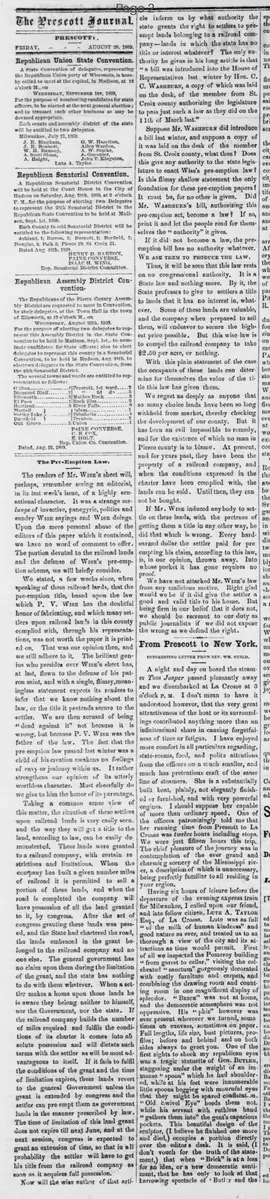
The Pre-Emption Law.
The readers of Mr. Wise's sheet will, perhaps, remember seeing an editorial, in its last week's issue, of a highly sensational character. It was a strange mélange of invective, panegyric, politics and sundry Wise sayings and Wise doings. Upon the mere personal abuse of the editors of this paper which it contained, we have no word of comment to offer.
The portion devoted to the railroad lands and the defense of Wise's pre-emption scheme, we will briefly consider.
We stated, a few weeks since, when speaking of these railroad lands, that the pre-emption title, based upon the law which P. V. Wise has the doubtful honor of fabricating, and which many settlers upon railroad lands in this county complied with, through his representations, was not worth the paper it is printed on. That was our opinion then, and we still adhere to it. The brilliant genius who presides over Wise's sheet has, at last, flown to the defense of his patron saint, and with a single, flimsy, meaningless statement expects its readers to infer that we know nothing about the law, or the title it pretends secure to the settler. We are then accused of being "dead against it" not because it is wrong, but because P. V. Wise was the father of the law. The fact that the pre-emption law passed last winter was a child of his creation awakens no feelings of envy or jealousy within us. It rather strengthens our opinion of its utterly worthless character. Most cheerfully do we give to him the honor of its parentage.
Taking a common sense view of this matter, the situation of these settlers upon railroad lands is very easily seen, and the way they will get a title to the land, according to law, can be easily demonstrated. These lands were granted to a railroad company, with certain restrictions and limitations. When the company has built a given number miles of railroad it is permitted to sell a portion of these lands, and when the road is completed the company will have possession of all the land granted to it, by congress. After the act of congress granting these lands was passed, and the State had chartered the road, the lands embraced in the grant belonged to the railroad company and no one else. The general government has no claim upon them during the limitation of the grant, and the state has nothing to do with them whatever. When a settler makes a home upon those lands he is aware they belong neither to himself, nor the Government, nor the state. If the railroad company builds the number of miles required and fulfils the conditions of its charter it comes into absolute possession and will dictate such terms with the settler as will be most advantageous to itself. If it fails to fulfil the conditions of the grant and the time of limitation expires, these lands revert to the general Government unless the grant is extended by congress and the settler can pre-empt them as government lands in the manner prescribed by law.
The time of limitation of this land grant does not expire till next June, and at the next session, congress is expected to grant an extension of time, so that in all probability the settler will have to get his title from the railroad company as soon as it acquires full possession.
Now will the wise author of that article inform us by what authority the state grants the right to settlers to pre-empt lands belonging to a railroad company—lands in which the state has no title or interest whatever? The only authority he gives in his long article is that "a bill was introduced into the House of Representatives last winter by Hon. C. C. Washburn, a copy of which was laid on the desk, of the member from St. Croix county authorizing the legislature to pass just such a law as they did on the 11th of March last."
Suppose Mr. Washburn did introduce a bill last winter, and suppose a copy of it was laid on the desk of the member from St. Croix county, what then? Does this give any authority to the state legislature to enact Wise's pre-emption law? Is this flimsy shallow statement the only foundation for these pre-emption papers? It must be, for no other is given. Did Mr. Washburn's bill, authorizing this pre-emption act, become a law? If so, print it and let the people read for themselves the "authority" it gives. If it did not become a law, the pre-emption bill has no authority whatever.
WE ASK THEM TO PRODUCE THE LAW.
Thus, it will be seen that this law rests on no congressional authority. It is a State law and nothing more. By it, the State professes to give to settlers a title to lands that it has no interest in, whatever. Some of these lands are valuable, and the company when prepared to sell them, will endeavor to secure the highest price possible. But this wise law is to compel the railroad company to take $2.50 per acre, or nothing.
With this plain statement of the case the occupants of these lands can determine for themselves the value of the title this law has given them.
We regret as deeply as anyone that so many choice lands have been so long withheld from market, thereby checking the development of our county. But it has been an evil impossible to remedy, and for the existence of which no man in Pierce county is to blame. At present, and for years past, they have been the property of a railroad company, and when the conditions expressed in the charter have been complied with, the lands can be sold. Until then, they can not be bought.
If Mr. Wise induced anybody to settle on these lands, with the pretense of getting them a title in any other way, he did that which is wrong. Every hard-earned dollar the settler paid for preempting his claim, according to this law, is, in our opinion, thrown away. Into whose pocket it has gone requires no proof.
We have not attacked Mr. Wise's law from any malicious motive. Right glad would we be if it did give the settler a good and valid title to his home. But being firm in our belief that it does not, we should be recreant to our duty as public journalists if we did not expose the wrong as we defend the right.
The readers of Mr. Wise's sheet will, perhaps, remember seeing an editorial, in its last week's issue, of a highly sensational character. It was a strange mélange of invective, panegyric, politics and sundry Wise sayings and Wise doings. Upon the mere personal abuse of the editors of this paper which it contained, we have no word of comment to offer.
The portion devoted to the railroad lands and the defense of Wise's pre-emption scheme, we will briefly consider.
We stated, a few weeks since, when speaking of these railroad lands, that the pre-emption title, based upon the law which P. V. Wise has the doubtful honor of fabricating, and which many settlers upon railroad lands in this county complied with, through his representations, was not worth the paper it is printed on. That was our opinion then, and we still adhere to it. The brilliant genius who presides over Wise's sheet has, at last, flown to the defense of his patron saint, and with a single, flimsy, meaningless statement expects its readers to infer that we know nothing about the law, or the title it pretends secure to the settler. We are then accused of being "dead against it" not because it is wrong, but because P. V. Wise was the father of the law. The fact that the pre-emption law passed last winter was a child of his creation awakens no feelings of envy or jealousy within us. It rather strengthens our opinion of its utterly worthless character. Most cheerfully do we give to him the honor of its parentage.
Taking a common sense view of this matter, the situation of these settlers upon railroad lands is very easily seen, and the way they will get a title to the land, according to law, can be easily demonstrated. These lands were granted to a railroad company, with certain restrictions and limitations. When the company has built a given number miles of railroad it is permitted to sell a portion of these lands, and when the road is completed the company will have possession of all the land granted to it, by congress. After the act of congress granting these lands was passed, and the State had chartered the road, the lands embraced in the grant belonged to the railroad company and no one else. The general government has no claim upon them during the limitation of the grant, and the state has nothing to do with them whatever. When a settler makes a home upon those lands he is aware they belong neither to himself, nor the Government, nor the state. If the railroad company builds the number of miles required and fulfils the conditions of its charter it comes into absolute possession and will dictate such terms with the settler as will be most advantageous to itself. If it fails to fulfil the conditions of the grant and the time of limitation expires, these lands revert to the general Government unless the grant is extended by congress and the settler can pre-empt them as government lands in the manner prescribed by law.
The time of limitation of this land grant does not expire till next June, and at the next session, congress is expected to grant an extension of time, so that in all probability the settler will have to get his title from the railroad company as soon as it acquires full possession.
Now will the wise author of that article inform us by what authority the state grants the right to settlers to pre-empt lands belonging to a railroad company—lands in which the state has no title or interest whatever? The only authority he gives in his long article is that "a bill was introduced into the House of Representatives last winter by Hon. C. C. Washburn, a copy of which was laid on the desk, of the member from St. Croix county authorizing the legislature to pass just such a law as they did on the 11th of March last."
Suppose Mr. Washburn did introduce a bill last winter, and suppose a copy of it was laid on the desk of the member from St. Croix county, what then? Does this give any authority to the state legislature to enact Wise's pre-emption law? Is this flimsy shallow statement the only foundation for these pre-emption papers? It must be, for no other is given. Did Mr. Washburn's bill, authorizing this pre-emption act, become a law? If so, print it and let the people read for themselves the "authority" it gives. If it did not become a law, the pre-emption bill has no authority whatever.
WE ASK THEM TO PRODUCE THE LAW.
Thus, it will be seen that this law rests on no congressional authority. It is a State law and nothing more. By it, the State professes to give to settlers a title to lands that it has no interest in, whatever. Some of these lands are valuable, and the company when prepared to sell them, will endeavor to secure the highest price possible. But this wise law is to compel the railroad company to take $2.50 per acre, or nothing.
With this plain statement of the case the occupants of these lands can determine for themselves the value of the title this law has given them.
We regret as deeply as anyone that so many choice lands have been so long withheld from market, thereby checking the development of our county. But it has been an evil impossible to remedy, and for the existence of which no man in Pierce county is to blame. At present, and for years past, they have been the property of a railroad company, and when the conditions expressed in the charter have been complied with, the lands can be sold. Until then, they can not be bought.
If Mr. Wise induced anybody to settle on these lands, with the pretense of getting them a title in any other way, he did that which is wrong. Every hard-earned dollar the settler paid for preempting his claim, according to this law, is, in our opinion, thrown away. Into whose pocket it has gone requires no proof.
We have not attacked Mr. Wise's law from any malicious motive. Right glad would we be if it did give the settler a good and valid title to his home. But being firm in our belief that it does not, we should be recreant to our duty as public journalists if we did not expose the wrong as we defend the right.
What sub-type of article is it?
Historical Event
Deception Fraud
What themes does it cover?
Deception
Justice
Misfortune
What keywords are associated?
Pre Emption Law
Railroad Lands
P. V. Wise
Settlers
Pierce County
Congressional Grant
Land Titles
What entities or persons were involved?
P. V. Wise
Hon. C. C. Washburn
Where did it happen?
Pierce County
Story Details
Key Persons
P. V. Wise
Hon. C. C. Washburn
Location
Pierce County
Event Date
11th Of March Last
Story Details
Newspaper editorial denounces P. V. Wise's state pre-emption law as invalid for granting titles to settlers on federally granted railroad lands, lacking congressional authority; argues settlers misled and titles worthless, demanding proof from proponents.