Thank you for visiting SNEWPapers!
Sign up free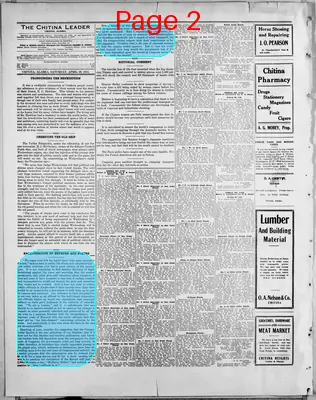
Editorial
April 20, 1912
The Chitina Leader
Chitina, Alaska
What is this article about?
Editorial defends the press against criticism from Senator Heyburn of Idaho, who attacks newspapers for reporting congressional jests and sensations. It highlights press role in exposing Alaskan officials' irregularities and satirizes the revised, censored Congressional Record as an unreliable source of news, contrasting it with free press.
Clipping
OCR Quality
98%
Excellent
Full Text
HALLUCINATION OF HEYBURN AND OTHERS
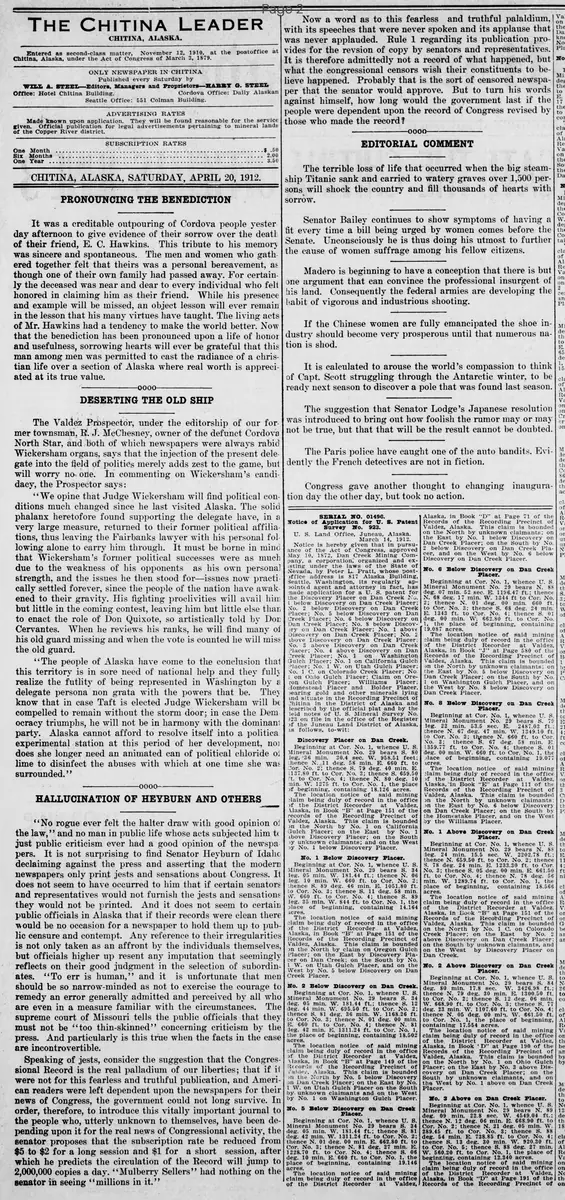
"No rogue ever felt the halter draw with good opinion of the law," and no man in public life whose acts subjected him to just public criticism ever had a good opinion of the newspapers. It is not surprising to find Senator Heyburn of Idaho declaiming against the press and asserting that the modern newspapers only print jests and sensations about Congress. It does not seem to have occurred to him that if certain senators and representatives would not furnish the jests and sensations they would not be printed. And it does not seem to certain public officials in Alaska that if their records were clean there would be no occasion for a newspaper to hold them up to public censure and contempt. Any reference to their irregularities is not only taken as an affront by the individuals themselves but officials higher up resent any imputation that seemingly reflects on their good judgment in the selection of subordinates. "To err is human," and it is unfortunate that men should be so narrow-minded as not to exercise the courage to remedy an error generally admitted and perceived by all who are even in a measure familiar with the circumstances. The supreme court of Missouri tells the public officials that they must not be "too thin-skinned" concerning criticism by the press. And particularly is this true when the facts in the case are incontrovertible.
Speaking of jests, consider the suggestion that the Congressional Record is the real palladium of our liberties; that if it were not for this fearless and truthful publication, and American readers were left dependent upon the newspapers for their news of Congress, the government could not long survive. In order, therefore, to introduce this vitally important journal to the people who, utterly unknown to themselves, have been depending upon it for the real news of Congressional activity, the senator proposes that the subscription rate be reduced from $5 to $2 for a long session and $1 for a short session, after which he predicts the circulation of the Record will jump to 2,000,000 copies a day. "Mulberry Sellers" had nothing on the senator in seeing "millions in it."
Now a word as to this fearless and truthful palladium, with its speeches that were never spoken and its applause that was never applauded. Rule 1 regarding its publication provides for the revision of copy by senators and representatives. It is therefore admittedly not a record of what happened, but what the congressional censors wish their constituents to believe happened. Probably that is the sort of censored newspaper that the senator would approve. But to turn his words against himself, how long would the government last if the people were dependent upon the record of Congress revised by those who made the record?
"No rogue ever felt the halter draw with good opinion of the law," and no man in public life whose acts subjected him to just public criticism ever had a good opinion of the newspapers. It is not surprising to find Senator Heyburn of Idaho declaiming against the press and asserting that the modern newspapers only print jests and sensations about Congress. It does not seem to have occurred to him that if certain senators and representatives would not furnish the jests and sensations they would not be printed. And it does not seem to certain public officials in Alaska that if their records were clean there would be no occasion for a newspaper to hold them up to public censure and contempt. Any reference to their irregularities is not only taken as an affront by the individuals themselves but officials higher up resent any imputation that seemingly reflects on their good judgment in the selection of subordinates. "To err is human," and it is unfortunate that men should be so narrow-minded as not to exercise the courage to remedy an error generally admitted and perceived by all who are even in a measure familiar with the circumstances. The supreme court of Missouri tells the public officials that they must not be "too thin-skinned" concerning criticism by the press. And particularly is this true when the facts in the case are incontrovertible.
Speaking of jests, consider the suggestion that the Congressional Record is the real palladium of our liberties; that if it were not for this fearless and truthful publication, and American readers were left dependent upon the newspapers for their news of Congress, the government could not long survive. In order, therefore, to introduce this vitally important journal to the people who, utterly unknown to themselves, have been depending upon it for the real news of Congressional activity, the senator proposes that the subscription rate be reduced from $5 to $2 for a long session and $1 for a short session, after which he predicts the circulation of the Record will jump to 2,000,000 copies a day. "Mulberry Sellers" had nothing on the senator in seeing "millions in it."
Now a word as to this fearless and truthful palladium, with its speeches that were never spoken and its applause that was never applauded. Rule 1 regarding its publication provides for the revision of copy by senators and representatives. It is therefore admittedly not a record of what happened, but what the congressional censors wish their constituents to believe happened. Probably that is the sort of censored newspaper that the senator would approve. But to turn his words against himself, how long would the government last if the people were dependent upon the record of Congress revised by those who made the record?
What sub-type of article is it?
Press Freedom
Satire
Partisan Politics
What keywords are associated?
Press Freedom
Senator Heyburn
Congressional Record
Public Criticism
Alaska Officials
Satire
What entities or persons were involved?
Senator Heyburn Of Idaho
Public Officials In Alaska
Supreme Court Of Missouri
Congress
Congressional Record
Editorial Details
Primary Topic
Criticism Of Senator Heyburn's Attack On The Press And Defense Of Journalistic Exposure Of Official Misconduct
Stance / Tone
Supportive Of Press Freedom, Satirical Of Congressional Hypocrisy And The Congressional Record
Key Figures
Senator Heyburn Of Idaho
Public Officials In Alaska
Supreme Court Of Missouri
Congress
Congressional Record
Key Arguments
Public Officials Resent Press Criticism Because It Exposes Their Irregularities
If Officials Acted Properly, There Would Be No Basis For Newspaper Censure
Officials Should Not Be Thin Skinned About Incontrovertible Facts, As Advised By Missouri Supreme Court
Congressional Record Is Not Truthful Due To Revisions By Members
Reducing Congressional Record Subscription Price Won't Make It A Reliable News Source
Government Would Not Survive If Dependent On Censored Congressional Records Instead Of Free Press