Thank you for visiting SNEWPapers!
Sign up free
Toledo Union Journal
Toledo, Lucas County, Ohio
What is this article about?
A Bank of New York study warns of a $17 billion U.S. federal deficit and 5 million unemployed in a mild recession, rising to $29 billion and 8.5 million in a severe one. Economist Dr. Nadler predicts only a short mild downturn, crediting post-war economic changes and government policies. (Post-Korean truce context.)
Clipping
OCR Quality
Full Text
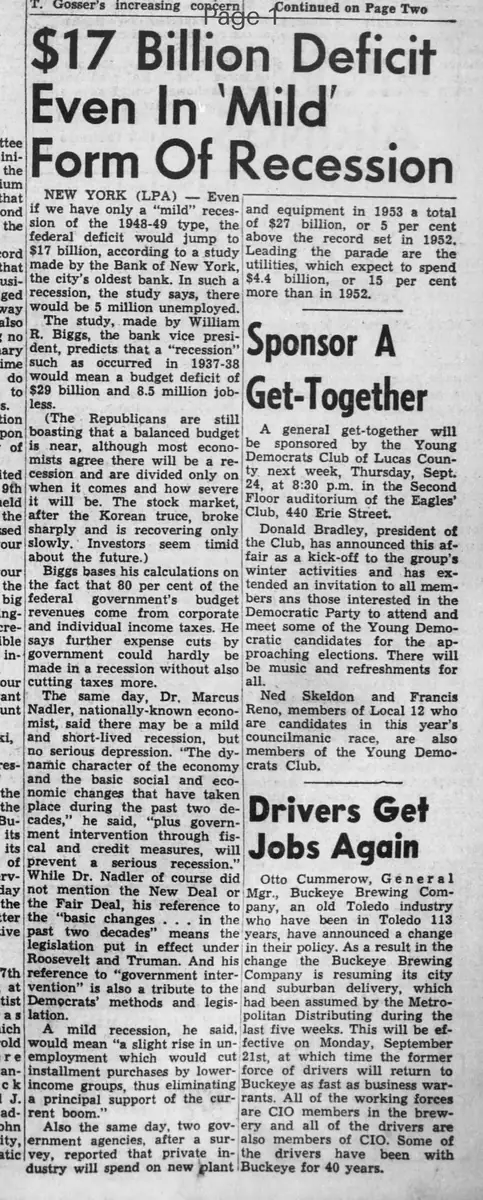
NEW YORK (LPA)—Even if we have only a "mild" recession of the 1948-49 type, the federal deficit would jump to $17 billion, according to a study made by the Bank of New York, the city's oldest bank. In such a recession, the study says, there would be 5 million unemployed.
The study, made by William R. Biggs, the bank vice president, predicts that a "recession" such as occurred in 1937-38 would mean a budget deficit of $29 billion and 8.5 million jobless.
(The Republicans are still boasting that a balanced budget is near, although most economists agree there will be a recession and are divided only on when it comes and how severe it will be. The stock market, after the Korean truce, broke sharply and is recovering only slowly. Investors seem timid about the future.)
Biggs bases his calculations on the fact that 80 per cent of the federal government's budget revenues come from corporate and individual income taxes. He says further expense cuts by government could hardly be made in a recession without also cutting taxes more.
The same day, Dr. Marcus Nadler, nationally-known economist, said there may be a mild and short-lived recession, but no serious depression. "The dynamic character of the economy and the basic social and economic changes that have taken place during the past two decades," he said, "plus government intervention through fiscal and credit measures, will prevent a serious recession."
While Dr. Nadler of course did not mention the New Deal or the Fair Deal, his reference to the "basic changes . . . in the past two decades" means the legislation put in effect under Roosevelt and Truman. And his reference to "government intervention" is also a tribute to the Democrats' methods and legislation.
A mild recession, he said, would mean "a slight rise in unemployment which would cut installment purchases by lower-income groups, thus eliminating a principal support of the current boom."
Also the same day, two government agencies, after a survey, reported that private industry will spend on new plant
What sub-type of article is it?
What themes does it cover?
What keywords are associated?
What entities or persons were involved?
Where did it happen?
Story Details
Key Persons
Location
New York
Event Date
1948 49, 1937 38
Story Details
Bank of New York study by William R. Biggs predicts $17 billion federal deficit and 5 million unemployed in a mild recession like 1948-49, or $29 billion and 8.5 million jobless in a 1937-38 style recession. Dr. Marcus Nadler forecasts a mild, short-lived recession without serious depression due to economic changes and government intervention.