Thank you for visiting SNEWPapers!
Sign up free
Letter to Editor
November 8, 1813
Daily National Intelligencer
Washington, District Of Columbia
What is this article about?
In his third letter, Hortensius defends the American declaration of war in 1812 as a justified response to British injustices, including impressment of seamen and the Orders in Council, refuting claims that the U.S. was the aggressor and criticizing British policy and parliamentary support.
Clipping
OCR Quality
98%
Excellent
Full Text
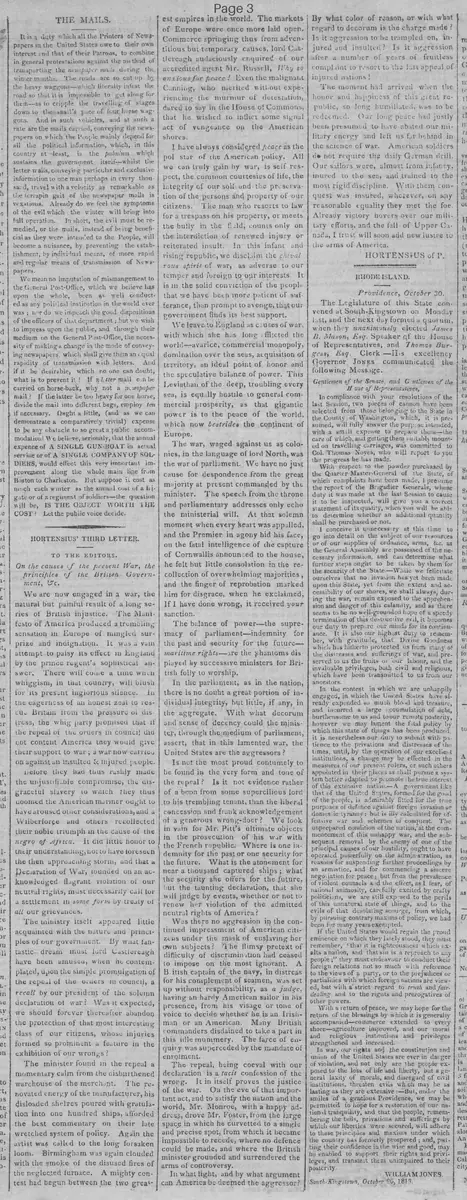
HORTENSIUS' THIRD LETTER.
TO THE EDITORS.
On the causes of the present War, the principles of the British Government, &c.
We are now engaged in a war, the natural but painful result of a long series of British injustice. The Manifesto of America produced a trembling sensation in Europe of mingled surprise and indignation. It was a vain attempt to palsy its effect in England by the prince regent's sophistical answer. There will come a time when whiggism, in that country, will blush for its present inglorious silence. In the eagerness of an honest zeal to rescue Britain from the pressure of distress, the whig party promised that if the repeal of the orders in council did not content America they would give their support to war; a war now carried on against an insulted & injured people.
Before they had thus rashly made the unjustifiable compromise, the disgraceful slavery to which they thus doomed the American mariner ought to have aroused other considerations, and a Wilberforce and others recollected their noble triumph in the cause of the negro of Africa. It did little honor to their understanding, not to have foreseen the then approaching storm, and that a Declaration of War, founded on an acknowledged flagrant violation of our neutral rights, must necessarily call for a settlement in some form by treaty of all our grievances.
The ministry itself appeared little acquainted with the nature and principles of our government. By what fantastic dream must lord Castlereagh have been amused, when he contemplated, upon the simple promulgation of the repeal of the orders in council, a recall by our president of the solemn declaration of war? Was it expected, we should forever thereafter abandon the protection of that most interesting class of our citizens, whose injuries formed so prominent a feature in the exhibition of our wrongs?
The minister found in the repeal a momentary calm from the disburthened warehouse of the merchant. The renovated energy of the manufacturer, his disloaded shelves poured with gratulation into one hundred ships, afforded the best commentary on their late wretched system of policy. Again the artist was called to the long forsaken loom. Birmingham was again clouded with the smoke of the disused fires of the neglected furnace. A mighty contest had begun between the two greatest empires in the world. The markets of Europe were once more laid open. Commerce springing thus from adventitious but temporary causes, lord Castlereagh audaciously enquired of our accredited agent Mr. Russell, Why so anxious for peace! Even the malignant Cunning, who merited without experiencing the murmur of detestation dared to say in the House of Commons, that he wished to inflict some signal act of vengeance on the American shores.
I have always considered peace as the pole star of the American policy. All we can truly gain by war, is self respect, the common courtesies of life, the integrity of our soil and the preservation of the persons and property of our citizens. The man who resorts to law for a trespass on his property, or meets the bully in the field, counts only on the interdiction of renewed injury or reiterated insult. In this infant and rising republic, we disclaim the chivalrous spirit of war, as adverse to our temper and foreign to our interests. It is in the solid conviction of the people that we have been more patient of sufferance, than prompt to avenge, that our government finds its best support.
We leave to England as causes of war, with which she has long afflicted the world—avarice, commercial monopoly, domination over the seas, acquisition of territory, an ideal point of honor and the speculative balance of power. This Leviathan of the deep, troubling every sea, is equally hostile to general commercial prosperity, as that gigantic power is to the peace of the world, which now bestrides the continent of Europe.
The war, waged against us as colonies, in the language of lord North, was the war of parliament. We have no just cause for despondence from the great majority at present commanded by the minister. The speech from the throne and parliamentary addresses only echo the ministerial will. At that solemn moment when every heart was appalled, and the Premier in agony hid his face, on the fatal intelligence of the capture of Cornwallis announced to the house, he felt but little consolation in the recollection of overwhelming majorities and the finger of reprobation marked him for disgrace, when he exclaimed, If I have done wrong, it received your sanction.
The balance of power—the supremacy of parliament—indemnity for the past and security for the future—maritime rights—are the phantoms displayed by successive ministers for British folly to worship.
In the parliament, as in the nation, there is no doubt a great portion of individual integrity, but little, if any, in the aggregate. With what decorum and sense of decency could the minister, through the medium of parliament, assert, that in this lamented war, the United States are the aggressors?
Is not the most proud contumely to be found in the very form and tone of the repeal? Is it not evidence rather of a boon from some supercilious lord to his trembling tenant, than the liberal concession and frank acknowledgement of a generous wrong-doer? We look in vain for Mr. Pitt's ultimate objects in the prosecution of his war with the French republic. Where is one indemnity for the past or one security for the future. What is the atonement for near a thousand captured ships; what the security she offers for the future, but the taunting declaration, that she will judge by events, whether or not to renew her violation of the admitted neutral rights of America?
Was there no aggression in the continued impressment of American citizens under the mask of enslaving her own subjects? The flimsy pretext of difficulty of discrimination had ceased to impose on the most ignorant. A British captain of the navy, in distress for his complement of seamen, was set up without responsibility, as a judge, having a hardy American sailor in his presence, from his visage or tone of voice to decide whether he is an Irishman or an American. Many British commanders disdained to take a part in this idle mummery. The farce of enquiry was superceded by the mandate of enrolment.
The repeal, being coeval with our declaration is a tacit confession of the wrong. It in itself proves the justice of the war. On the eve of that important act, and to satisfy the nation and the world, Mr. Monroe, with a happy address, drove Mr. Foster, from the large space in which he curvetted to a single and precise spot, from which it became impossible to recede, where no defence could be made, and where the British minister grounded and surrendered the arms of controversy.
In what light, and by what argument can America be deemed the aggressor?
By what color of reason, or with what regard to decorum is the charge made? Is it aggression to be trampled on, injured and insulted? Is it aggression after a number of years of fruitless complaint to resort to the last appeal of injured nations!
The moment had arrived when the honor and happiness of this great republic, so long humiliated, was to be redeemed. Our long peace had justly been presumed to have abated our military energy and left us far behind in the science of war. American soldiers do not require the daily German drill. Our sailors were, almost from infancy, inured to the sea, and trained to the most rigid discipline. With them conquest was insured, wherever, on any reasonable equality they met the foe. Already victory hovers over our military efforts, and the fall of Upper Canada, I trust will soon add new lustre to the arms of America.
HORTENSIUS of P.
TO THE EDITORS.
On the causes of the present War, the principles of the British Government, &c.
We are now engaged in a war, the natural but painful result of a long series of British injustice. The Manifesto of America produced a trembling sensation in Europe of mingled surprise and indignation. It was a vain attempt to palsy its effect in England by the prince regent's sophistical answer. There will come a time when whiggism, in that country, will blush for its present inglorious silence. In the eagerness of an honest zeal to rescue Britain from the pressure of distress, the whig party promised that if the repeal of the orders in council did not content America they would give their support to war; a war now carried on against an insulted & injured people.
Before they had thus rashly made the unjustifiable compromise, the disgraceful slavery to which they thus doomed the American mariner ought to have aroused other considerations, and a Wilberforce and others recollected their noble triumph in the cause of the negro of Africa. It did little honor to their understanding, not to have foreseen the then approaching storm, and that a Declaration of War, founded on an acknowledged flagrant violation of our neutral rights, must necessarily call for a settlement in some form by treaty of all our grievances.
The ministry itself appeared little acquainted with the nature and principles of our government. By what fantastic dream must lord Castlereagh have been amused, when he contemplated, upon the simple promulgation of the repeal of the orders in council, a recall by our president of the solemn declaration of war? Was it expected, we should forever thereafter abandon the protection of that most interesting class of our citizens, whose injuries formed so prominent a feature in the exhibition of our wrongs?
The minister found in the repeal a momentary calm from the disburthened warehouse of the merchant. The renovated energy of the manufacturer, his disloaded shelves poured with gratulation into one hundred ships, afforded the best commentary on their late wretched system of policy. Again the artist was called to the long forsaken loom. Birmingham was again clouded with the smoke of the disused fires of the neglected furnace. A mighty contest had begun between the two greatest empires in the world. The markets of Europe were once more laid open. Commerce springing thus from adventitious but temporary causes, lord Castlereagh audaciously enquired of our accredited agent Mr. Russell, Why so anxious for peace! Even the malignant Cunning, who merited without experiencing the murmur of detestation dared to say in the House of Commons, that he wished to inflict some signal act of vengeance on the American shores.
I have always considered peace as the pole star of the American policy. All we can truly gain by war, is self respect, the common courtesies of life, the integrity of our soil and the preservation of the persons and property of our citizens. The man who resorts to law for a trespass on his property, or meets the bully in the field, counts only on the interdiction of renewed injury or reiterated insult. In this infant and rising republic, we disclaim the chivalrous spirit of war, as adverse to our temper and foreign to our interests. It is in the solid conviction of the people that we have been more patient of sufferance, than prompt to avenge, that our government finds its best support.
We leave to England as causes of war, with which she has long afflicted the world—avarice, commercial monopoly, domination over the seas, acquisition of territory, an ideal point of honor and the speculative balance of power. This Leviathan of the deep, troubling every sea, is equally hostile to general commercial prosperity, as that gigantic power is to the peace of the world, which now bestrides the continent of Europe.
The war, waged against us as colonies, in the language of lord North, was the war of parliament. We have no just cause for despondence from the great majority at present commanded by the minister. The speech from the throne and parliamentary addresses only echo the ministerial will. At that solemn moment when every heart was appalled, and the Premier in agony hid his face, on the fatal intelligence of the capture of Cornwallis announced to the house, he felt but little consolation in the recollection of overwhelming majorities and the finger of reprobation marked him for disgrace, when he exclaimed, If I have done wrong, it received your sanction.
The balance of power—the supremacy of parliament—indemnity for the past and security for the future—maritime rights—are the phantoms displayed by successive ministers for British folly to worship.
In the parliament, as in the nation, there is no doubt a great portion of individual integrity, but little, if any, in the aggregate. With what decorum and sense of decency could the minister, through the medium of parliament, assert, that in this lamented war, the United States are the aggressors?
Is not the most proud contumely to be found in the very form and tone of the repeal? Is it not evidence rather of a boon from some supercilious lord to his trembling tenant, than the liberal concession and frank acknowledgement of a generous wrong-doer? We look in vain for Mr. Pitt's ultimate objects in the prosecution of his war with the French republic. Where is one indemnity for the past or one security for the future. What is the atonement for near a thousand captured ships; what the security she offers for the future, but the taunting declaration, that she will judge by events, whether or not to renew her violation of the admitted neutral rights of America?
Was there no aggression in the continued impressment of American citizens under the mask of enslaving her own subjects? The flimsy pretext of difficulty of discrimination had ceased to impose on the most ignorant. A British captain of the navy, in distress for his complement of seamen, was set up without responsibility, as a judge, having a hardy American sailor in his presence, from his visage or tone of voice to decide whether he is an Irishman or an American. Many British commanders disdained to take a part in this idle mummery. The farce of enquiry was superceded by the mandate of enrolment.
The repeal, being coeval with our declaration is a tacit confession of the wrong. It in itself proves the justice of the war. On the eve of that important act, and to satisfy the nation and the world, Mr. Monroe, with a happy address, drove Mr. Foster, from the large space in which he curvetted to a single and precise spot, from which it became impossible to recede, where no defence could be made, and where the British minister grounded and surrendered the arms of controversy.
In what light, and by what argument can America be deemed the aggressor?
By what color of reason, or with what regard to decorum is the charge made? Is it aggression to be trampled on, injured and insulted? Is it aggression after a number of years of fruitless complaint to resort to the last appeal of injured nations!
The moment had arrived when the honor and happiness of this great republic, so long humiliated, was to be redeemed. Our long peace had justly been presumed to have abated our military energy and left us far behind in the science of war. American soldiers do not require the daily German drill. Our sailors were, almost from infancy, inured to the sea, and trained to the most rigid discipline. With them conquest was insured, wherever, on any reasonable equality they met the foe. Already victory hovers over our military efforts, and the fall of Upper Canada, I trust will soon add new lustre to the arms of America.
HORTENSIUS of P.
What sub-type of article is it?
Persuasive
Political
Provocative
What themes does it cover?
Military War
Politics
Commerce Trade
What keywords are associated?
War Of 1812
British Impressment
Orders In Council
Neutral Rights
American Declaration
Lord Castlereagh
Maritime Rights
What entities or persons were involved?
Hortensius Of P.
To The Editors.
Letter to Editor Details
Author
Hortensius Of P.
Recipient
To The Editors.
Main Argument
the war of 1812 is a justified response to long-standing british injustices, particularly violations of american neutral rights through impressment and the orders in council; america is not the aggressor but a patient victim resorting to war after fruitless complaints.
Notable Details
References To Wilberforce And Abolition
Criticism Of Lord Castlereagh And Canning
Mention Of Monroe And Foster Negotiations
Historical Parallel To Revolutionary War And Cornwallis Capture
Discussion Of Impressment Practices