Thank you for visiting SNEWPapers!
Sign up free
Letter to Editor
March 30, 1793
National Gazette
Philadelphia, Philadelphia County, Pennsylvania
What is this article about?
Satirical letter to aspiring doctors advising on cheating for medical theses, using foreign languages to disguise plagiarism, and flattering dedications to professors, congressmen, and relatives for professional advantage. Published in National Gazette, March 26, 1793, signed Galen.
Clipping
OCR Quality
95%
Excellent
Full Text
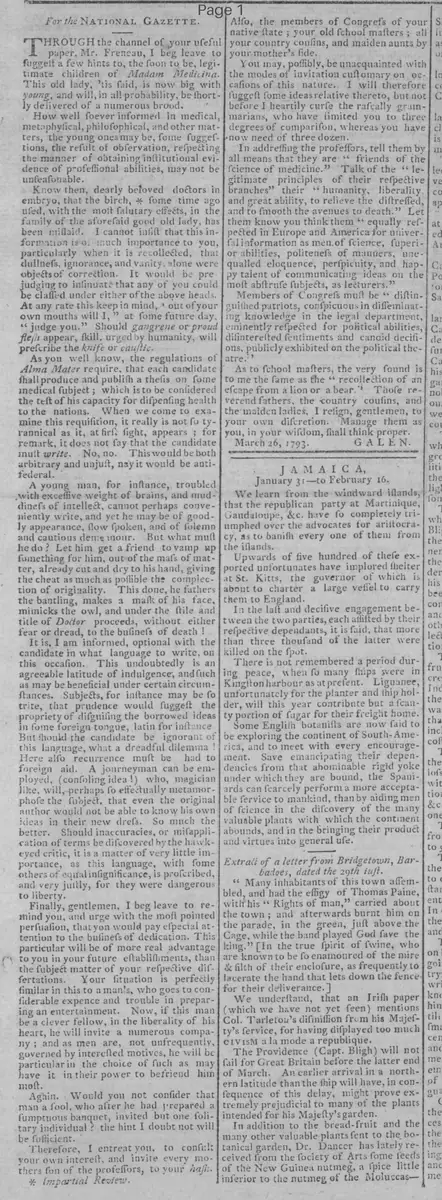
For the NATIONAL GAZETTE.
THROUGH the channel of your useful paper, Mr. Freneau, I beg leave to suggest a few hints to the soon to be legitimate children of Madam Medicina.
This old lady, 'tis said, is now big with young, and will, in all probability, be shortly delivered of a numerous brood.
How well soever informed in medical, metaphysical, philosophical, and other matters, the young ones may be, some suggestions, the result of observation, respecting the manner of obtaining institutional evidence of professional abilities, may not be unseasonable.
Know then, dearly beloved doctors in embryo, that the birch, some time ago used, with the most salutary effects, in the family of the aforesaid good old lady, has been mislaid. I cannot insist that this information is of much importance to you, particularly when it is recollected, that dullness, ignorance, and vanity, alone were objects of correction. It would be presuming to insinuate that any of you could be classed under either of the above heads.
At any rate this keep in mind, out of your own mouths will I, "at some future day, judge you." Should gangrene or proud flesh appear, skill, urged by humanity, will prescribe the knife or caustic.
As you well know, the regulations of Alma Mater require, that each candidate shall produce and publish a thesis on some medical subject; which is to be considered the test of his capacity for dispensing health to the nations. When we come to examine this requisition, it really is not so tyrannical as it, at first sight, appears; for remark, it does not say that the candidate must write. No, no. This would be both arbitrary and unjust, nay it would be anti-federal.
A young man, for instance, troubled with excessive weight of brains, and muddiness of intellect, cannot perhaps conveniently write, and yet he may be of goodly appearance, slow spoken, and of solemn and cautious demeanor. But what must he do? Let him get a friend to vamp up something for him, out of the mass of matter, already cut and dry to his hand, giving the cheat as much as possible the complexion of originality. This done, he fathers the bantling, makes a mask of his face, mimics the owl, and under the style and title of Doctor proceeds, without either fear or dread, to the business of death!
It is, I am informed, optional with the candidate in what language to write, on this occasion. This undoubtedly is an agreeable latitude of indulgence, and such as may be beneficial under certain circumstances. Subjects, for instance may be so trite, that prudence would suggest the propriety of disguising the borrowed ideas in some foreign tongue, Latin for instance. But should the candidate be ignorant of this language, what a dreadful dilemma! Here also recurrence must be had to foreign aid. A journeyman can be employed, (consoling idea!) who, magician like, will, perhaps so effectually metamorphose the subject, that even the original author would not be able to know his own ideas in their new dress. So much the better. Should inaccuracies, or misapplication of terms be discovered by the hawk-eyed critic, it is a matter of very little importance, as this language, with some others of equal insignificance, is proscribed, and very justly, for they were dangerous to liberty.
Finally, gentlemen, I beg leave to remind you, and urge with the most pointed persuasion, that you would pay especial attention to the business of dedication. This particular will be of more real advantage to you in your future establishments, than the subject matter of your respective dissertations. Your situation is perfectly similar in this to a man's, who goes to considerable expense and trouble in preparing an entertainment. Now, if this man be a clever fellow, in the liberality of his heart, he will invite a numerous company; and as men are, not unfrequently, governed by interested motives, he will be particular in the choice of such as may have it in their power to befriend him most.
Again. Would you not consider that man a fool, who after he had prepared a sumptuous banquet, invited but one solitary individual? the hint I doubt not will be sufficient.
Therefore, I entreat you, to consult your own interest, and invite every mother's son of the professors, to your hash.
Also, the members of Congress of your native state; your old school masters; all your country cousins, and maiden aunts by your mother's side.
You may, possibly, be unacquainted with the modes of invitation customary on occasions of this nature. I will therefore suggest some ideas relative thereto, but not before I heartily curse the rascally grammarians, who have limited you to three degrees of comparison, whereas you have now need of three dozen.
In addressing the professors, tell them by all means that they are "friends of the science of medicine." Talk of the "legitimate principles of their respective branches" their "humanity, liberality and great ability, to relieve the distressed, and to smooth the avenues to death." Let them know you think them "equally respected in Europe and America for universal information as men of science, superior abilities, politeness of manners, unequalled eloquence, perspicuity, and happy talent of communicating ideas on the most abstruse subjects, as lecturers."
Members of Congress must be "distinguished patriots, conspicuous in disseminating knowledge in the legal department, eminently respected for political abilities, disinterested sentiments and candid decisions, publicly exhibited on the political theatre."
As to school masters, the very sound is to me the same as the "recollection of an escape from a lion or a bear." Those reverend fathers, the country cousins, and the maiden ladies, I resign, gentlemen, to your own discretion. Manage them as you, in your wisdom, shall think proper.
March 26, 1793.
GALEN.
Impartial Review.
THROUGH the channel of your useful paper, Mr. Freneau, I beg leave to suggest a few hints to the soon to be legitimate children of Madam Medicina.
This old lady, 'tis said, is now big with young, and will, in all probability, be shortly delivered of a numerous brood.
How well soever informed in medical, metaphysical, philosophical, and other matters, the young ones may be, some suggestions, the result of observation, respecting the manner of obtaining institutional evidence of professional abilities, may not be unseasonable.
Know then, dearly beloved doctors in embryo, that the birch, some time ago used, with the most salutary effects, in the family of the aforesaid good old lady, has been mislaid. I cannot insist that this information is of much importance to you, particularly when it is recollected, that dullness, ignorance, and vanity, alone were objects of correction. It would be presuming to insinuate that any of you could be classed under either of the above heads.
At any rate this keep in mind, out of your own mouths will I, "at some future day, judge you." Should gangrene or proud flesh appear, skill, urged by humanity, will prescribe the knife or caustic.
As you well know, the regulations of Alma Mater require, that each candidate shall produce and publish a thesis on some medical subject; which is to be considered the test of his capacity for dispensing health to the nations. When we come to examine this requisition, it really is not so tyrannical as it, at first sight, appears; for remark, it does not say that the candidate must write. No, no. This would be both arbitrary and unjust, nay it would be anti-federal.
A young man, for instance, troubled with excessive weight of brains, and muddiness of intellect, cannot perhaps conveniently write, and yet he may be of goodly appearance, slow spoken, and of solemn and cautious demeanor. But what must he do? Let him get a friend to vamp up something for him, out of the mass of matter, already cut and dry to his hand, giving the cheat as much as possible the complexion of originality. This done, he fathers the bantling, makes a mask of his face, mimics the owl, and under the style and title of Doctor proceeds, without either fear or dread, to the business of death!
It is, I am informed, optional with the candidate in what language to write, on this occasion. This undoubtedly is an agreeable latitude of indulgence, and such as may be beneficial under certain circumstances. Subjects, for instance may be so trite, that prudence would suggest the propriety of disguising the borrowed ideas in some foreign tongue, Latin for instance. But should the candidate be ignorant of this language, what a dreadful dilemma! Here also recurrence must be had to foreign aid. A journeyman can be employed, (consoling idea!) who, magician like, will, perhaps so effectually metamorphose the subject, that even the original author would not be able to know his own ideas in their new dress. So much the better. Should inaccuracies, or misapplication of terms be discovered by the hawk-eyed critic, it is a matter of very little importance, as this language, with some others of equal insignificance, is proscribed, and very justly, for they were dangerous to liberty.
Finally, gentlemen, I beg leave to remind you, and urge with the most pointed persuasion, that you would pay especial attention to the business of dedication. This particular will be of more real advantage to you in your future establishments, than the subject matter of your respective dissertations. Your situation is perfectly similar in this to a man's, who goes to considerable expense and trouble in preparing an entertainment. Now, if this man be a clever fellow, in the liberality of his heart, he will invite a numerous company; and as men are, not unfrequently, governed by interested motives, he will be particular in the choice of such as may have it in their power to befriend him most.
Again. Would you not consider that man a fool, who after he had prepared a sumptuous banquet, invited but one solitary individual? the hint I doubt not will be sufficient.
Therefore, I entreat you, to consult your own interest, and invite every mother's son of the professors, to your hash.
Also, the members of Congress of your native state; your old school masters; all your country cousins, and maiden aunts by your mother's side.
You may, possibly, be unacquainted with the modes of invitation customary on occasions of this nature. I will therefore suggest some ideas relative thereto, but not before I heartily curse the rascally grammarians, who have limited you to three degrees of comparison, whereas you have now need of three dozen.
In addressing the professors, tell them by all means that they are "friends of the science of medicine." Talk of the "legitimate principles of their respective branches" their "humanity, liberality and great ability, to relieve the distressed, and to smooth the avenues to death." Let them know you think them "equally respected in Europe and America for universal information as men of science, superior abilities, politeness of manners, unequalled eloquence, perspicuity, and happy talent of communicating ideas on the most abstruse subjects, as lecturers."
Members of Congress must be "distinguished patriots, conspicuous in disseminating knowledge in the legal department, eminently respected for political abilities, disinterested sentiments and candid decisions, publicly exhibited on the political theatre."
As to school masters, the very sound is to me the same as the "recollection of an escape from a lion or a bear." Those reverend fathers, the country cousins, and the maiden ladies, I resign, gentlemen, to your own discretion. Manage them as you, in your wisdom, shall think proper.
March 26, 1793.
GALEN.
Impartial Review.
What sub-type of article is it?
Satirical
Comedic
Persuasive
What themes does it cover?
Education
Health Medicine
What keywords are associated?
Medical Education
Thesis Plagiarism
Dedication Flattery
Satirical Advice
Doctors In Embryo
Alma Mater
What entities or persons were involved?
Galen
Mr. Freneau
Letter to Editor Details
Author
Galen
Recipient
Mr. Freneau
Main Argument
aspiring doctors should cheat on theses by having friends write them and disguise plagiarism in foreign languages, and flatter professors, congressmen, and relatives in dedications to advance their careers.
Notable Details
References To Birch For Punishment
Alma Mater Regulations
Anti Federal Writing Requirement
Use Of Latin To Hide Borrowing
Dedication As Key To Success
Exaggerated Flattery Examples