Thank you for visiting SNEWPapers!
Sign up free
Story
June 11, 1899
Pine Bluff Daily Graphic
Pine Bluff, Jefferson County, Arkansas
What is this article about?
N. P. Melnikoff, editor of Russian journal Technologue, creates a model engine powered by bacterial fermentation of glucose, producing alcohol and CO2 gas for pressure; scalable for 20-30 hours of operation.
Clipping
OCR Quality
98%
Excellent
Full Text
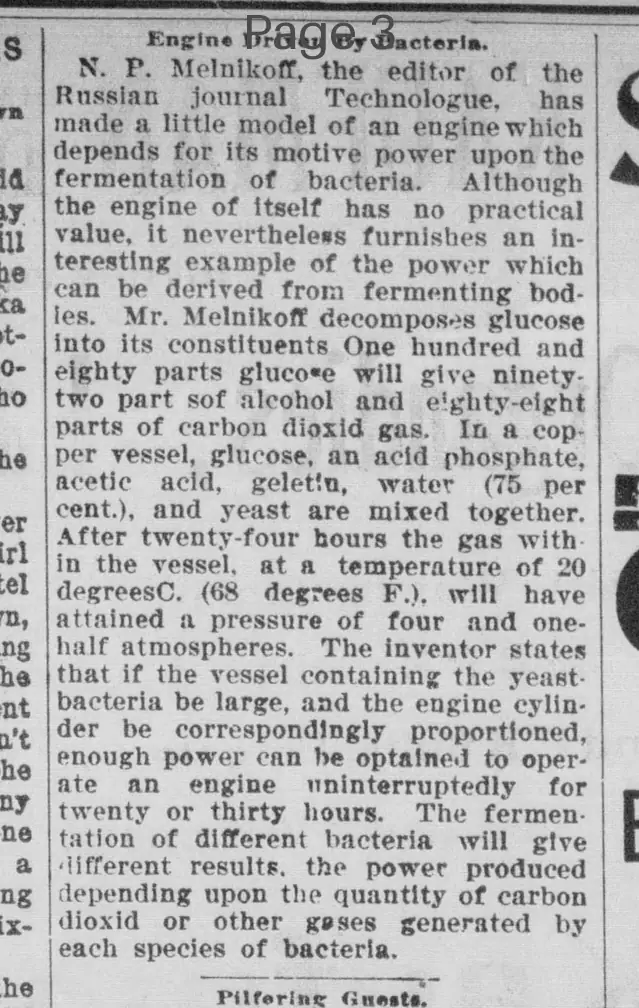
N. P. Melnikoff, the editor of the Russian journal Technologue, has made a little model of an engine which depends for its motive power upon the fermentation of bacteria. Although the engine of itself has no practical value, it nevertheless furnishes an interesting example of the power which can be derived from fermenting bodies.
Mr. Melnikoff decomposes glucose into its constituents. One hundred and eighty parts glucose will give ninety-two parts of alcohol and eighty-eight parts of carbon dioxid gas. In a copper vessel, glucose, an acid phosphate, acetic acid, gelatine, water (75 per cent.), and yeast are mixed together. After twenty-four hours the gas within the vessel, at a temperature of 20 degrees C. (68 degrees F.), will have attained a pressure of four and one-half atmospheres.
The inventor states that if the vessel containing the yeast bacteria be large, and the engine cylinder be correspondingly proportioned, enough power can be obtained to operate an engine uninterruptedly for twenty or thirty hours. The fermentation of different bacteria will give different results, the power produced depending upon the quantity of carbon dioxid or other gases generated by each species of bacteria.
Mr. Melnikoff decomposes glucose into its constituents. One hundred and eighty parts glucose will give ninety-two parts of alcohol and eighty-eight parts of carbon dioxid gas. In a copper vessel, glucose, an acid phosphate, acetic acid, gelatine, water (75 per cent.), and yeast are mixed together. After twenty-four hours the gas within the vessel, at a temperature of 20 degrees C. (68 degrees F.), will have attained a pressure of four and one-half atmospheres.
The inventor states that if the vessel containing the yeast bacteria be large, and the engine cylinder be correspondingly proportioned, enough power can be obtained to operate an engine uninterruptedly for twenty or thirty hours. The fermentation of different bacteria will give different results, the power produced depending upon the quantity of carbon dioxid or other gases generated by each species of bacteria.
What sub-type of article is it?
Curiosity
Extraordinary Event
What themes does it cover?
Exploration
Triumph
What keywords are associated?
Bacterial Fermentation
Model Engine
Glucose Decomposition
Carbon Dioxide Gas
Yeast Bacteria
What entities or persons were involved?
N. P. Melnikoff
Story Details
Key Persons
N. P. Melnikoff
Story Details
N. P. Melnikoff builds a model engine powered by gas from bacterial fermentation of glucose, demonstrating potential for sustained operation.