Thank you for visiting SNEWPapers!
Sign up free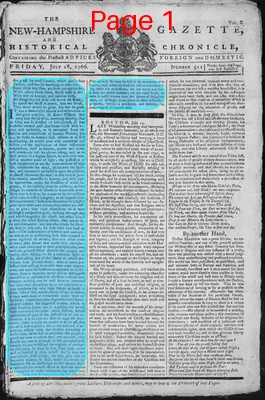
Editorial
July 18, 1766
The New Hampshire Gazette And Historical Chronicle
Portsmouth, Greenland, Rockingham County, New Hampshire
What is this article about?
An editorial poem and prose reflection on the corrupting influence of power, quoting Sir Robert Walpole's maxim that 'every man has his price.' It warns of human frailty, bribery's temptations, and praises those who resist corruption while condemning those who succumb.
Clipping
OCR Quality
95%
Excellent
Full Text
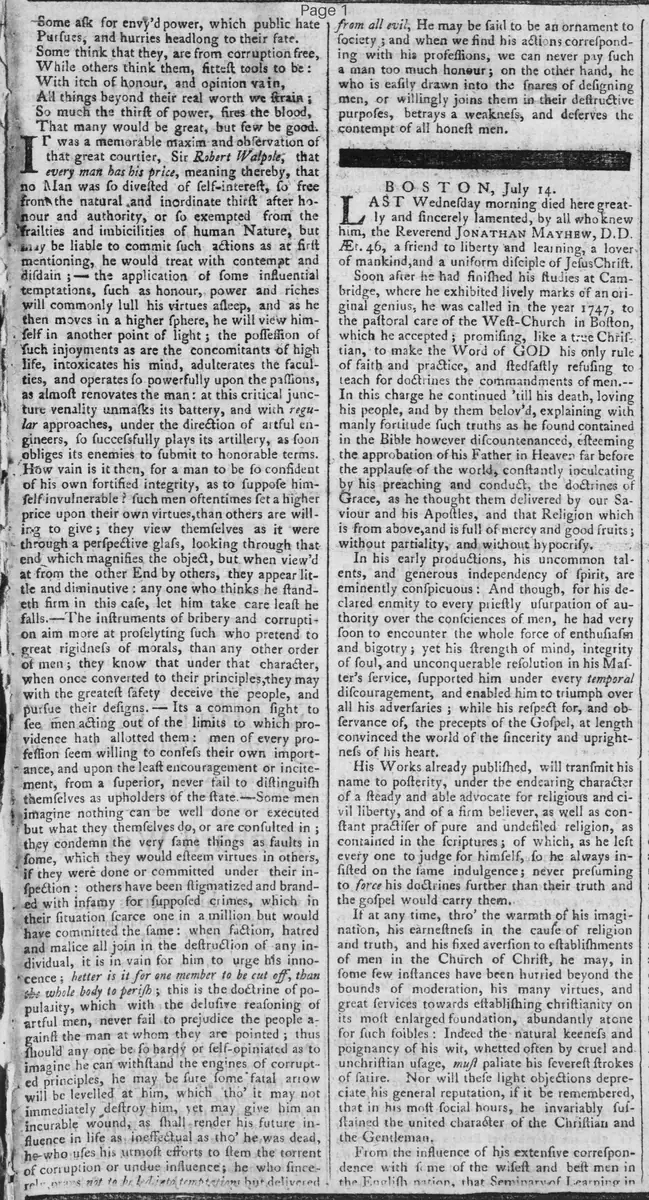
Some ask for envied power, which public hate
Pursues and hurries headlong to their fate.
Some think that they are from corruption free,
While others think them fittest tools to be
With itch of honour and opinion vain,
All things beyond their real worth we strain;
So much the thirst of power fires the blood,
That many would be great, but few be good.
It was a memorable maxim and observation of
that great courtier, Sir Robert Walpole, that
every man has his price, meaning thereby that
no man was so divested of self-interest, so free
from the natural and inordinate thirst after honour
and authority, or so exempted from the
frailties and imbecilities of human nature, but
must be liable to commit such actions as at first
view mentioning, he would treat with contempt and
disdain; the application of some influential
temptations, such as honour, power and riches
will commonly lull his virtues asleep, and as he
then moves in a higher sphere, he will view himself
in another point of light; the possession of
such enjoyments as are the concomitants of high
life, intoxicates his mind, adulterates the faculties,
and operates so powerfully upon the passions,
as almost renovates the man: at this critical juncture
venality unmasks its battery, and with regular
approaches, under the direction of artful engineers,
so successfully plays its artillery, as soon
obliges its enemies to submit to honorable terms.
How vain is it then, for a man to be so confident
of his own fortified integrity, as to suppose himself
invulnerable? Such men oftentimes set a higher
price upon their own virtues, than others are willing
to give; they view themselves as it were
through a perspective glass, looking through that
end which magnifies the object, but when viewed
at from the other end by others, they appear little
and diminutive: any one who thinks he standeth
firm in this case, let him take care lest he
falls. -- The instruments of bribery and corruption
aim more at proselyting such who pretend to
great rigidness of morals, than any other order
of men; they know that under that character,
when once converted to their principles, they may
with the greatest safety deceive the people, and
pursue their designs. -- It's a common sight to
see men acting out of the limits to which providence
hath allotted them: men of every profession seem
willing to confess their own importance, and upon
the least encouragement or incitement,
from a superior, never fail to distinguish
themselves as upholders of the state. -- Some men
imagine nothing can be well done or executed
but what they themselves do, or are consulted in;
they condemn the very same things as faults in
some, which they would esteem virtues in others,
if they were done or committed under their inspection:
others have been stigmatized and branded
with infamy for supposed crimes, which in
their situation scarce one in a million but would
have committed the same: when faction, hatred
and malice all join in the destruction of any individual,
it is in vain for him to urge his innocence;
better is it for one member to be cut off, than
the whole body to perish; this is the doctrine of populace,
which with the delusive reasoning of
artful men, never fail to prejudice the people against
the man at whom they are pointed; thus
should any one be so hardy or self-opiniated as to
imagine he can withstand the engines of corrupted
principles, he may be sure some fatal arrow
will be levelled at him, which tho' it may not
immediately destroy him, yet may give him an
incurable wound, as shall render his future influence
in life as ineffectual as tho' he was dead,
he who uses his utmost efforts to stem the torrent
of corruption or undue influence; he who sincerely
prays not to be beset by temptations but delivered
from all evil, he may be said to be an ornament to
society; and when we find his actions corresponding
with his professions, we can never pay such
a man too much honour; on the other hand, he
who is easily drawn into the snares of designing
men, or willingly joins them in their destructive
purposes, betrays a weakness, and deserves the
contempt of all honest men.
Pursues and hurries headlong to their fate.
Some think that they are from corruption free,
While others think them fittest tools to be
With itch of honour and opinion vain,
All things beyond their real worth we strain;
So much the thirst of power fires the blood,
That many would be great, but few be good.
It was a memorable maxim and observation of
that great courtier, Sir Robert Walpole, that
every man has his price, meaning thereby that
no man was so divested of self-interest, so free
from the natural and inordinate thirst after honour
and authority, or so exempted from the
frailties and imbecilities of human nature, but
must be liable to commit such actions as at first
view mentioning, he would treat with contempt and
disdain; the application of some influential
temptations, such as honour, power and riches
will commonly lull his virtues asleep, and as he
then moves in a higher sphere, he will view himself
in another point of light; the possession of
such enjoyments as are the concomitants of high
life, intoxicates his mind, adulterates the faculties,
and operates so powerfully upon the passions,
as almost renovates the man: at this critical juncture
venality unmasks its battery, and with regular
approaches, under the direction of artful engineers,
so successfully plays its artillery, as soon
obliges its enemies to submit to honorable terms.
How vain is it then, for a man to be so confident
of his own fortified integrity, as to suppose himself
invulnerable? Such men oftentimes set a higher
price upon their own virtues, than others are willing
to give; they view themselves as it were
through a perspective glass, looking through that
end which magnifies the object, but when viewed
at from the other end by others, they appear little
and diminutive: any one who thinks he standeth
firm in this case, let him take care lest he
falls. -- The instruments of bribery and corruption
aim more at proselyting such who pretend to
great rigidness of morals, than any other order
of men; they know that under that character,
when once converted to their principles, they may
with the greatest safety deceive the people, and
pursue their designs. -- It's a common sight to
see men acting out of the limits to which providence
hath allotted them: men of every profession seem
willing to confess their own importance, and upon
the least encouragement or incitement,
from a superior, never fail to distinguish
themselves as upholders of the state. -- Some men
imagine nothing can be well done or executed
but what they themselves do, or are consulted in;
they condemn the very same things as faults in
some, which they would esteem virtues in others,
if they were done or committed under their inspection:
others have been stigmatized and branded
with infamy for supposed crimes, which in
their situation scarce one in a million but would
have committed the same: when faction, hatred
and malice all join in the destruction of any individual,
it is in vain for him to urge his innocence;
better is it for one member to be cut off, than
the whole body to perish; this is the doctrine of populace,
which with the delusive reasoning of
artful men, never fail to prejudice the people against
the man at whom they are pointed; thus
should any one be so hardy or self-opiniated as to
imagine he can withstand the engines of corrupted
principles, he may be sure some fatal arrow
will be levelled at him, which tho' it may not
immediately destroy him, yet may give him an
incurable wound, as shall render his future influence
in life as ineffectual as tho' he was dead,
he who uses his utmost efforts to stem the torrent
of corruption or undue influence; he who sincerely
prays not to be beset by temptations but delivered
from all evil, he may be said to be an ornament to
society; and when we find his actions corresponding
with his professions, we can never pay such
a man too much honour; on the other hand, he
who is easily drawn into the snares of designing
men, or willingly joins them in their destructive
purposes, betrays a weakness, and deserves the
contempt of all honest men.
What sub-type of article is it?
Moral Or Religious
Partisan Politics
What keywords are associated?
Corruption
Power Thirst
Bribery
Integrity
Human Frailty
Walpole Maxim
What entities or persons were involved?
Sir Robert Walpole
Editorial Details
Primary Topic
Corruption And The Thirst For Power
Stance / Tone
Warning Against Corruption And Praise For Integrity
Key Figures
Sir Robert Walpole
Key Arguments
Every Man Has His Price
Thirst For Power Corrupts Virtues
Overconfidence In Integrity Leads To Falls
Bribery Targets The Morally Rigid
Faction And Malice Destroy The Innocent
Resisting Corruption Ornaments Society