Thank you for visiting SNEWPapers!
Sign up free
The Virginia Gazette
Richmond, Williamsburg, Richmond County, Virginia
What is this article about?
A satirical letter from an Oxonian to a Reverend at Oxford humorously describes London's vast size, constant noise from coaches and street vendors, indulgent eating and drinking, fleeting marriages, extravagant dress, coquettish women, theater preferences, and nuisances like attorneys and quacks, contrasting it with Oxford's simplicity.
Merged-components note: Continuation of the humorous description of London manners and fashions across page 1 and 2.
Clippings
1 of 2
OCR Quality
Full Text
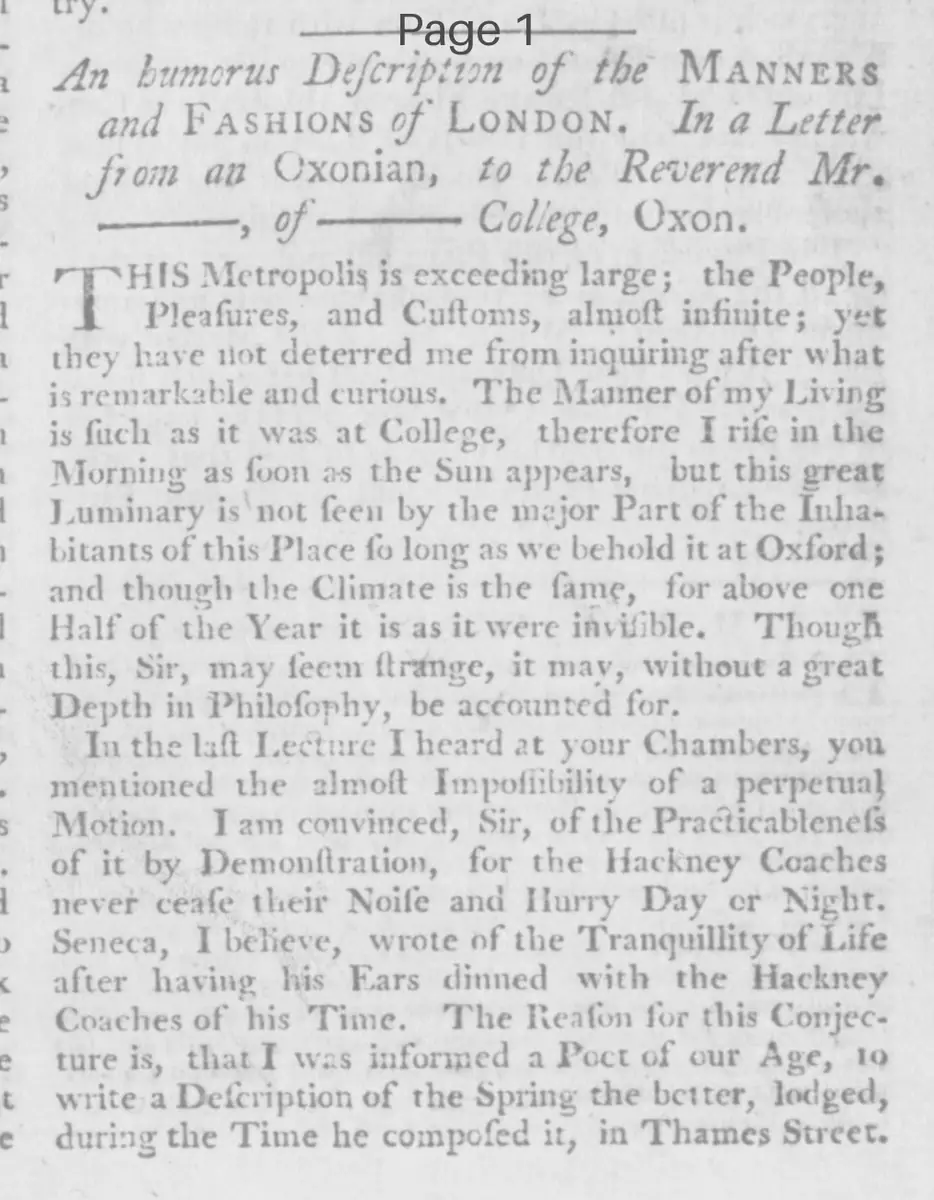
His Metropolis is exceeding large; the People, Pleasures, and Customs, almost infinite; yet they have not deterred me from inquiring after what is remarkable and curious. The Manner of my Living is such as it was at College, therefore I rise in the Morning as soon as the Sun appears, but this great Luminary is not seen by the major Part of the Inhabitants of this Place so long as we behold it at Oxford; and though the Climate is the same, for above one Half of the Year it is as it were invisible. Though this, Sir, may seem strange, it may, without a great Depth in Philosophy, be accounted for.
In the last Lecture I heard at your Chambers, you mentioned the almost Impossibility of a perpetual Motion. I am convinced, Sir, of the Practicableness of it by Demonstration, for the Hackney Coaches never cease their Noise and Hurry Day or Night. Seneca, I believe, wrote of the Tranquillity of Life after having his Ears dinned with the Hackney Coaches of his Time. The Reason for this Conjecture is, that I was informed a Poet of our Age, to write a Description of the Spring the better, lodged, during the Time he composed it, in Thames Street.
The hideous Cries of People who walk the Streets to vend Herbs, Milk, Fruit, old Clothes, Sand, Brick Dust, News, Ghosts, and bloody Murders, increase their Noise in such a horrid Manner that they seem so many Furies in the Regions of Pluto.
As for the People in general, they are not unlike those of the City of Oxford in most Respects, for eating and drinking well is what pleases them; and if their Industry can support their Belly, and a few fine Clothes, they think themselves happy. They seem no great Admirers of Antiquity, but are more delighted with Novelty; for they seek chiefly new Books, new Mistresses, new Ministers, and new Friends.
The Women are very fine and handsome. They who have Cunning or Beauty have a Command over the Men; Husbands here are treated as their Servants, Gallants as their Slaves. I have observed, by the Number of Nurses, it is not the Fashion for Mothers to suckle their own Children: nor is it the Fashion to keep up a female Virtue, called Housewifery; there are few Penelopes who weave; and Needle Work, with an unanimous Consent, has been voted pernicious to the Eyes.
Marriages, which I always thought were for Life, among the politer People, are, after a certain Time, dissolved. My Lord and My Lady, after the first Month, are never seen together, never eat together, and, I had almost said, never lie together. The Husband lives quietly at one End of the House, the Wife makes merry at the other; and when they have been married a few Years, they endeavour to separate as soon as possible.
Dress seems a favourite Passion here, in both Sexes. Every One is for appearing gay; and, considering the Deference which in this City is paid to Clothes, this Foible is not unpardonable. A laced Coat, Waistcoat, or Trimmings, are so common, that they are indifferently wore by the Master and the Servant; nor is it easy to distinguish the Chambermaid from the Mistress. Here are two particular Classes of People who are not much different in their Principles, though of contrary Sexes, which are worthy of Notice: The Men are called Beaus, the Women are Coquets; they are singular from the rest of the World in their Dress, their Customs, and Manners: their whole Study, Ambition, and Business of Life, is to be admired by all; their Pleasure, to admire none but themselves; they are Idolaters, and all the Devotion they pay is to a Phantom in a Glass, which they omit not to admire and adore every Morning, for some Hours together.
There are several Theatres here, where almost every Evening People of all Ranks assemble; from whence you may judge of the Prosperity and Riches, or of the Decline and Poverty, of this great Metropolis, as your Reason suggests. But if it is true what an Ancient said, "That excessive Expense is a certain Sign of a City being in Decay." One would not think London in a very flourishing State. Whenever Cato, or any noble Greek or Roman, appears on the Stage, the Audience is thin: but a little French Gentleman in a party-coloured Jacket, whom they called Monsieur Harlequin, is a great Favourite, and prodigiously followed.
The Attornies, the Quacks, the Gameters, and the Footmen, are very numerous. The Inhabitants complain of them as a common Nuisance, but I think them a very ornamental and instructive Set of People. The first teach us to avoid Wrangling and the Law, lest by our Folly we lose our Estates; the second show us the Way to Chastity and Sobriety, that we may not fall into their Hands and be killed with their Medicines; the Gameters are an Example to us of the Instability of Fortune; and the Footmen inculcate Humility, and teach us to serve ourselves, that we may not have Enemies in our own Houses. The Lawyers here are surprising Logicians, and Westminster Hall has stranger Paradoxes maintained in it than the Schools at Oxford; for in this they prove right wrong, and wrong right. This Hall is said to be the largest Room in England; and yet it is filled in Term Time with those who defend their own Estate, or endeavour to get another's.
I should be glad to see the Floor of this Hall, as Cato would have had the Courts of Law in his Time, stuck full with Tenter Hooks, to tear the Feet of those who first entered to begin a Lawsuit.
The Physicians of this Place kill and cure, as they do all the World over; they ask too the same impertinent Questions: What, Sir, is the Matter with you? What's your Distemper? That which seems the greatest Injustice is, that One pays the same Fee to the Physician who kills him as to him that cures, and no Judge has Power to punish an ignorant Physician.
What sub-type of article is it?
What themes does it cover?
What keywords are associated?
What entities or persons were involved?
Literary Details
Title
An Humorous Description Of The Manners And Fashions Of London
Author
An Oxonian
Subject
In A Letter From An Oxonian, To The Reverend Mr. , Of College, Oxon.
Form / Style
Satirical Prose Letter
Key Lines