Thank you for visiting SNEWPapers!
Sign up free
The New York Packet
New York, New York County, New York
What is this article about?
A May 1, 1787, letter from Nashville complains of Spanish claims to exclusive Mississippi navigation and western territory east of the Appalachians and south of a line from Kanawha to Lake Michigan, asserting US rights via 1763 and 1783 treaties despite Spain's forcible control.
Clipping
OCR Quality
Full Text
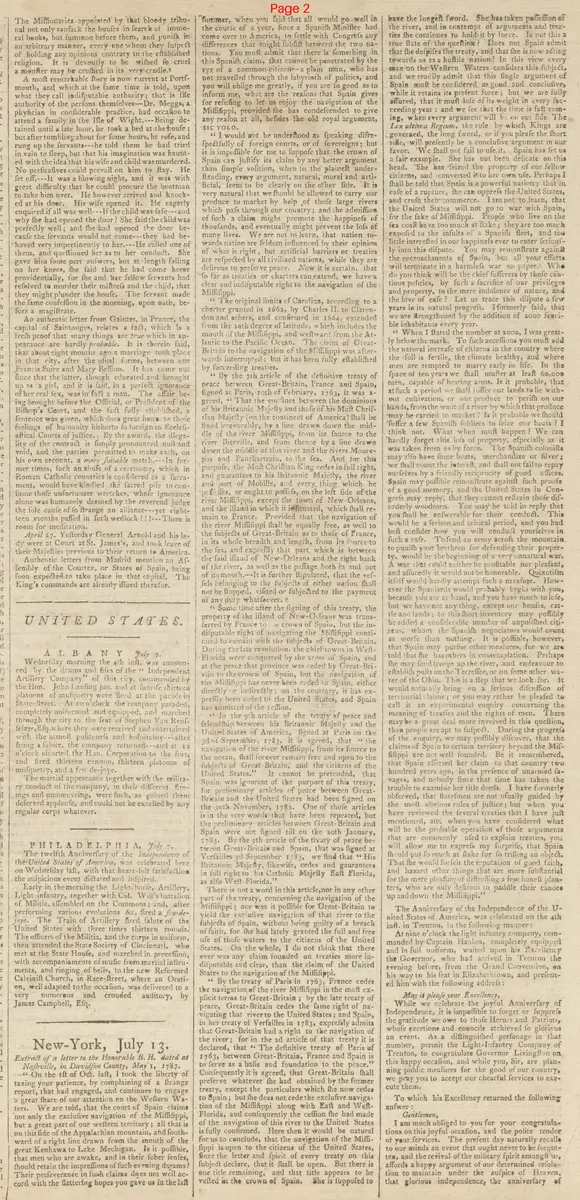
Extract of a letter to the Honorable B. H. dated at Nashville, in Davidson County, May 1, 1787.
"On the 1st of Oct. last, I took the liberty of taxing your patience, by complaining of a strange report, that had engaged, and continues to engage a great share of our attention on the Western Waters. We are told, that the court of Spain claims not only the exclusive navigation of the Mississippi, but a great part of our western territory; all that is on this side of the Appalachian mountain, and southward of a right line drawn from the mouth of the great Kanawha to Lake Michigan. Is it possible, that men who are awake, and in their sober senses, should retain the impressions of such evening dreams? Their perseverance in such claims does not well accord with the flattering hopes you gave us in the last summer, when you said that all would go well in the course of a year, since a Spanish Minister had come over to America, to settle with Congress any differences that might subsist between the two nations. You must admit that there is something in this Spanish claim, that cannot be penetrated by the eye of a common citizen—a plain man, who has not travelled through the labyrinth of politics, and you will oblige me greatly, if you are so good as to inform me, what are the reasons that Spain gives for refusing to let us enjoy the navigation of the Mississippi, provided she has condescended to give any reason at all, besides the old royal argument, SIC VOLO.
"I would not be understood as speaking disrespectfully of foreign courts, or of sovereigns; but it is impossible for me to suppose that the crown of Spain can justify its claim by any better argument than simple volition, when to the plainest understanding, every argument, natural, moral and artificial, seem to be clearly on the other side. It is very natural that we should be allowed to carry our produce to market by help of those large rivers which pass through our country; and the admission of such a claim might promote the happiness of thousands, and eventually might prevent the loss of many lives. We are not to learn, that nation towards nation are seldom influenced by their opinion of what is right, but artificial barriers or treaties are respected by all civilized nations, while they are desirous to preserve peace. Now it is certain, that so far as treaties or charters can extend, we have a clear and indisputable right to the navigation of the Mississippi.
"The original limits of Carolina, according to a charter granted in 1662, by Charles II. to Clarendon and others, and confirmed in 1664, extended from the 30th degree of latitude, which includes the mouth of the Mississippi, and westward from the Atlantic to the Pacific Ocean. The claim of Great-Britain to the navigation of the Mississippi was afterwards interrupted; but it has been fully established by succeeding treaties.
"By the 7th article of the definitive treaty of peace between Great-Britain, France and Spain, signed at Paris, 10th of February, 1763, it was agreed, "That the confines between the dominions of his Britannic Majesty and those of his Most Christian Majesty (on the continent of America) shall be fixed irrevocably, by a line drawn down the middle of the river Mississippi, from its source to the river Iberville, and from thence by a line drawn down the middle of the river and the lakes Maurepas and Pontchartrain, to the sea. And for this purpose, the Most Christian King cedes in full right, and guarantees to his Britannic Majesty, the river and port of Mobile, and everything which he possesses, or ought to possess, on the left side of the river Mississippi, except the town of New-Orleans, and the island in which it is situated, which shall remain to France. Provided that the navigation of the river Mississippi shall be equally free, as well to the subjects of Great-Britain as to those of France, in its whole breadth and length, from its source to the sea, and expressly that part which is between the said island of New-Orleans and the right bank of the river, as well as the passage both in and out of its mouth.—It is further stipulated, that the vessels belonging to the subjects of either nation shall not be stopped, visited or subjected to the payment of any duty whatsoever."
Some time after the signing of this treaty, the property of the island of New-Orleans was transferred by France to the crown of Spain, but the indisputable right of navigating the Mississippi continued to remain with the subjects of Great-Britain.
During the late revolution, the chief towns in West-Florida were conquered by the arms of Spain, and at the peace that province was ceded by Great-Britain to the crown of Spain, but the navigation of the Mississippi has never been ceded to Spain, either directly or indirectly; on the contrary, it has expressly been ceded to the United States, and Spain has admitted of the cession.
In the 8th article of the treaty of peace and friendship between his Britannic Majesty and the United States of America, signed at Paris on the 3d of September, 1783, it is agreed, that "the navigation of the river Mississippi, from its source to the ocean, shall forever remain free and open to the subjects of Great-Britain, and the citizens of the United States." It cannot be pretended, that Spain was ignorant of the purport of this treaty, for preliminary articles of peace between Great-Britain and the United States had been signed on the 30th November, 1782. One of those articles is in the very words that have been repeated, but the preliminary articles between Great-Britain and Spain were not signed till on the 20th January, 1783. By the 5th article of the treaty of peace between Great-Britain and Spain, that was signed at Versailles 3d September 1783, we find that "His Britannic Majesty, likewise, cedes and guarantees in full right to his Catholic Majesty East Florida, as also West-Florida."
There is not a word in this article, nor in any other part of the treaty, concerning the navigation of the Mississippi; nor was it possible for Great-Britain to yield the exclusive navigation of that river to the subjects of Spain, without being guilty of a breach of faith, for she had lately granted the full and free use of those waters to the citizens of the United States. On the whole, I do not think that there ever was any claim founded on treaties more indisputable and clear, than the claim of the United States to the navigation of the Mississippi.
"By the treaty of Paris in 1763, France cedes the navigation of the river Mississippi in the most explicit terms to Great-Britain; by the late treaty of peace, Great-Britain cedes the same right of navigating that river to the United States; and Spain, in her treaty of Versailles in 1783, expressly admits that Great-Britain had a right to the navigation of the river; for in the 2d article of that treaty it is declared, that "The definitive treaty of Paris of 1763, between Great-Britain, France and Spain is to serve as a basis and foundation to the peace." Consequently it is agreed, that Great-Britain shall preserve whatever she had obtained by the former treaty, except the particulars which she now cedes to Spain; but she does not cede the exclusive navigation of the Mississippi along with East and West-Florida, and consequently the cession she had made of the navigation of this river to the United States is fully confirmed. Here then it would be natural for us to conclude, that the navigation of the Mississippi is open to the citizens of the United States, since the letter and spirit of every treaty on this subject declare, that it shall be open. But there is one title remaining, and that title appears to be vested in the crown of Spain. She is supposed to have the longest sword. She has taken possession of the river, and in contempt of arguments and treaties she continues to hold it by force. Is not this a true state of the question? Does not Spain admit that she despises the treaty, and that she is now acting towards us as a hostile nation? In this view every man on the Western Waters considers this subject, and we readily admit that this single argument of Spain must be considered as good and conclusive, while it retains its present force; but we are fully assured, that it must lose of its weight in every succeeding year: and we see that the time is fast coming, when every argument will be on our side. The Lex ultima Regum, the rule by which Kings are governed, the long sword, or if you please the short rifle, will presently be a conclusive argument in our favor. We shall not fail to use it. Spain has set us a fair example. She has not been delicate on this head. She has seized the property of our fellow citizens, and converted it to her own use. Perhaps, I shall be told that Spain is a powerful nation; that in case of a rupture, she can oppress the United States, and crush their commerce. I am not to learn, that the United States will not go to war with Spain, for the sake of Mississippi. People who live on the sea coast have too much at stake; they are too much exposed to the insults of a Spanish fleet, and too little interested in our happiness ever to enter seriously into this dispute. You may remonstrate against the encroachments of Spain, but all your efforts will terminate in a harmless war on paper. Who do you think will be the chief sufferers by those cautious politics, by such a sacrifice of our privileges and property, to the mere indolence of nature, and the love of ease? Let us trace this dispute a few years in its natural progress. I formerly said, that we are strengthened by the addition of 2000 fenceable inhabitants every year.
"When I stated the number at 2000, I was greatly below the mark. To such accessions you must add the natural increase of citizens in the country where the soil is fertile, the climate healthy, and where men are tempted to marry early in life. In the space of ten years we shall muster at least 60,000 men, capable of bearing arms. Is it probable, that at such a period we shall suffer our lands to lie without cultivation, or our produce to perish on our hands, from the want of a river by which that produce may be carried to market? Is it probable we should suffer a few Spanish soldiers to seize our boats? I think not. What then must happen? We can hardly forget this loss of property, especially as it was taken from us by force. The Spanish colonists may also have some boats, merchandize or silver; we shall count the interest, and shall not fail to repay ourselves by a friendly reciprocity of good offices. Spain may possibly remonstrate against such proofs of a good memory, and the United States in Congress may reply, that they cannot restrain those disorderly woodmen. You may be told in reply that you shall be answerable for their conduct. This would be a serious and critical period, and you had better consider how you will conduct yourselves in such a case. To send an army across the mountain to punish your brethren for defending their property, would be the beginning of a very unnatural war. A war that could neither be profitable nor pleasant, and assuredly it would not be honorable. Quixotism itself would hardly attempt such a measure. However the Spaniards would probably begin with you, because you are at hand, and you have much to lose, but we have not any thing, except our houses, cattle and lands; to this short inventory may possibly be added a considerable number of unpolished citizens, whom the Spanish negociaters would count as worse than nothing. It is possible, however, that Spain may pursue other measures, for we are told that she has others in contemplation. Perhaps she may send troops up the river, and endeavour to establish posts on the Tennessee, or on some other water of the Ohio. This is a step that we look for. It would naturally bring on a serious discussion of territorial claims; or you may rather be pleased to call it an experimental enquiry concerning the meaning of treaties and the rights of men. There may be a great deal more involved in this question, than people are apt to suppose. During the progress of the enquiry, we may possibly discover, that the claims of Spain to certain territory beyond the Mississippi are not well founded. Be it remembered, that Spain asserted her claim to that country two hundred years ago, in the presence of unarmed savages, and nobody since that time has taken the trouble to examine her title deeds. I have formerly observed, that statesmen are not usually guided by the most obvious rules of justice; but when you have reviewed the several treaties that I have just mentioned, and when you have considered what will be the probable operation of those arguments that are commonly used to explain treaties, you will allow me to express my surprise, that Spain should put so much at stake for so trifling an object. That she would forfeit the reputation of good faith, and hazard other things that are more substantial for the mere pleasure of distressing a few honest planters, who are only desirous to paddle their canoes up and down the Mississippi."
What sub-type of article is it?
What keywords are associated?
What entities or persons were involved?
Where did it happen?
Foreign News Details
Primary Location
Mississippi River
Event Date
May 1, 1787
Key Persons
Outcome
spain claims exclusive navigation of the mississippi and western territory; holds river by force despite us treaty rights; potential future conflict anticipated as us western population grows.
Event Details
Letter complains of Spanish claims to exclusive Mississippi navigation and territory east of Appalachians south to line from Kanawha mouth to Lake Michigan; argues US rights via 1662 Carolina charter, 1763 Paris treaty (France to Britain), transfer to Spain, 1783 Paris treaty (Britain to US), and 1783 Versailles treaty; Spain seizes US property and acts hostilely; writer predicts western settlers will eventually enforce rights by force as population reaches 60,000 armed men in ten years.