Thank you for visiting SNEWPapers!
Sign up free
Norfolk Gazette And Publick Ledger
Norfolk, Virginia
What is this article about?
In the U.S. House of Representatives in Washington on February 18, Mr. Broom (Delaware) debates his resolution for stronger laws protecting the writ of Habeas Corpus, referencing military violations of civil liberties in New Orleans. Mr. Burrell supports referral to committee but argues current laws suffice. Motion passes 57-0.
Merged-components note: These two components form a single continuous debate in the US House of Representatives on the writ of Habeas Corpus, starting on page 1 and continuing on page 2. The second component is explicitly a continuation of the first, as indicated by the text flow and the '(To be continued.)' at the end, though no further continuation appears. Relabeling the second from 'story' to 'domestic_news' for consistency, as it pertains to domestic legislative matters.
Clippings
1 of 2
OCR Quality
Full Text
HOUSE OF REPRESENTATIVES
Washington, February 18
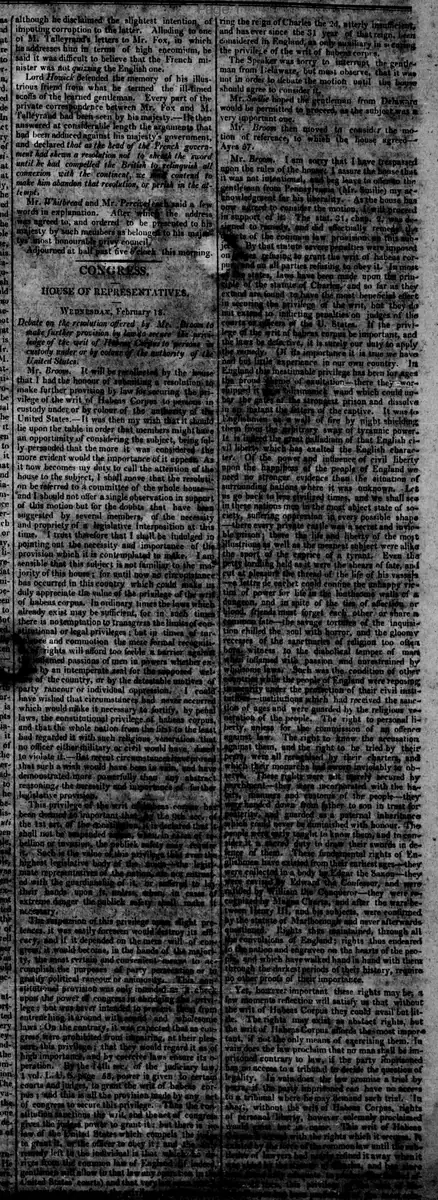
Debate on the resolution offered by Mr. Broom to make further provision by law to secure the privilege of the writ of Habeas Corpus to persons in custody under or by colour of the authority of the United States.
Mr. Broom. It will be recollected by the house that I had the honour of submitting a resolution to make further provision by law for securing the privilege of the writ of Habeas Corpus to persons in custody under or by colour of the authority of the United States. It was then my wish that it should lie upon the table in order that members might have an opportunity of considering the subject, being fully persuaded that the more it was considered the more evident would the importance of it appear. As it now becomes my duty to call the attention of the house to the subject, I shall move that the resolution be referred to a committee of the whole house; and I should not offer a single observation in support of this motion but for the doubts that have been suggested by several members, of the necessity and propriety of a legislative interposition at this time. I trust therefore that I shall be indulged in pointing out the necessity and importance of the provision which it is contemplated to make. I am sensible that this subject is not familiar to the majority of this house. for until now no circumstance has occurred in this country which could make us duly appreciate the value of the privilege of habeas corpus. In ordinary times the laws which already exist may be sufficient for in such time there is no temptation to transgress the limits of constitutional or legal privileges; but in times of trouble and commotion the mere formal recognition of rights will afford too feeble a barrier against the inflamed passions of men in power whether excited by an intemperate zeal for the supposed welfare of the country, or by the detestable motives of party rancour or individual oppression. I could have wished that circumstances had never occurred which would make it necessary to fortify, by penal laws, the constitutional privilege of habeas corpus, and that the whole nation from the first to the last had regarded it with such religious veneration that no officer either military or civil would have dared to violate it. But recent circumstances yet demonstrate more powerfully than any abstract reasoning the necessity and importance of further legislative provision.
This privilege of the writ of habeas corpus has been deemed so important to the state or the country that the constitution declares that it shall not be suspended unless when in cases of rebellion or invasion the public safety may require it. Such is the value of this privilege that even the highest legislative body in England thought it necessary to lay strong guards around it under extreme danger.
The suspension of this privilege it was easily discerned would destroy its efficacy and if it depended on the mere will of congress it would become, in the hands of one man, the most certain and convenient accomplishment of the purposes of party persecution or to gratify political revenge or ambition. Such constitutional provision was only intended to abide upon the power of congress to abridge privileges but was never intended to prevent them from entrenching it around with sound and wholesome laws. On the contrary it was expected that as congress were prohibited from impairing at their pleasure this privilege that they would regard it as of high importance, and by perceptive laws ensure its better operation. By the 14th section of the judiciary act power is given to certain courts and judges to grant the writ of habeas corpus and this is all the provision made by any of congress to secure this privilege. Thus the constitution sanctions the writ and the act of congress gives the judges power to grant it, but there is no law of the United States which compels the judge to grant it, or the officer to obey it and thus the remedy is left to the individual whose rights it is intended to secure.
The remedy derived from the common law of England has, indeed this laid open to that salutary operation in United States courts, and that service.
ring the reign of Charles the 2d utterly insufficient and has ever since the 31 year of that reign been considered in England as only an inferior security to the privilege of the writ of habeas corpus.
The Speaker was sorry to interrupt the gentleman from Delaware but must observe, that it was not in order to debate the motion until the house should agree to consider it.
Mr. Smilie hoped the gentleman from Delaware would be permitted to proceed on the subject as a very important one.
Mr. Broom then moved to consider the motion of reference to which the house agreed.
Ayes 57.
Mr. Broom. I am sorry that I have trespassed upon the rules of the house; I assure the house that it was not intentional and beg leave to offer to the gentleman from Pennsylvania (Mr. Smilie) my acknowledgements for his liberality. As the house has now agreed to consider the motion I will proceed in support of it. The stat 31 chap 23 signed to remedy and did effectually remedy.
By that statute several penalties were imposed on those refusing to grant the writ of habeas corpus and on all parties refusing to obey it. In most states laws have been made upon the principle of the statute of Charles, and so far as they go they have the most beneficial tendency to secure the privilege of the writ but they do not extend to imposing penalties on judges of the courts or officers in the states. In the privilege of the writ of habeas corpus be important and the laws be defective it is surely our duty to apply the remedy.
Of its importance it is true we have had but little experience in our own country. In England this inestimable privilege, has been for ages the proud boast and admiration of Englishmen a wall of fire by night shielding them from the arbitrary sway of tyrannic power.
Indeed the rent palladium of that English constitution which has exalted the English character and of the power and influence of civil liberty upon the happiness of the people of England we need no stronger evidence than the situation of surrounding nations where it was unknown. If we go back to less civilized times, and we shall see in these nations men in the most abject state of society suffering oppression in every possible shape where every private castle was a secret and inviolable prison there the life and liberty of the most illustrious and the meanest subject were alike the sport of the caprice of a tyrant. Even the padding held as it were the shears of fate and could at pleasure cut the thread of the life of his vassals. Lettre de cachet could confine the unhappy victim to a power for life in the loathsome walls of a dungeon and an entire family of the ties of affection or blood friends must forget each other or share an common fate the savage tortures of the inquisition chilled the soul with horror and the gloomy recesses of the sanctuaries of religion too often were witness to the diabolical temper of man inflamed with passion and unrestrained by remorse. Such was the condition of other people while the people of England were reposing securely under the protection of their civil institutions which had received the sanction of ages and were guarded by the religious veneration of the people. The right to personal liberty unless for the commission of an offence the right to know the accusation against them, and the right to be tried by their peers all recognised by their charters and monarchs.
These rights were not merely secured they were incorporated with the habits and customs of the people handed down from father to son in trust posterity guarded as a paternal inheritance undiminished with honour to know them and to defend them.
These fundamental rights of whom there earnest.
In a body by the door the Saxon w. Edward Confessor and William the conqueror they were chartered and after the wars of the Roses life and his subjects, were confirmed by the statute of Marlborough and never afterwards disputed through all convulsions of England rights thus endeared to the nation and engraved on the hearts of the people and which have walked hand in hand with them through the darkest periods of their history, require no other proofs of their importance.
Yet however important these rights may be a few moments reflection will satisfy us that without the writ of Habeas Corpus they could avail but little, the right may exist as abstract rights but the writ of Habeas Corpus affords the most important if not the only means of exercising them. In vain does the law proclaim that no man shall be imprisoned contrary to law. if the party imprisoned has no access to a tribunal to decide the question of legality. In vain does the law promise a trial by jury if the party imprisoned can have no access to a tribunal where he may demand such trial. In short without the writ of Habeas Corpus, rights of personal liberty however solemnly proclaimed would have no protective power. This writ of Habeas Corpus was with the rights which it secures.
Exercised by the archai on common law until the statute of Charles the 2d rendered it away when.
Her and L.
[Military effects in England regarding the liberty of the subject,] we have the strongest proof which we can require of its importance to us, except our own experience. It is true we live under a form of government where the sovereignty is acknowledged to belong to the people; but let us not vainly imagine that we have no necessity for laws restrictive upon men in power. Under the fair semblance of republicanism has often been practised the most detestable tyranny, and the mild laws of a republic have too often afforded a shelter for knaves and tyrants instead of a shield for the virtuous and oppressed. I ask then of this House to hedge round this valuable privilege of the writ of Habeas Corpus with efficient laws. I beg them to profit by the experience of others and grow wise in time. Let it not be said that we are less jealous of our personal liberty than the people of England, or that the important privilege which guards it is less dear to us, because we have not like them waded through blood to maintain it. Let us with the constitution, acknowledge the importance and sanctity of the privilege and proceed without delay to fortify it with penal statutes. The warnings which we have lately received call loudly on us to guard it more effectually in future. It has been too generally our misfortune to wait until offences have been committed before we have provided a punishment but when such offences have been committed, the public attention has been awakened, and laws have been made to guard against them in future. The violations of our constitutional privileges at New-Orleans have shewn clearly, the insufficiency of existing laws and the imperious necessity of providing this remedy. If we will not be roused from our slumbers by the experience which we have had I shall despair that we will ever be awakened to any sensibility of our personal rights for let it be remembered that these abuses are not of an ordinary character- they have been committed by a military officer at the head of the army of the U. States, and in the full view of the highest authorities of the union. The civil authority at New-Orleans has been trampled under foot and the commander of the army in the plentitude of his power avows disobedience to laws and constitution and takes on himself all the responsibility of the violation of our constitutional rights of personal liberty. Lost in amazement at this bold and unprecedented stretch of power we can scarcely be sensible of its extent unless we contrast it deliberately with the constitution. The constitution declares that no warrant shall issue but upon probable cause supported by oath or affirmation. That no citizen shall be deprived of his liberty without due process of law and that the accused shall enjoy the right of a speedy trial by a jury of the district where the offence was committed; yet in defiance of these constitutional provisions, our citizens have been arrested without any process of law whatsoever: deprived of their liberty, confined in military prisons and transported under military guards two thousand miles from the place where the offence was committed. The constitutional privilege of the writ of habeas corpus which is to secure these rights to the citizen has been treated with contempt, and a military officer vauntingly takes upon himself all the responsibility of wilful disobedience to the writ. For all these violations we are to be told that the conspiracy which existed in that country will afford a sufficient justification. With respect to the conspiracy whatever might have been its contemplated extent, we have reason to believe that it is now at an end, and without determining whether the aspect which it had at New-Orleans was really alarming to the general, or whether any circumstances do exist which may palliate his conduct, this much we all know, that his power was employed in the arbitrary violation of the rights of the citizen, and that the conspiracy is to furnish the justification. Such conduct, and even such a justification I look upon with abhorrence and dread: for if upon every alarm of conspiracy our rights of personal liberty are to be entrusted to the keeping of a military commander, we may prepare to take our leave of them forever. For my own part I wish to live under a government of laws and not of men for however pure and upright be the intention of our military commanders, however virtuous and even unsuspected be their conduct I can never agree that my right to personal liberty shall depend on their forbearance and discretion. I know not whether these men that have been arrested are innocent or guilty of the treason with which they have been charged; but whether innocent or guilty they must be arrested and tried according to law. However atrocious the crime which has been committed, the punishment must be according to law, for in transgressing the limits of the law to revenge upon a criminal the wrongs of society we are guilty of injustice both to society and the criminal. The manner and circumstances attending these arrests have been of the most uncommon kind. It is said that all intercourse between one of the prisoners and his family and friends was cut off and that not a soul except military men was suffered to approach him. That after being detained under close military confinement for nearly two weeks he was transported by the way of Baltimore to this city and that upon his arrival here he was informed that there was no evidence to support any charge against him whatever. But whether this man or the others who have been arrested, are guilty or not, it can have no influence upon our deliberations at this time- for if even these violations now affect only the guilty they may, at the discretion of the military officer extended to the innocent. It is enough for us to know that rights of personal liberty guaranteed by the constitution, have been openly violated in the person of a citizen of the United States, and that no laws exist sufficiently effectual to prevent or to punish such violations. It then becomes our duty as faithful guardians of the public rights, to interpose our authority, in order to preserve them. But if we content ourselves with tamely looking on while our best rights are trampled upon we become partakers of the guilt by the encouragement which we give the offenders. For these violations what remedy has the most innocent individual against the officer who arrested and transported him as the laws of the United States have provided none but a remedy is at common law He must sue for false imprisonment, and it depends entirely on the jury whether they will give him any thing or nothing. Can a punishment so uncertain prevent or will a remedy so precarious always remain the injured? But if to this we add exemplary penalties, we have nearly an additional security the laws are not, in my opinion to be sufficient unless they [are] in the most peremptory and exemplary [kind]
[Continuation, deciphered from garbled sections:] Whereas [penalties for such cases of correction and all officers yet for such offenses when he has so [acted] laws to guard against these abuses and [the] sovereign [is] willing to make any [sacrifice] upon ourselves [to assume] the responsibility of future violations. I wish and propose to entrench our rights with the most vigorous laws, such as no man [can] violate them with impunity [to] every citizen of the United States, whatever his condition in society. The constitutional rights of personal liberty [are] sacred and however exalted the situation of the person who tramples upon them, or however plausible the pretence, the punishment ought to be prompt certain and exemplary. Dangerous indeed will be the situation of our country if every alarm of conspiracy is to be followed with the seizure and transportation of our citizens, at the will of a military commander, and in defiance of the civil authority. If such a doctrine be looked upon not only without abhorrence, but even with approbation, how easy will be the transition from lawful to lawless power.
Leaving the examples of ancient times, where the rumours of conspiracies have raised in an instant the body guards of tyrants, we have seen in modern France the cry of conspiracy made the signal of massacre, on the pretext of some violent usurpations of power. I do not pretend to say that this conspiracy has been fomented or permitted for any sinister views. It is enough to point out the danger to be apprehended from suffering this dark and dangerous machine of conspiracy, to be any apology for the violation of all the most solemn constitutional rights of personal liberty. Having witnessed the defects of our laws and the dangerous abuses of our most valuable privileges, let us proceed to provide the remedies. Rights so important cannot be too strongly guarded and violations so serious cannot be too strictly prohibited.
Mr. Burrell said: he had determined to vote for the reference of the resolution, that the mover might suggest any additional security to the personal liberty of the citizen he thought necessary, although he did not believe a change in the law material or that one essential provision had been omitted. Had the gentleman from Delaware confined his remarks to the subject of his motion, and avoided observations unconnected with his ostensible object, he should have acquiesced silently. The constitution of the United States recognizes the writ of habeas corpus without determining in what manner it shall be enforced in the courts. That can only be ascertained by recurring to the acts of congress passed in 1789 establishing a judicial system, organizing courts and fixing their powers. The 14th section of that law relates to this writ, and says, "This and all other writs not specially provided for by statute shall be issued agreeable to the principles and usages of law." Mr. B. contended the principles here alluded to could only be those of the English law and the usages those of their courts: otherwise there could not be found in the constitution or laws of the union, a single sentence relative to the subject, and the decisions heretofore had in our courts would be consequently illegal. He said he was fully justified in this position by the uniform proceedings in the courts, and particularly those which had recently taken place in this district before the court acting expressly under the laws of congress. To shew how ample the provisions were he referred to Blackstone's Commentaries, vol.3 p. 137. stat. Charles 2d, 4 Any prisoner may move for and obtain his writ of Habeas Corpus &c and the lord chancellor or judges, denying the same on sight of the warrant or oath that the same is refused, shall forfeit to the party grieved the sum, &c. The judge is here compelled under heavy penalties, to afford relief to all persons who apply for the writ, and we shall presently see the law guards against delay or by other limitations on the discretion of officers. Mr. B. said he admitted the specific penalties of the statute did not attach to the judges courts of this country; but it established their duties, and the punishment inflicted is regulated by the constitution and law of the U.S. applicable to judicial offences and misdemeanors. The same statute provides, that officers and keepers neglecting to make due returns or not delivering to the prisoner or his agent, a copy of the warrant of commitment within six hours, or shifting the custody of the prisoner without sufficient authority, shall forfeit &c. In addition to this the court could enforce its process by attachment fine and imprisonment and call on the executive for aid, if resistance is made. Mr. B. said this statute was considered as having completely guarded against oppression, as was expressly intended to put an end to the refusal of the judges. The oppression of Charles I. [on an] individual gave birth to the famous habeas corpus act 31st. Charles 2d which is frequently considered as another magna charta of the kingdom and by consequence and analogy has also in subsequent times reduced the general method of proceeding on these writs and (though not within the reach of that statute) by issuing merely of common law to the true standard of law and liberty. B. C. 13O. What more is requisite? Our courts are compelled to issue process and grant relief, your officers to carry it into effect and your citizens to obey. Mr B observed it appeared to him impossible to devise additional provisions when those already incorporated into the jurisprudence of the country by the act of congress and exercised by the courts, embrace every case arising under the laws, and extend to all persons confined under the authority or colour of authority of the United States. He, however, was not a professional man and was therefore the more disposed in favour of the commitment least he should be mistaken in his impressions, if the gentleman from Delaware should discover any salutary alterations, he should not only receive his vote but his thanks. We have been told, said Mr. B. that all the states have passed laws upon this subject. Does it follow we had none? Certainly not. They have enacted the provisions of this statute specifically, we have adopted them by reference; each mode is equally good, and affords equal protection to individual rights. Indeed it is incredible we should have remained until the present time ignorant of this chasm in our institutions and whatever the gentleman may say the recent events at New Orleans are not the first [in] his country which would have announced its existence.
Mr. B. said he would let the facts sit produced acquitted him guilt in the direction and proved exerted his great election [to] moderate [and] be one [to] quiet the apprehensions and restrain the violence of the people. If this statement was denied Mr. B. said he could not believe it; [a similar] case had been reported in the supreme court of the United States, which had been frequently [cited] during the present term. Why has the vigilance of gentlemen reposed so long? Why has this early and impressive intimation been disregarded, if the law was defective? The gentleman from Delaware says the late arrests at New Orleans by the military, are early warnings of the danger of arms. Mr. B. accepted the hint, and hoped the gentleman would himself recollect and profit by it. Those who acted with him had long been partial to those establishments and blind to their tendency. The events alluded to proved the indispensable necessity of preserving them subordinate to the civil authority. This proved the importance of reducing the standing army to the lowest point compatible with the safety of the frontiers. This was the reason which induced him during the present session to vote against the proposed augmentation of our forces, and while he continued to entertain his present opinion, and felt his present jealousies of a conflict between the civil and military power, he was determined to avoid the issue by keeping the latter in complete subordination. If an opposite policy should ever become ascendant in this country, the measures at New Orleans instead of being temporary will be entailed upon us. Mr. B. said he thought it important to mention the events which had occurred at New Orleans. It was extremely probable prosecutions would be commenced against the officer, and any expressions of disapprobation in that House would give a tone to public opinion, which justice required should as yet be suspended; every person admitted the commander in chief had violated the law. He admitted it himself, and assigned reasons of justification which we ought not to decide, but leave to the courts of justice. They are the proper tribunals to punish those who infringe the rights of the citizen, and until they are closed by power, or their decrees set at defiance, and the executive unable to enforce them, legislative interference cannot be necessary. It has been said every officer who refuses to obey the writ of habeas corpus from a court should be punished with death, and this has been proposed as an effectual provision to secure the benefit of this writ. Has the gentleman so soon forgotten the doctrine advanced on that side of the house, and assented to during the present session, when we were told a military officer knew no law but the orders of his superior when we were told the contrary was monstrous, absurd, and subversive of all subordination in the army; that they were not lawyers, versed in your laws and constitution. Mr. B. hoped he had. But the gentleman from Delaware had run into exactly the opposite extreme by placing the highest and lowest officer upon the same footing, exacting from both the same knowledge of the law, attaching the same responsibility, and contrary to every principle of justice and humanity, punishing with the same severity the man who intentionally and knowingly violates the law, and the man who ignorantly commits a breach of duty. It would completely reverse what has been so long and wisely recognized in our criminal jurisprudence. The redress allowed to a man who has been forcibly seized and imprisoned without authority under the existing laws is much more amenable to equity than this mode. It is an offence against an individual's rights-and should be redressed like all other injuries of a personal nature by action and the recovery of damages, in which the jury will always have a just regard to the rank of the offender, the innocence of the victim, and the wantonness of the violence. They will discriminate between the lawless exercise of power by the commander in chief, and the subordinate who executes what he supposes he is bound by his oath to perform. Mr. B. said the mover of this resolution had expressed more alarm at the situation of this country than was real, or than he supposed was felt by any member of this house. One would imagine that the arrests at Orleans had extended through the whole nation, and that no man was safe from persecution. As far as he had understood, the moment those arrested had reached the U S. they had been turned over to the courts, and every privilege been extended to them. The people of this country can never be in danger while their representatives remain pure, and are disposed to withhold from the executive dictatorial powers. Have we not already during the present session given the most honourable pledge to our constituents that we are not inattentive to their security, when we rejected the bill to suspend the writ of habeas corpus. Why talk of Lettres de Cachet, which have issued in France and of other oppressions in the nation. Our government is neither actuated by such passions nor invested with such powers. It is degrading to assimilate the two governments, and argue from a similarity which does not and cannot exist. The one is composed of responsible agents; the other is despotic, cruel, unrelenting and corrupt.
(To be continued.)
What sub-type of article is it?
What keywords are associated?
What entities or persons were involved?
Where did it happen?
Domestic News Details
Primary Location
Washington
Event Date
February 18
Key Persons
Outcome
motion to refer the resolution to a committee of the whole house agreed to, ayes 57.
Event Details
Debate in the House of Representatives on Mr. Broom's resolution to make further provision by law to secure the privilege of the writ of Habeas Corpus to persons in custody under or by colour of the authority of the United States. Mr. Broom argues for the necessity of penal laws to protect the writ, citing recent violations in New Orleans by a military officer. Mr. Burrell supports reference but contends existing laws are sufficient.