Thank you for visiting SNEWPapers!
Sign up free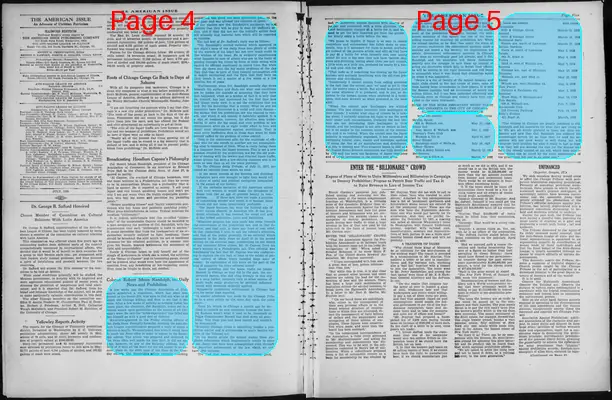
The American Issue
Westerville, Delaware County, Ohio
What is this article about?
Editorial responding to Col. Robert Isham Randolph's attack on prohibition in the Chicago Daily News, featuring Dr. Safford's defense arguing that Chicago's crime stems from pre-existing liquor traffic, prohibition is remedying it, and enforcement has closed many night clubs.
Merged-components note: This is a single editorial on Colonel Robert Isham Randolph and prohibition, continuing across pages 4 and 5, including the table of closed night clubs which is integral to the content; original labels were story, table, and editorial.
Clippings
1 of 2
OCR Quality
Full Text
News and Prohibition
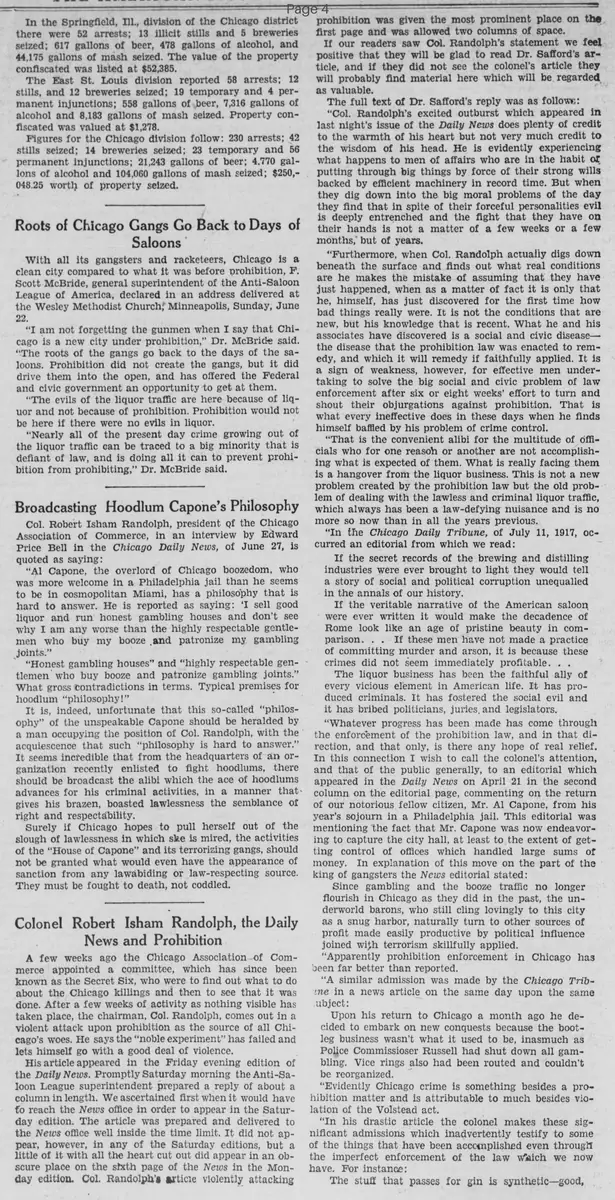
A few weeks ago the Chicago Association of Commerce appointed a committee, which has since been known as the Secret Six, who were to find out what to do about the Chicago killings and then to see that it was done. After a few weeks of activity as nothing visible has taken place, the chairman, Col. Randolph, comes out in a violent attack upon prohibition as the source of all Chicago's woes. He says the "noble experiment" has failed and lets himself go with a good deal of violence.
His article appeared in the Friday evening edition of the Daily News. Promptly Saturday morning the Anti-Saloon League superintendent prepared a reply of about a column in length. We ascertained first when it would have to reach the News office in order to appear in the Saturday edition. The article was prepared and delivered to the News office well inside the time limit. It did not appear, however, in any of the Saturday editions, but a little of it with all the heart cut out did appear in an obscure place on the sixth page of the News in the Monday edition. Col. Randolph's article violently attacking prohibition was given the most prominent place on the first page and was allowed two columns of space.
If our readers saw Col. Randolph's statement we feel positive that they will be glad to read Dr. Safford's article, and if they did not see the colonel's article they will probably find material here which will be regarded as valuable.
The full text of Dr. Safford's reply was as follows:
"Col. Randolph's excited outburst which appeared in last night's issue of the Daily News does plenty of credit to the warmth of his heart but not very much credit to the wisdom of his head. He is evidently experiencing what happens to men of affairs who are in the habit of putting through big things by force of their strong wills backed by efficient machinery in record time. But when they dig down into the big moral problems of the day they find that in spite of their forceful personalities evil is deeply entrenched and the fight that they have on their hands is not a matter of a few weeks or a few months, but of years.
"Furthermore, when Col. Randolph actually digs down beneath the surface and finds out what real conditions are he makes the mistake of assuming that they have just happened, when as a matter of fact it is only that he, himself, has just discovered for the first time how bad things really were. It is not the conditions that are new, but his knowledge that is recent. What he and his associates have discovered is a social and civic disease—the disease that the prohibition law was enacted to remedy, and which it will remedy if faithfully applied. It is a sign of weakness, however, for effective men undertaking to solve the big social and civic problem of law enforcement after six or eight weeks' effort to turn and shout their objurgations against prohibition. That is what every ineffective does in these days when he finds himself baffled by his problem of crime control.
"That is the convenient alibi for the multitude of officials who for one reason or another are not accomplishing what is expected of them. What is really facing them is a hangover from the liquor business. This is not a new problem created by the prohibition law but the old problem of dealing with the lawless and criminal liquor traffic, which always has been a law-defying nuisance and is no more so now than in all the years previous.
"In the Chicago Daily Tribune, of July 11, 1917, occurred an editorial from which we read:
If the secret records of the brewing and distilling industries were ever brought to light they would tell a story of social and political corruption unequalled in the annals of our history.
If the veritable narrative of the American saloon were ever written it would make the decadence of Rome look like an age of pristine beauty in comparison. . . If these men have not made a practice of committing murder and arson, it is because these crimes did not seem immediately profitable. . .
The liquor business has been the faithful ally of every vicious element in American life. It has produced criminals. It has fostered the social evil and it has bribed politicians, juries and legislators.
"Whatever progress has been made has come through the enforcement of the prohibition law, and in that direction, and that only, is there any hope of real relief. In this connection I wish to call the colonel's attention, and that of the public generally, to an editorial which appeared in the Daily News on April 21 in the second column on the editorial page, commenting on the return of our notorious fellow citizen, Mr. Al Capone, from his year's sojourn in a Philadelphia jail. This editorial was mentioning the fact that Mr. Capone was now endeavoring to capture the city hall, at least to the extent of getting control of offices which handled large sums of money. In explanation of this move on the part of the king of gangsters the News editorial stated:
Since gambling and the booze traffic no longer flourish in Chicago as they did in the past, the underworld barons, who still cling lovingly to this city as a snug harbor, naturally turn to other sources of profit made easily productive by political influence joined with terrorism skillfully applied.
"Apparently prohibition enforcement in Chicago has been far better than reported.
"A similar admission was made by the Chicago Tribune in a news article on the same day upon the same subject:
Upon his return to Chicago a month ago he decided to embark on new conquests because the bootleg business wasn't what it used to be, inasmuch as Police Commissioner Russell had shut down all gambling. Vice rings also had been routed and couldn't be reorganized.
"Evidently Chicago crime is something besides a prohibition matter and is attributable to much besides violation of the Volstead act.
"In his drastic article the colonel makes these significant admissions which inadvertently testify to some of the things that have been accomplished even through the imperfect enforcement of the law which we now have. For instance:
The stuff that passes for gin is synthetic goo,
| NAME AND ADDRESS | DATE CLOSED |
| Moulin Rouge | |
| 426 S. Wabash ave. | May 22, 1926 |
| Friars Inn | |
| Van Buren & Wabash ave. | Dec. 1, 1926 |
| Tearney's Town Club | |
| Wabash & 7th st. | April 14, 1927 |
| Silver Slipper | |
| Randolph north of Wells st. | July 19, 1927 |
| Jeffrey Tavern | |
| 79th & Stony Island ave. | March 13, 1928 |
| Rendezvous | |
| Diversey & Clark st. | March 13, 1928 |
bad, or indifferent alcohol flavored with essence of juniper and sweetened with a little glycerine. The hotel bootleggers charged $5 a bottle for it, and we used to get the best imported gin from the grower for ninety cents a bottle before the war.
"We pause to inquire, if liquor is so easy to obtain everywhere and enforcement has fallen down so completely, why is it necessary for them to accept synthetic gin instead of the genuine article, and why do they have to pay $5 a bottle for what formerly cost only ninety cents? Or why is the beer they now have 'terrible slop, green and sickening, testing about three per cent alcohol, a little more or a little less, produced for nearly $3 a barrel and now sold for $60.
"That looks as if something was slowing up the liquor business and seriously interfering with the old-time production and distribution.
"Incidentally I cannot refrain from calling attention to the fact that the colonel says 'we' used to get it (the gin) for ninety cents a bottle. But alcohol is alcohol just the same wherever it is produced, and is just as injurious to the human system when produced in a handsome, well-built brewery as when produced in the back alley.
"When the colonel says 'bootleggers are without obloquy. The best citizens introduce their bootleggers to their friends,' I wonder what class of citizens he is talking about. I certainly question his right to use the word 'best' under such circumstances. Certainly the best citizens are not introducing their bootleggers to their friends, and the bootlegger is not only an outlaw in fact, but is an outlaw in the common opinion of the community and is so treated. When the colonel says the liquor industry is magnificently organized, it has succeeded in corrupting federal, state, county and municipal agencies all along the line of its manufacture and distribution.
But this is nothing new. This situation began in 1862 and the United States Brewers Association was fully developed by 1870 and has been the backbone of liquor resistance and of liquor corruption in the country ever since.
THE AMERICAN ISSUE
"Here, again, the colonel is confusing the cause and the result. He is reasoning as if this organization of the liquor power and its activity were produced by the enactment of the prohibition law when, instead, the well-known existence of this agency was one of the compelling reasons for enacting the prohibition law. When the colonel implies, as he does, that under the stress of the present excitement the enforcement agencies made a mistake and seized a big brewery, his implications are unfair. Government enforcement agencies in Chicago have done an exceedingly good job already, and if Col. Randolph and his associates will throw themselves heartily into the struggle to back them up instead of giving out interviews which help to defeat their efforts, he will be moving in the right direction and will begin to accomplish what it was hoped that committee would do when it was appointed.
"Below is a list of twenty of the largest cabarets and night clubs closed in the last couple of years, some of them having large investments in their plants. It is said the Rainbo Gardens had an investment of nearly one million dollars, but it has been padlocked effectively and hundreds more in Chicago and vicinity have been subjected to the same treatment:
SOME OF THE MORE IMPORTANT NIGHT CLUBS AND CABARETS IN THE CITY OF CHICAGO CLOSED ON OBSERVATION EVIDENCE
Page Five
NAME AND ADDRESS DATE CLOSED
Plantation March 15, 1928
35th & Cottage Grove
Bagdad March 16, 1928
64th & Cottage Grove
Hollywood Barn March 27, 1928
Kedzie ave. north of Lawrence
Rainbo Gardens May 3, 1928
Clark st. north of Lawrence
Parady May 4, 1928
945 N. State st.
Frolics May 7, 1928
22nd st. west of Wabash ave.
Ansonia May 10, 1928
Chicago ave. east of Michigan
Colosimo May 28, 1928
Wabash ave. and 22nd st.
Alamo Aug. 5, 1928
Wilson ave. near Sheridan rd.
Chez Pierre Mar. 1, 1929
Ontario & Fairbanks sts.
Samavar Mar. 14, 1929
Blum Bldg., S. Michigan ave.
Club Royale Feb. 7, 1930
426 S. Wabash ave.
Beaumonde Club Feb. 14, 1930
519 Diversey Parkway
Kelly's Stables March, 1930
431 Rush st.
"The citizens of Chicago are greatly indebted to Col. Randolph and his associates for what they are trying to do. We are all deeply grateful to them for their endeavors and now that Col. Randolph has relieved his overwrought nerves let us hope that he and his associates will not grow weary in well doing but will recognize their problem for what it really is. Let us hope that they will not mistake the cure for the disease and fight the remedy instead of the evil, which long experience shows can be cured by the strict enforcement of the prohibition law and in no other way."
What sub-type of article is it?
What keywords are associated?
What entities or persons were involved?
Editorial Details
Primary Topic
Defense Of Prohibition Enforcement In Chicago
Stance / Tone
Strongly Supportive Of Prohibition And Critical Of Its Detractors
Key Figures
Key Arguments