Thank you for visiting SNEWPapers!
Sign up free
Story
January 18, 1918
The Daily Alaskan
Skagway, Alaska
What is this article about?
William J. Robinson, a young American, enlists in a British cavalry regiment in London and serves on the Western Front in 1914, experiencing battles around Ypres, trench warfare, and a mission to locate Prince Maurice of Battenberg's grave in Menin churchyard amid shelling and snipers.
Clipping
OCR Quality
75%
Good
Full Text
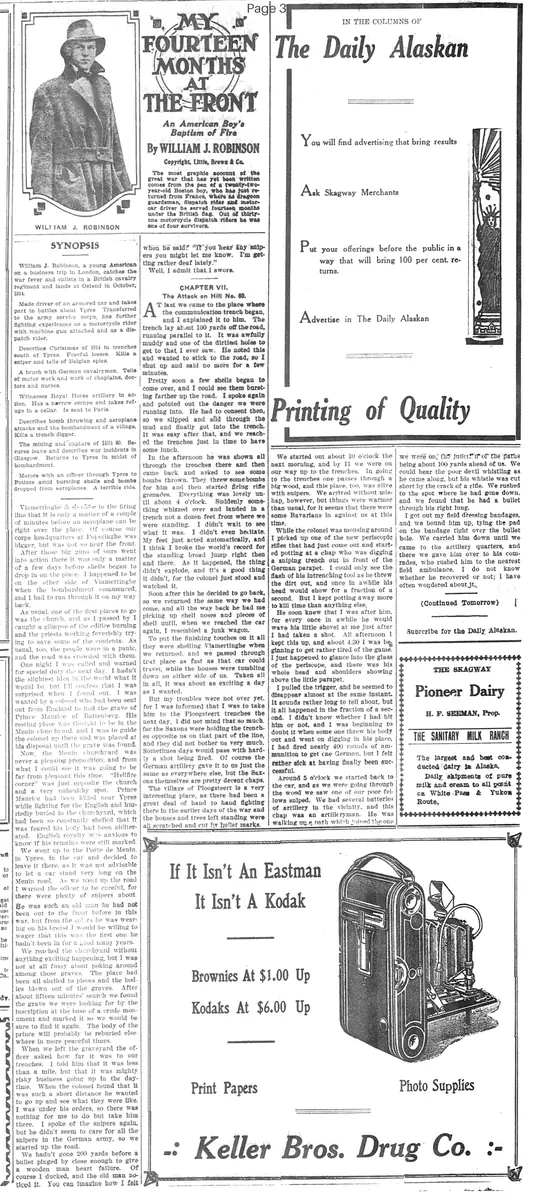
William J. Robinson, a young American on a business trip in London, catches the war fever and enlists in a British cavalry regiment and lands at Ostend in October, 1914.
Made driver of an armored car and takes part in battles about Ypres. Transferred to the army service corps, has further fighting experiences as a motorcycle rider with machine gun attached and as a dispatch rider.
Describes Christmas of 1914 in trenches south of Ypres. Fearful losses. Kills a sniper and tells of Belgian spies.
A brush with German cavalrymen. Tells of motor work and work of chaplains, doctors and nurses.
Witnesses Royal Horse artillery in action. Has a narrow escape and takes refuge in a cellar. Is sent to Paris.
Describes bomb throwing and aeroplane attacks and the bombardment of a village.
Kills a trench digger.
The mining and capture of Hill 60. Secures leave and describes war incidents in Glasgow. Returns to Ypres in midst of bombardment.
Motors with an officer through Ypres to Potijze amid bursting shells and bombs dropped from aeroplanes. A terrible ride.
Vlamertinghe is so close to the firing line that it is only a matter of a couple of minutes before an aeroplane can be right over the place. Of course our corps headquarters at Poperinghe was bigger, but was not so near the front.
After those big guns of ours went into action there it was only a matter of a few days before shells began to drop in on the place. I happened to be on the other side of Vlamertinghe when the bombardment commenced, and I had to run through it on my way back.
As usual, one of the first places to go was the church, and as I passed by I caught a glimpse of the edifice burning and the priests working feverishly trying to save some of the contents. As usual, too, the people were in a panic, and the road was crowded with them.
One night I was called and warned for special duty the next day. I hadn't the slightest idea in the world what it would be, but I'll confess that I was surprised when I found out. I was wanted by a colonel who had been sent out from England to find the grave of Prince Maurice of Battenberg. His resting place was thought to be in the Menin churchyard, and I was to guide the colonel up there and was placed at his disposal until the grave was found.
Now, the Menin churchyard was never a pleasing proposition, and from what I could see it was going to be far from pleasant this time. "Hellfire corner" was just opposite the church and a very unhealthy spot. Prince Maurice had been killed near Ypres while fighting for the English and hurriedly buried in the churchyard, which had been so constantly shelled that it was feared his body had been obliterated. English royalty was anxious to know if his remains were still marked. Date? Menin.
We went up to the Gate at Ypres, in the car and decided to leave it there, as it was not advisable to let a car stand very long on the Menin road. As we went up the road I warned the officer to be careful, for there were plenty of snipers about.
He was such an old man he had not been out to the front before in this war, but from the colors he was wearing on his breast I would be willing to wager that this was the first one he hadn't been in for a good many years.
We reached the churchyard without anything exciting happening, but I was not at all fussy about poking around among those graves. The place had been all shelled to pieces and the bodies blown out of the graves. After about fifteen minutes' search we found the grave we were looking for by the inscription at the base of a crude monument and marked it so we would be sure to find it again. The body of the prince will probably be reburied elsewhere in more peaceful times.
When we left the graveyard the officer asked how far it was to our trenches. I told him that it was less than a mile, but that it was mighty risky business going up in the daytime. When the colonel found that it was such a short distance he wanted to go up and see what they were like.
I was under his orders, so there was nothing for me to do but take him there. I spoke of the snipers again, but he didn't seem to care for all the snipers in the German army, so we started up the road.
We hadn't gone 200 yards before a bullet pinged by close enough to give a wooden man heart failure. Of course I ducked, and the old man noticed it. You can imagine how I felt.
Made driver of an armored car and takes part in battles about Ypres. Transferred to the army service corps, has further fighting experiences as a motorcycle rider with machine gun attached and as a dispatch rider.
Describes Christmas of 1914 in trenches south of Ypres. Fearful losses. Kills a sniper and tells of Belgian spies.
A brush with German cavalrymen. Tells of motor work and work of chaplains, doctors and nurses.
Witnesses Royal Horse artillery in action. Has a narrow escape and takes refuge in a cellar. Is sent to Paris.
Describes bomb throwing and aeroplane attacks and the bombardment of a village.
Kills a trench digger.
The mining and capture of Hill 60. Secures leave and describes war incidents in Glasgow. Returns to Ypres in midst of bombardment.
Motors with an officer through Ypres to Potijze amid bursting shells and bombs dropped from aeroplanes. A terrible ride.
Vlamertinghe is so close to the firing line that it is only a matter of a couple of minutes before an aeroplane can be right over the place. Of course our corps headquarters at Poperinghe was bigger, but was not so near the front.
After those big guns of ours went into action there it was only a matter of a few days before shells began to drop in on the place. I happened to be on the other side of Vlamertinghe when the bombardment commenced, and I had to run through it on my way back.
As usual, one of the first places to go was the church, and as I passed by I caught a glimpse of the edifice burning and the priests working feverishly trying to save some of the contents. As usual, too, the people were in a panic, and the road was crowded with them.
One night I was called and warned for special duty the next day. I hadn't the slightest idea in the world what it would be, but I'll confess that I was surprised when I found out. I was wanted by a colonel who had been sent out from England to find the grave of Prince Maurice of Battenberg. His resting place was thought to be in the Menin churchyard, and I was to guide the colonel up there and was placed at his disposal until the grave was found.
Now, the Menin churchyard was never a pleasing proposition, and from what I could see it was going to be far from pleasant this time. "Hellfire corner" was just opposite the church and a very unhealthy spot. Prince Maurice had been killed near Ypres while fighting for the English and hurriedly buried in the churchyard, which had been so constantly shelled that it was feared his body had been obliterated. English royalty was anxious to know if his remains were still marked. Date? Menin.
We went up to the Gate at Ypres, in the car and decided to leave it there, as it was not advisable to let a car stand very long on the Menin road. As we went up the road I warned the officer to be careful, for there were plenty of snipers about.
He was such an old man he had not been out to the front before in this war, but from the colors he was wearing on his breast I would be willing to wager that this was the first one he hadn't been in for a good many years.
We reached the churchyard without anything exciting happening, but I was not at all fussy about poking around among those graves. The place had been all shelled to pieces and the bodies blown out of the graves. After about fifteen minutes' search we found the grave we were looking for by the inscription at the base of a crude monument and marked it so we would be sure to find it again. The body of the prince will probably be reburied elsewhere in more peaceful times.
When we left the graveyard the officer asked how far it was to our trenches. I told him that it was less than a mile, but that it was mighty risky business going up in the daytime. When the colonel found that it was such a short distance he wanted to go up and see what they were like.
I was under his orders, so there was nothing for me to do but take him there. I spoke of the snipers again, but he didn't seem to care for all the snipers in the German army, so we started up the road.
We hadn't gone 200 yards before a bullet pinged by close enough to give a wooden man heart failure. Of course I ducked, and the old man noticed it. You can imagine how I felt.
What sub-type of article is it?
Biography
Military Action
Historical Event
What themes does it cover?
Bravery Heroism
Survival
Misfortune
What keywords are associated?
Wwi Enlistment
Ypres Battles
Armored Car Driver
Sniper Encounter
Prince Maurice Grave
Menin Churchyard
Western Front
Trench Warfare
What entities or persons were involved?
William J. Robinson
Prince Maurice Of Battenberg
Colonel
Where did it happen?
Ypres, Menin Churchyard, Vlamertinghe, Western Front, Belgium
Story Details
Key Persons
William J. Robinson
Prince Maurice Of Battenberg
Colonel
Location
Ypres, Menin Churchyard, Vlamertinghe, Western Front, Belgium
Event Date
October 1914
Story Details
American William J. Robinson enlists in British forces, fights in battles around Ypres, experiences trench warfare and dangers, and guides a colonel to locate Prince Maurice of Battenberg's shelled grave near Menin amid snipers and bombardment.