Thank you for visiting SNEWPapers!
Sign up free
Literary
August 17, 1848
The Davenport Gazette
Davenport, Scott County, Iowa
What is this article about?
A mechanic named Leonard refuses to discount a customer's bill, leading the offended customer, Baker, to switch tradesmen and rumor Leonard's impending failure. Despite this, Leonard prospers, building a grand house for his daughter's marriage, while Baker's son misses a wealthy match due to the false rumors.
Merged-components note: Merged continuations of the short story 'GOING TO THE DOGS' by T.S. Arthur across sequential reading orders.
Clipping
OCR Quality
95%
Excellent
Full Text
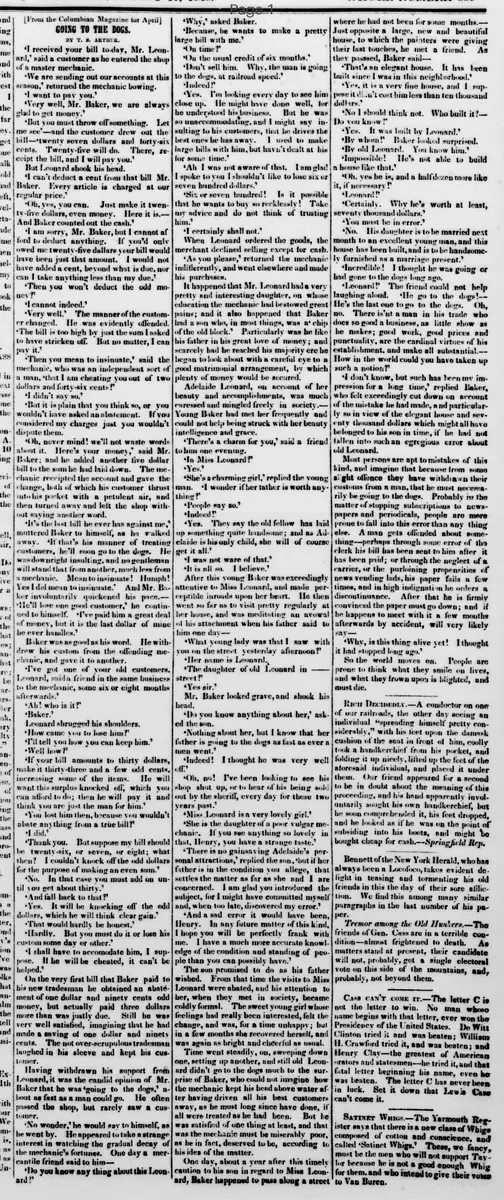
[From the Columbian Magazine for April]
GOING TO THE DOGS.
BY T. S. ARTHUR,
'I received your bill to-day, Mr. Leonard,' said a customer as he entered the shop of a master mechanic.
'We are sending out our accounts at this season,' returned the mechanic bowing.
'I want to pay you.'
'Very well, Mr. Baker, we are always glad to get money.'
'But you must throw off something. Let me see'—and the customer drew out the bill—'twenty seven dollars and forty-six cents. Twenty-five will do. There, receipt the bill, and I will pay you.'
But Leonard shook his head.
'I can't deduct a cent from that bill Mr. Baker. Every article is charged at our regular price.'
'Oh, yes, you can. Just make it twenty-five dollars, even money. Here it is.'—And Baker counted out the cash.
'I am sorry. Mr. Baker, but I cannot afford to deduct anything. If you'd only owed me twenty-five dollars your bill would have been just that amount. I would not have added a cent, beyond what is due, nor can I take anything less than my due.'
'Then you won't deduct the odd money?'
'I cannot indeed.'
'Very well.' The manner of the customer changed. He was evidently offended.
'The bill is too high by just the sum I asked to have stricken off. But no matter, I can pay it.'
'Then you mean to insinuate,' said the mechanic, who was an independent sort of a man, 'that I am cheating you out of two dollars and forty-six cents?'
'I didn't say so.'
'But it is plain that you think so, or you wouldn't have asked an abatement. If you considered my charges just you wouldn't dispute them.'
'Oh, never mind! we'll not waste words about it. Here's your money,' said Mr. Baker; and he added another five dollar bill to the sum he had laid down. The mechanic receipted the account and gave the change, both of which his customer thrust into his pocket with a petulant air, and then turned away and left the shop without saying another word
'It's the last bill he ever has against me.' uttered Baker to himself. as he walked away. 'If that's his manner of treating customers, he'll soon go to the dogs. He was downright insulting, and no gentleman will stand that from another, much less from a mechanic. Meant to insinuate! Humph! Yes I did mean to insinuate.' And Mr. Baker involuntarily quickened his pace.—
'He'll lose one good customer,' he continued to himself. I've paid him a great deal of money, but it is the last dollar of mine he ever handles.'
Baker was as good as his word. He withdrew his custom from the offending mechanic, and gave it to another.
'I've got one of your old customers. Leonard, said a friend in the same business to the mechanic, some six or eight months afterwards.'
'Ah! who is it?'
'Baker.'
Leonard shrugged his shoulders.
'How came you to lose him?'
'I'll tell you how you can keep him.'
'Well how?'
'If your bill amounts to thirty dollars. make it thirty-three and a few odd cents increasing some of the items. He will want this surplus knocked off, which you can afford to do; then he will pay it and think you are just the man for him.'
'You lost him then, because you wouldn't abate anything from a true bill?'
'I did.'
'Thank you. But suppose my bill should be twenty-six, or seven, or eight; what then? I couldn't knock off the odd dollars for the purpose of making an even sum.'
'No. In that case you must add on until you get about thirty.'
'And fall back to that?'
'Yes. It will be knocking off the odd dollars, which he will think clear gain.'
'That would hardly be honest.'
'Hardly. But you must do it or lose his custom some day or other.'
'I shall have to accommodate him, I suppose. If he will be cheated, it can't be helped.'
On the very first bill that Baker paid to his new tradesman he obtained an abatement of one dollar and ninety cents odd money. but actually paid three dollars more than was justly due. Still he was very well satisfied, imagining that he had made a saving of one dollar and ninety cents. The not over-scrupulous tradesman laughed in his sleeve and kept his customer.
Having withdrawn his support from Leonard, it was the candid opinion of Mr. Baker that he was going to the dogs' as about as fast as a man could go. He often passed the shop, but rarely saw a customer.
'No wonder.' he would say to himself, as he went by. He appeared to take a strange interest in watching the gradual decay of the mechanic's fortunes. One day a mercantile friend said to him—
'Do you know anything about this Leonard?'
'Why, asked Baker.
'Because, he wants to make a pretty large bill with me.'
'On time?'
'On the usual credit of six months.'
'Don't sell him. Why, the man is going to the dogs, at railroad speed.'
'Indeed?'
'Yes. I'm looking every day to see him close up. He might have done well, for he understood his business. But he was so unaccommodating, and I might say insulting to his customers, that he drives the best ones he has away. I used to make large bills with him, but haven't dealt at his for some time.'
'Ah! I was not aware of that. I am glad I spoke to you I shouldn't like to lose six or seven hundred dollars.'
'Six or seven hundred! Is it possible that he wants to buy so recklessly! Take my advice and do not think of trusting him.'
'I certainly shall not.'
When Leonard ordered the goods, the merchant declined selling except for cash.
'As you please,' returned the mechanic indifferently, and went elsewhere and made his purchases.
It happened that Mr. Leonard had a very pretty and interesting daughter, on whose education the mechanic had bestowed great pains; and it also happened that Baker had a son who, in most things, was a chip of the old block.' Particularly was he like his father in his great love of money; and scarcely had he reached his majority ere he began to look about with a careful eye to a good matrimonial arrangement, by which plenty of money would be secured.
Adelaide Leonard, on account of her beauty and accomplishments, was much caressed and mingled freely in society.— Young Baker had met her frequently and could not help being struck with her beauty intelligence and grace.
'There's a charm for you,' said a friend to him one evening.
'In Miss Leonard?'
'Yes.'
'She's a charming girl,' replied the young man. I wonder if her father is worth anything?
'People say so.'
'Indeed!'
'Yes. They say the old fellow has laid up something quite handsome; and as Adelaide is his only child, she will of course get it all.'
'I was not aware of that.'
'It is all so. I believe.'
After this young Baker was exceedingly attentive to Miss Leonard, and made perceptible inroads upon her heart. He then went so far as to visit pretty regularly at her house, and was meditating an avowal of his attachment when his father said to him one day—
'What young lady was that I saw with you on the street yesterday afternoon?'
'Her name is Leonard.'
'The daughter of old Leonard in street?'
'Yes sir.'
Mr. Baker looked grave, and shook his head.
'Do you know anything about her,' asked the son.
'Nothing about her, but I know that her father is going to the dogs as fast as ever a man went.'
'Indeed! I thought he was very well off.'
'Oh, no! I've been looking to see his shop shut up, or to hear of his being sold out by the sheriff, every day for these two years past.'
'Miss Leonard is a very lovely girl.'
'She is the daughter of a poor vulgar mechanic. If you see anything so lovely in that, Henry, you have a strange taste.'
'There is no gainsaying Adelaide's personal attractions,' replied the son, 'but if her father is in the condition you allege, that settles the matter as far as she and I are concerned. I am glad you introduced the subject, for I might have committed myself and, when too late, discovered my error.'
'And a sad error it would have been, Henry. In any future matter of this kind, I hope you will be perfectly frank with me. I have a much more accurate knowledge of the condition and standing of people than you can possibly have.'
The son promised to do as his father wished. From that time the visits to Miss Leonard were abated, and his attention to her, when they met in society, became coldly formal. The sweet young girl whose feelings had really been interested, felt the change, and was, for a time unhappy; but in a few months she recovered herself, and was again as bright and cheerful as usual.
Time went steadily on, sweeping down one, setting up another, and still old Leonard didn't go to the dogs much to the surprise of Baker, who could not imagine how the mechanic kept his head above water after having driven all his best customers away, as he must long since have done, if all were treated as he had been. But he was satisfied of one thing at least, and that was the mechanic must be miserably poor, as he in fact, deserved to be, according to his idea of the matter.
One day, about a year after this timely caution to his son in regard to Miss Leonard, Baker happened to pass along a street where he had not been for some months.— Just opposite a large, new and beautiful house, to which the painters were giving their last touches, he met a friend. As they passed, Baker said—
'That's an elegant house. It has been built since I was in this neighborhood.'
'Yes, it is a very fine house, and I suppose it didn't cost him less than ten thousand dollars.'
'No I should think not. Who built it?— Do you know?'
'Yes. It was built by Leonard.'
'By whom! Baker looked surprised.
'By old Leonard. You know him.'
'Impossible! He's not able to build a house like that.'
'Oh, yes he is, and a half dozen more like it, if necessary
'Leonard'
'Certainly. Why he's worth at least, seventy thousand dollars.'
'You must be in error.'
'No. His daughter is to be married next month to an excellent young man, and this house has been built, and is to be handsomely furnished as a marriage present.'
'Incredible! I thought he was going or had gone to the dogs long ago.'
'Leonard!' The friend could not help laughing aloud. He go to the dogs!— He's the last one to go to the dogs. Oh, no.'
'There isn't a man in his trade who does so good a business, as little show as he makes; good work, good prices and punctuality, are the cardinal virtues of his establishment, and make all substantial.— How in the world could you have taken up such a notion?'
'I don't know, but such has been my impression for a long time,' replied Baker, who felt exceedingly cut down on account of the mistake he had made, and particularly so in view of the elegant house and seventy thousand dollars which might all have belonged to his son in time, if he had not fallen into such an egregious error about old Leonard.
Most persons are apt to mistakes of this kind, and imagine that because from some slight offence they have withdrawn their customs from a man, that he must necessarily be going to the dogs. Probably in the matter of stopping subscriptions to newspapers and periodicals, people are more prone to fall into this error than any thing else. A man gets offended about something—perhaps through some error of the clerk his bill has been sent to him after it has been paid; or through the neglect of a carrier, or the purloining propensities of news vending lads, his paper fails a few times, and in high indignation he orders a discontinuance. After that he is firmly convinced the paper must go down; and if he happens to meet with it a few months afterwards by accident, will very likely say
'Why, is this thing alive yet! I thought it had stopped long ago.'
So the world moves on. People are prone to think what they smile on lives, and what they frown upon is blighted, and must die.
GOING TO THE DOGS.
BY T. S. ARTHUR,
'I received your bill to-day, Mr. Leonard,' said a customer as he entered the shop of a master mechanic.
'We are sending out our accounts at this season,' returned the mechanic bowing.
'I want to pay you.'
'Very well, Mr. Baker, we are always glad to get money.'
'But you must throw off something. Let me see'—and the customer drew out the bill—'twenty seven dollars and forty-six cents. Twenty-five will do. There, receipt the bill, and I will pay you.'
But Leonard shook his head.
'I can't deduct a cent from that bill Mr. Baker. Every article is charged at our regular price.'
'Oh, yes, you can. Just make it twenty-five dollars, even money. Here it is.'—And Baker counted out the cash.
'I am sorry. Mr. Baker, but I cannot afford to deduct anything. If you'd only owed me twenty-five dollars your bill would have been just that amount. I would not have added a cent, beyond what is due, nor can I take anything less than my due.'
'Then you won't deduct the odd money?'
'I cannot indeed.'
'Very well.' The manner of the customer changed. He was evidently offended.
'The bill is too high by just the sum I asked to have stricken off. But no matter, I can pay it.'
'Then you mean to insinuate,' said the mechanic, who was an independent sort of a man, 'that I am cheating you out of two dollars and forty-six cents?'
'I didn't say so.'
'But it is plain that you think so, or you wouldn't have asked an abatement. If you considered my charges just you wouldn't dispute them.'
'Oh, never mind! we'll not waste words about it. Here's your money,' said Mr. Baker; and he added another five dollar bill to the sum he had laid down. The mechanic receipted the account and gave the change, both of which his customer thrust into his pocket with a petulant air, and then turned away and left the shop without saying another word
'It's the last bill he ever has against me.' uttered Baker to himself. as he walked away. 'If that's his manner of treating customers, he'll soon go to the dogs. He was downright insulting, and no gentleman will stand that from another, much less from a mechanic. Meant to insinuate! Humph! Yes I did mean to insinuate.' And Mr. Baker involuntarily quickened his pace.—
'He'll lose one good customer,' he continued to himself. I've paid him a great deal of money, but it is the last dollar of mine he ever handles.'
Baker was as good as his word. He withdrew his custom from the offending mechanic, and gave it to another.
'I've got one of your old customers. Leonard, said a friend in the same business to the mechanic, some six or eight months afterwards.'
'Ah! who is it?'
'Baker.'
Leonard shrugged his shoulders.
'How came you to lose him?'
'I'll tell you how you can keep him.'
'Well how?'
'If your bill amounts to thirty dollars. make it thirty-three and a few odd cents increasing some of the items. He will want this surplus knocked off, which you can afford to do; then he will pay it and think you are just the man for him.'
'You lost him then, because you wouldn't abate anything from a true bill?'
'I did.'
'Thank you. But suppose my bill should be twenty-six, or seven, or eight; what then? I couldn't knock off the odd dollars for the purpose of making an even sum.'
'No. In that case you must add on until you get about thirty.'
'And fall back to that?'
'Yes. It will be knocking off the odd dollars, which he will think clear gain.'
'That would hardly be honest.'
'Hardly. But you must do it or lose his custom some day or other.'
'I shall have to accommodate him, I suppose. If he will be cheated, it can't be helped.'
On the very first bill that Baker paid to his new tradesman he obtained an abatement of one dollar and ninety cents odd money. but actually paid three dollars more than was justly due. Still he was very well satisfied, imagining that he had made a saving of one dollar and ninety cents. The not over-scrupulous tradesman laughed in his sleeve and kept his customer.
Having withdrawn his support from Leonard, it was the candid opinion of Mr. Baker that he was going to the dogs' as about as fast as a man could go. He often passed the shop, but rarely saw a customer.
'No wonder.' he would say to himself, as he went by. He appeared to take a strange interest in watching the gradual decay of the mechanic's fortunes. One day a mercantile friend said to him—
'Do you know anything about this Leonard?'
'Why, asked Baker.
'Because, he wants to make a pretty large bill with me.'
'On time?'
'On the usual credit of six months.'
'Don't sell him. Why, the man is going to the dogs, at railroad speed.'
'Indeed?'
'Yes. I'm looking every day to see him close up. He might have done well, for he understood his business. But he was so unaccommodating, and I might say insulting to his customers, that he drives the best ones he has away. I used to make large bills with him, but haven't dealt at his for some time.'
'Ah! I was not aware of that. I am glad I spoke to you I shouldn't like to lose six or seven hundred dollars.'
'Six or seven hundred! Is it possible that he wants to buy so recklessly! Take my advice and do not think of trusting him.'
'I certainly shall not.'
When Leonard ordered the goods, the merchant declined selling except for cash.
'As you please,' returned the mechanic indifferently, and went elsewhere and made his purchases.
It happened that Mr. Leonard had a very pretty and interesting daughter, on whose education the mechanic had bestowed great pains; and it also happened that Baker had a son who, in most things, was a chip of the old block.' Particularly was he like his father in his great love of money; and scarcely had he reached his majority ere he began to look about with a careful eye to a good matrimonial arrangement, by which plenty of money would be secured.
Adelaide Leonard, on account of her beauty and accomplishments, was much caressed and mingled freely in society.— Young Baker had met her frequently and could not help being struck with her beauty intelligence and grace.
'There's a charm for you,' said a friend to him one evening.
'In Miss Leonard?'
'Yes.'
'She's a charming girl,' replied the young man. I wonder if her father is worth anything?
'People say so.'
'Indeed!'
'Yes. They say the old fellow has laid up something quite handsome; and as Adelaide is his only child, she will of course get it all.'
'I was not aware of that.'
'It is all so. I believe.'
After this young Baker was exceedingly attentive to Miss Leonard, and made perceptible inroads upon her heart. He then went so far as to visit pretty regularly at her house, and was meditating an avowal of his attachment when his father said to him one day—
'What young lady was that I saw with you on the street yesterday afternoon?'
'Her name is Leonard.'
'The daughter of old Leonard in street?'
'Yes sir.'
Mr. Baker looked grave, and shook his head.
'Do you know anything about her,' asked the son.
'Nothing about her, but I know that her father is going to the dogs as fast as ever a man went.'
'Indeed! I thought he was very well off.'
'Oh, no! I've been looking to see his shop shut up, or to hear of his being sold out by the sheriff, every day for these two years past.'
'Miss Leonard is a very lovely girl.'
'She is the daughter of a poor vulgar mechanic. If you see anything so lovely in that, Henry, you have a strange taste.'
'There is no gainsaying Adelaide's personal attractions,' replied the son, 'but if her father is in the condition you allege, that settles the matter as far as she and I are concerned. I am glad you introduced the subject, for I might have committed myself and, when too late, discovered my error.'
'And a sad error it would have been, Henry. In any future matter of this kind, I hope you will be perfectly frank with me. I have a much more accurate knowledge of the condition and standing of people than you can possibly have.'
The son promised to do as his father wished. From that time the visits to Miss Leonard were abated, and his attention to her, when they met in society, became coldly formal. The sweet young girl whose feelings had really been interested, felt the change, and was, for a time unhappy; but in a few months she recovered herself, and was again as bright and cheerful as usual.
Time went steadily on, sweeping down one, setting up another, and still old Leonard didn't go to the dogs much to the surprise of Baker, who could not imagine how the mechanic kept his head above water after having driven all his best customers away, as he must long since have done, if all were treated as he had been. But he was satisfied of one thing at least, and that was the mechanic must be miserably poor, as he in fact, deserved to be, according to his idea of the matter.
One day, about a year after this timely caution to his son in regard to Miss Leonard, Baker happened to pass along a street where he had not been for some months.— Just opposite a large, new and beautiful house, to which the painters were giving their last touches, he met a friend. As they passed, Baker said—
'That's an elegant house. It has been built since I was in this neighborhood.'
'Yes, it is a very fine house, and I suppose it didn't cost him less than ten thousand dollars.'
'No I should think not. Who built it?— Do you know?'
'Yes. It was built by Leonard.'
'By whom! Baker looked surprised.
'By old Leonard. You know him.'
'Impossible! He's not able to build a house like that.'
'Oh, yes he is, and a half dozen more like it, if necessary
'Leonard'
'Certainly. Why he's worth at least, seventy thousand dollars.'
'You must be in error.'
'No. His daughter is to be married next month to an excellent young man, and this house has been built, and is to be handsomely furnished as a marriage present.'
'Incredible! I thought he was going or had gone to the dogs long ago.'
'Leonard!' The friend could not help laughing aloud. He go to the dogs!— He's the last one to go to the dogs. Oh, no.'
'There isn't a man in his trade who does so good a business, as little show as he makes; good work, good prices and punctuality, are the cardinal virtues of his establishment, and make all substantial.— How in the world could you have taken up such a notion?'
'I don't know, but such has been my impression for a long time,' replied Baker, who felt exceedingly cut down on account of the mistake he had made, and particularly so in view of the elegant house and seventy thousand dollars which might all have belonged to his son in time, if he had not fallen into such an egregious error about old Leonard.
Most persons are apt to mistakes of this kind, and imagine that because from some slight offence they have withdrawn their customs from a man, that he must necessarily be going to the dogs. Probably in the matter of stopping subscriptions to newspapers and periodicals, people are more prone to fall into this error than any thing else. A man gets offended about something—perhaps through some error of the clerk his bill has been sent to him after it has been paid; or through the neglect of a carrier, or the purloining propensities of news vending lads, his paper fails a few times, and in high indignation he orders a discontinuance. After that he is firmly convinced the paper must go down; and if he happens to meet with it a few months afterwards by accident, will very likely say
'Why, is this thing alive yet! I thought it had stopped long ago.'
So the world moves on. People are prone to think what they smile on lives, and what they frown upon is blighted, and must die.
What sub-type of article is it?
Prose Fiction
Satire
What themes does it cover?
Commerce Trade
Moral Virtue
Social Manners
What keywords are associated?
Short Story
Business Ethics
Customer Relations
Moral Tale
Misconceptions
Honesty
Prosperity
What entities or persons were involved?
By T. S. Arthur
Literary Details
Title
Going To The Dogs.
Author
By T. S. Arthur
Key Lines
'If That's His Manner Of Treating Customers, He'll Soon Go To The Dogs.'
'He's The Last One To Go To The Dogs.'
People Are Prone To Think What They Smile On Lives, And What They Frown Upon Is Blighted, And Must Die.