Thank you for visiting SNEWPapers!
Sign up free
Editorial
March 5, 1867
The Western Democrat
Charlotte, Mecklenburg County, North Carolina
What is this article about?
Editorial analyzes the Sherman Substitute bill's effects on voting rights for male negroes and disqualifications for former Confederates in office-holding under provisional governments. Refutes Richmond Whig's interpretation, republishes Howard amendment Section 3, and notes legislature's adjournment.
Clipping
OCR Quality
95%
Excellent
Full Text
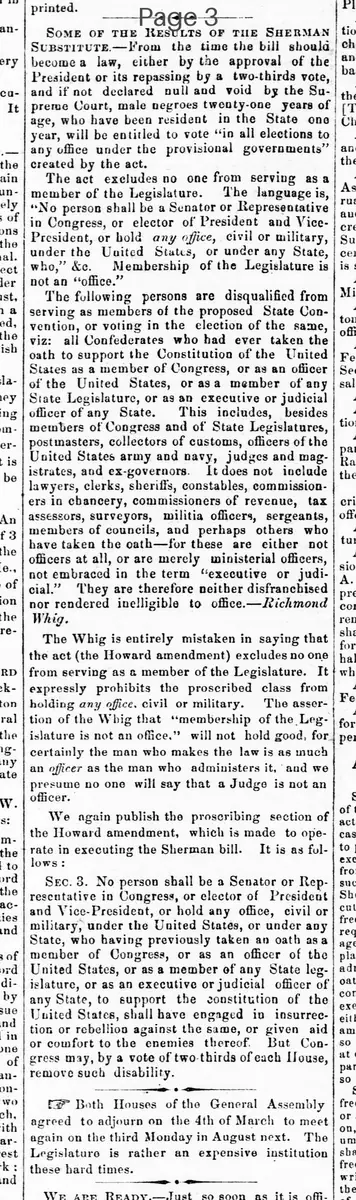
Some of the Results of the Sherman Substitute.
From the time the bill should become a law, either by the approval of the President or its repassing by a two-thirds vote, and if not declared null and void by the Supreme Court, male negroes twenty-one years of age, who have been resident in the State one year, will be entitled to vote "in all elections to any office under the provisional governments' created by the act.
The act excludes no one from serving as a member of the Legislature.
The language is,
"No person shall be a Senator or Representative in Congress, or elector of President and Vice-President, or hold any office, civil or military, under the United States, or under any State, who," &c.
Membership of the Legislature is not an "office."
The following persons are disqualified from serving as members of the proposed State Convention, or voting in the election of the same, viz: all Confederates who had ever taken the oath to support the Constitution of the United States as a member of Congress, or as an officer of the United States, or as a member of any State Legislature, or as an executive or judicial officer of any State.
This includes, besides members of Congress and of State Legislatures, postmasters, collectors of customs, officers of the United States army and navy, judges and magistrates, and ex-governors. It does not include lawyers, clerks, sheriffs, constables, commissioners in chancery, commissioners of revenue, tax assessors, surveyors, militia officers, sergeants, members of councils, and perhaps others who have taken the oath—for these are either not officers at all, or are merely ministerial officers, not embraced in the term "executive or judicial." They are therefore neither disfranchised nor rendered ineligible to office.—Richmond Whig.
The Whig is entirely mistaken in saying that the act (the Howard amendment) excludes no one from serving as a member of the Legislature. It expressly prohibits the proscribed class from holding any office, civil or military.
The assertion of the Whig that "membership of the Legislature is not an office," will not hold good, for certainly the man who makes the law is as much an officer as the man who administers it, and we presume no one will say that a Judge is not an officer.
We again publish the proscribing section of the Howard amendment, which is made to operate in executing the Sherman bill. It is as follows:
Sec. 3. No person shall be a Senator or Representative in Congress, or elector of President and Vice-President, or hold any office, civil or military, under the United States, or under any State, who having previously taken an oath as a member of Congress, or as an officer of the United States, or as a member of any State legislature, or as an executive or judicial officer of any State, to support the constitution of the United States, shall have engaged in insurrection or rebellion against the same, or given aid or comfort to the enemies thereof. But Congress may, by a vote of two-thirds of each House, remove such disability.
Both Houses of the General Assembly agreed to adjourn on the 4th of March to meet again on the third Monday in August next. The Legislature is rather an expensive institution these hard times.
From the time the bill should become a law, either by the approval of the President or its repassing by a two-thirds vote, and if not declared null and void by the Supreme Court, male negroes twenty-one years of age, who have been resident in the State one year, will be entitled to vote "in all elections to any office under the provisional governments' created by the act.
The act excludes no one from serving as a member of the Legislature.
The language is,
"No person shall be a Senator or Representative in Congress, or elector of President and Vice-President, or hold any office, civil or military, under the United States, or under any State, who," &c.
Membership of the Legislature is not an "office."
The following persons are disqualified from serving as members of the proposed State Convention, or voting in the election of the same, viz: all Confederates who had ever taken the oath to support the Constitution of the United States as a member of Congress, or as an officer of the United States, or as a member of any State Legislature, or as an executive or judicial officer of any State.
This includes, besides members of Congress and of State Legislatures, postmasters, collectors of customs, officers of the United States army and navy, judges and magistrates, and ex-governors. It does not include lawyers, clerks, sheriffs, constables, commissioners in chancery, commissioners of revenue, tax assessors, surveyors, militia officers, sergeants, members of councils, and perhaps others who have taken the oath—for these are either not officers at all, or are merely ministerial officers, not embraced in the term "executive or judicial." They are therefore neither disfranchised nor rendered ineligible to office.—Richmond Whig.
The Whig is entirely mistaken in saying that the act (the Howard amendment) excludes no one from serving as a member of the Legislature. It expressly prohibits the proscribed class from holding any office, civil or military.
The assertion of the Whig that "membership of the Legislature is not an office," will not hold good, for certainly the man who makes the law is as much an officer as the man who administers it, and we presume no one will say that a Judge is not an officer.
We again publish the proscribing section of the Howard amendment, which is made to operate in executing the Sherman bill. It is as follows:
Sec. 3. No person shall be a Senator or Representative in Congress, or elector of President and Vice-President, or hold any office, civil or military, under the United States, or under any State, who having previously taken an oath as a member of Congress, or as an officer of the United States, or as a member of any State legislature, or as an executive or judicial officer of any State, to support the constitution of the United States, shall have engaged in insurrection or rebellion against the same, or given aid or comfort to the enemies thereof. But Congress may, by a vote of two-thirds of each House, remove such disability.
Both Houses of the General Assembly agreed to adjourn on the 4th of March to meet again on the third Monday in August next. The Legislature is rather an expensive institution these hard times.
What sub-type of article is it?
Suffrage
Constitutional
Legal Reform
What keywords are associated?
Sherman Substitute
Howard Amendment
Negro Suffrage
Confederate Disqualification
Office Holding
Reconstruction
State Legislature
What entities or persons were involved?
Sherman Substitute
Howard Amendment
Richmond Whig
Confederates
Male Negroes
President
Supreme Court
Editorial Details
Primary Topic
Effects Of Sherman Substitute And Howard Amendment On Voting And Office Eligibility
Stance / Tone
Critical Refutation Of Richmond Whig's Interpretation
Key Figures
Sherman Substitute
Howard Amendment
Richmond Whig
Confederates
Male Negroes
President
Supreme Court
Key Arguments
Male Negroes 21+ Resident One Year Entitled To Vote In Provisional Government Elections
Act Disqualifies Certain Former Oath Takers Who Aided Rebellion From Offices
Legislative Membership Qualifies As An Office Under The Amendment
Refutes Whig's Claim That Legislature Membership Is Not An Office
Lists Disqualified Persons Including Congress Members, Officers, Judges
Excludes Ministerial Officers Like Sheriffs From Disqualification
Congress Can Remove Disabilities By Two Thirds Vote