Thank you for visiting SNEWPapers!
Sign up free
Story
April 20, 1816
Virginia Argus
Richmond, Virginia
What is this article about?
A new method for drawing heavy coal wagons using horses to push from behind is demonstrated in London, proving greater efficiency as 5 horses accomplish the work of 7, exciting public admiration for its simplicity.
Clipping
OCR Quality
95%
Excellent
Full Text
New mode for drawing a Waggon.
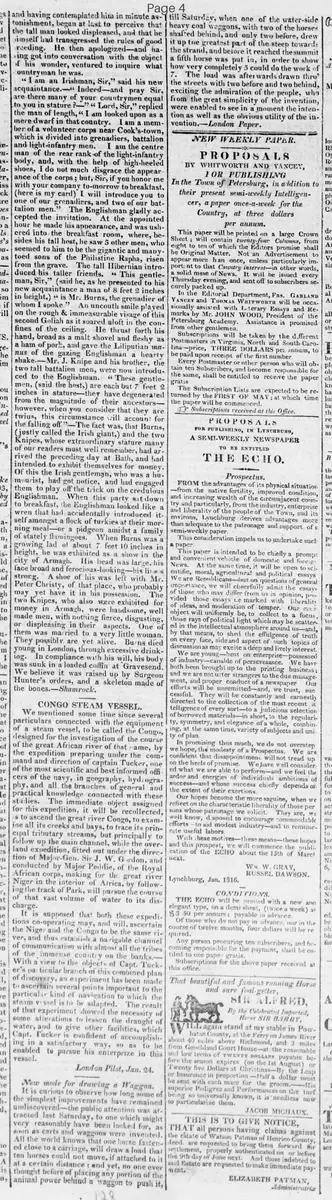
It is curious to observe how long some of the simplest improvements have remained undiscovered—the public attention was attracted last Saturday, to one which might very reasonably have been looked for, as soon as carts and waggons were invented. All the world knows that one horse fastened close to a carriage, will draw a load that ten horses could not move, if attached to it at a certain distance; and yet, no one ever thought before of placing any portion of the animal power behind a waggon to push it.
Till Saturday, when one of the water-side heavy coal waggons, with two of the horses shafted behind, and only two before, drew it up the greatest part of the steep towards the strand, and before it reached the summit a fifth horse was put in, in order to show how very completely 5 could do the work of 7. The load was afterwards drawn thro' the streets with two before and two behind, exciting the admiration of the people, who from the great simplicity of the invention, were enabled to see in a moment the intention as well as the obvious utility of the invention.—London Paper.
It is curious to observe how long some of the simplest improvements have remained undiscovered—the public attention was attracted last Saturday, to one which might very reasonably have been looked for, as soon as carts and waggons were invented. All the world knows that one horse fastened close to a carriage, will draw a load that ten horses could not move, if attached to it at a certain distance; and yet, no one ever thought before of placing any portion of the animal power behind a waggon to push it.
Till Saturday, when one of the water-side heavy coal waggons, with two of the horses shafted behind, and only two before, drew it up the greatest part of the steep towards the strand, and before it reached the summit a fifth horse was put in, in order to show how very completely 5 could do the work of 7. The load was afterwards drawn thro' the streets with two before and two behind, exciting the admiration of the people, who from the great simplicity of the invention, were enabled to see in a moment the intention as well as the obvious utility of the invention.—London Paper.
What sub-type of article is it?
Curiosity
What themes does it cover?
Triumph
What keywords are associated?
Wagon Drawing
Horse Efficiency
Invention Demonstration
Coal Wagon
Pushing Horses
Where did it happen?
London
Story Details
Location
London
Event Date
Last Saturday
Story Details
Demonstration of a wagon drawn by horses pushing from behind, allowing fewer horses to pull heavy loads up steep inclines and through streets, highlighting the invention's simplicity and utility.