Thank you for visiting SNEWPapers!
Sign up free
Editorial
November 17, 1838
South Branch Intelligencer
Romney, Hampshire County, West Virginia
What is this article about?
Editorial criticizes the jury's compromise verdict in the Baltimore trial of Stewart for murdering his father, where seven jurors found him guilty and five believed him innocent, resulting in second-degree murder conviction. Condemns the process as a mockery of justice, especially the minority's consent to imprison an innocent man.
Clipping
OCR Quality
95%
Excellent
Full Text
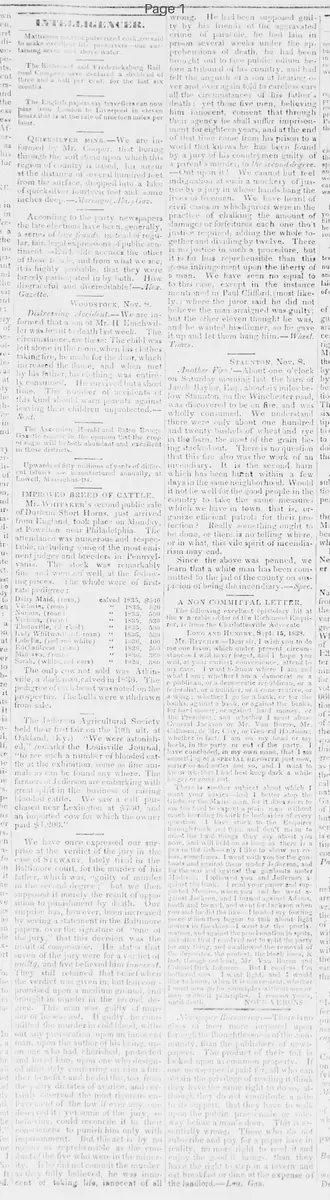
We have once expressed our surprise at the verdict of the jury in the case of Stewart, lately tried in the Baltimore court, for the murder of his father, which was, "guilty of murder in the second degree;" but we then supposed it merely the result of opposition to punishment by death. Our surprise has, however, been increased by seeing a statement in the Baltimore papers, over the signature of one of the jury, that this decision was the result of compromise. He states that seven of the jury were for a verdict of guilty, and five believed him innocent. They still retained that belief when the verdict was given in, but had compromised upon a medium ground, and brought in murder in the second degree.
This man was guilty of murder or he was not. If guilty, he committed the murder in cold blood, without any provocation, upon an innocent man, upon the author of his being, upon one who had cherished, protected and loved him, upon one who designed after death conferring on him a further benefit: and he did this, too, from the paltry dictates of avarice, and emphatically deserved the most rigorous enforcement of the law if ever any one deserved it: yet some of the jury, so believing, could reconcile it to their consciences to punish him only with imprisonment.
"But this act is by no means as reprehensible as the conduct of the five who were in the minority. If he did not commit the murder as they fully believed, he was innocent of taking life, innocent of all wrong. He had been supposed guilty by his friends of the aggravated crime of parricide, he had lain in prison several weeks under the apprehensions of death, he had been brought out to face public odium before a tribunal of his country, and had felt the anguish of a son at hearing over and over again told to careless ears all the circumstances of his father's death: yet those five men, believing him innocent, consent that through their agency he shall suffer imprisonment for eighteen years, and at the end of that time come from his prison to a world that knows he has been found by a jury of his countrymen guilty of a parent's murder, in the second degree. —Out upon it! We cannot but feel indignation at such a mockery of justice by a jury in whose hands hang the lives of freemen.
We have heard of civil cases, in which jurors were in the practice of chalking the amount of damages or forfeitures each one thought justice required, adding the whole together and dividing by twelve. There is no justice in such a procedure, but it is far less reprehensible than this gross infringement upon the liberty of a man. We have seen no equal to this case, except in the instance mentioned in Paul Clifford, (most likely,) where the juror said he did not believe the man arraigned was guilty; but the other eleven thought he was, and he wanted his dinner, so he gave it up and let them hang him.—Wheel. Times.
This man was guilty of murder or he was not. If guilty, he committed the murder in cold blood, without any provocation, upon an innocent man, upon the author of his being, upon one who had cherished, protected and loved him, upon one who designed after death conferring on him a further benefit: and he did this, too, from the paltry dictates of avarice, and emphatically deserved the most rigorous enforcement of the law if ever any one deserved it: yet some of the jury, so believing, could reconcile it to their consciences to punish him only with imprisonment.
"But this act is by no means as reprehensible as the conduct of the five who were in the minority. If he did not commit the murder as they fully believed, he was innocent of taking life, innocent of all wrong. He had been supposed guilty by his friends of the aggravated crime of parricide, he had lain in prison several weeks under the apprehensions of death, he had been brought out to face public odium before a tribunal of his country, and had felt the anguish of a son at hearing over and over again told to careless ears all the circumstances of his father's death: yet those five men, believing him innocent, consent that through their agency he shall suffer imprisonment for eighteen years, and at the end of that time come from his prison to a world that knows he has been found by a jury of his countrymen guilty of a parent's murder, in the second degree. —Out upon it! We cannot but feel indignation at such a mockery of justice by a jury in whose hands hang the lives of freemen.
We have heard of civil cases, in which jurors were in the practice of chalking the amount of damages or forfeitures each one thought justice required, adding the whole together and dividing by twelve. There is no justice in such a procedure, but it is far less reprehensible than this gross infringement upon the liberty of a man. We have seen no equal to this case, except in the instance mentioned in Paul Clifford, (most likely,) where the juror said he did not believe the man arraigned was guilty; but the other eleven thought he was, and he wanted his dinner, so he gave it up and let them hang him.—Wheel. Times.
What sub-type of article is it?
Crime Or Punishment
What keywords are associated?
Jury Compromise
Murder Verdict
Parricide
Baltimore Trial
Justice Mockery
Second Degree Murder
What entities or persons were involved?
Stewart
Baltimore Court
Jury
Editorial Details
Primary Topic
Criticism Of Jury Compromise In Stewart Parricide Trial
Stance / Tone
Indignant At Mockery Of Justice
Key Figures
Stewart
Baltimore Court
Jury
Key Arguments
Verdict Resulted From Compromise Between Seven Guilty Votes And Five Innocent Beliefs
Stewart Committed Cold Blooded Parricide For Avarice, Deserving Full Punishment
Minority Jurors Wrongly Consented To Imprisoning An Innocent Man For 18 Years
Process Is A Gross Infringement On Liberty, Worse Than Civil Case Averaging
Comparison To Fictional Juror Yielding For Dinner