Thank you for visiting SNEWPapers!
Sign up free
The Lancaster Ledger
Lancaster, Lancaster County, South Carolina
What is this article about?
Excerpts from chapters XII-XV of 'Almetta Meadows, The Maid of Watauga,' a romance novel. Almetta falls at Blowing Rock and learns of Walter's imprisonment. The Mountaineer helps Walter escape prison. They reunite, marry after adoptive mother's death, and at Salt Springs, Almetta discovers her true parents, Mr. and Mrs. Elvane, leading to family reconciliation.
Merged-components note: Continuation of the same serialized story 'Almetta Meadows' across pages 1 and 2, sequential reading order.
Clippings
1 of 2
OCR Quality
Full Text
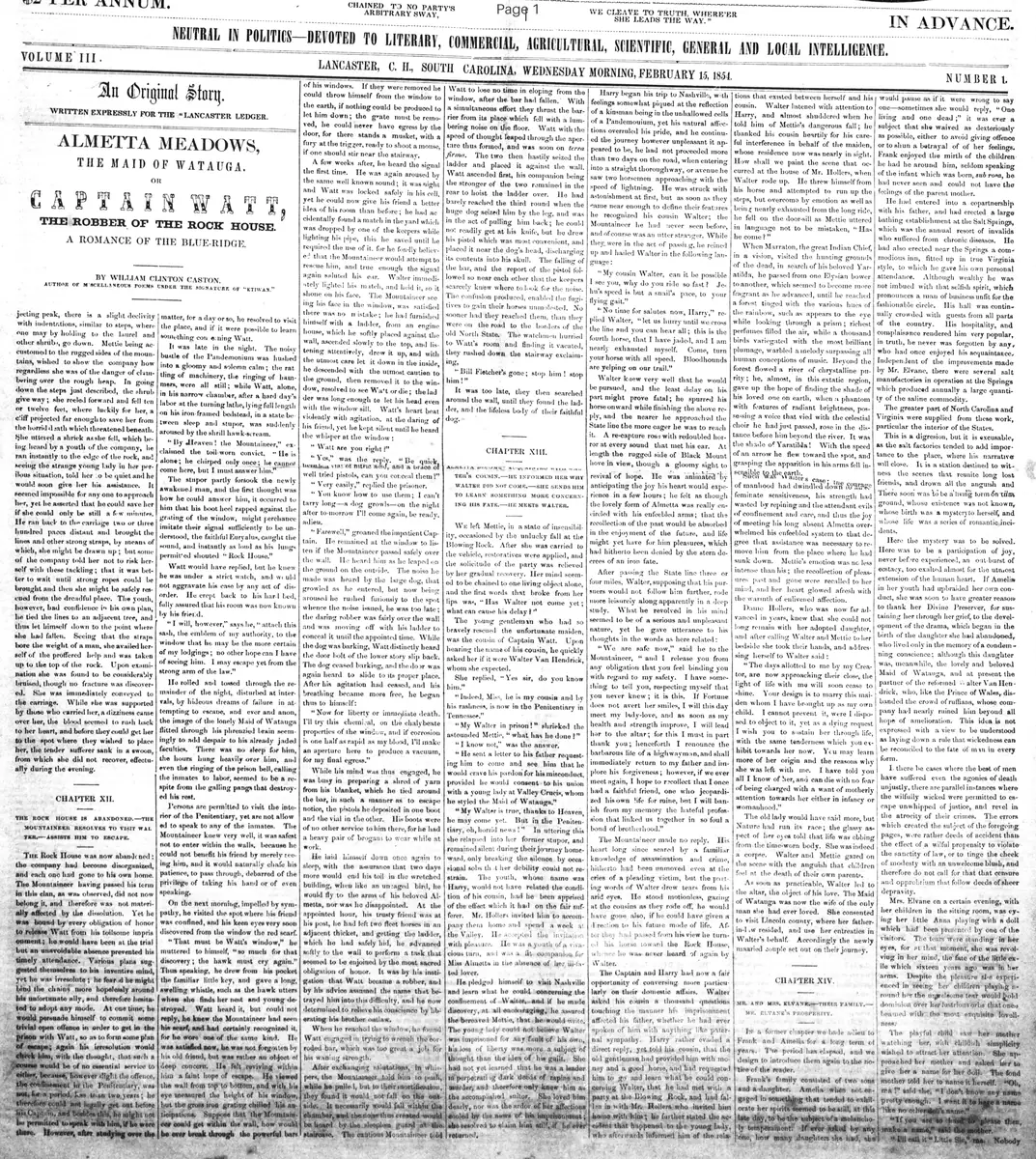
WRITTEN EXPRESSLY FOR THE LANCASTER LEDGER.
ALMETTA MEADOWS,
THE MAID OF WATAUGA.
OR
CAPTAIN
THE ROBBER OF THE ROCK HOUSE
A ROMANCE OF THE BLUE-RIDGE
BY WILLIAM CLINTON CASTON.
AUTHOR OF MISCELLANEOUS POEMS UNDER THE SIGNATURE OF "ETIWALX."
projecting peak, there is a slight declivity with indentations, similar to steps, where one may by holding to the laurel and other shrubs, go down. Mettie being accustomed to the rugged sides of the mountains, wished to show the company how regardless she was of the danger of clambering over the rough heap. In going down the steps just described, the shrub give way; she reached forward and fell ten or twelve feet, where luckily for her, a cliff projected far enough to save her from the horrid death which threatened beneath.
She uttered a shriek as she fell, which being heard by a youth of the company, he ran instantly to the edge of the rock, and seeing the strange young lady in her perilous situation, told her to be quiet and he would soon give her his assistance. It seemed impossible for any one to approach her, yet he asserted that he could save her if she could only be still a few minutes.
He ran back to the carriage two or three hundred paces distant and brought the lines and other strong straps, by means of which, she might be drawn up; but some of the company told her not to risk herself with these tackling; that it was better to wait until strong ropes could be brought and then she might be safely rescued from the dreadful place. The youth, however, had confidence in his own plan, he tied the lines to an adjacent tree, and thus let himself down to the point where she had fallen. Seeing that the straps bore the weight of a man, she availed herself of the proffered help and was taken up to the top of the rock. Upon examination she was found to be considerably bruised, though no fracture was discovered. She was immediately conveyed to the carriage. While she was supported by those who carried her, a dizziness came over her, the blood seemed to rush back to her heart, and before they could get her to the spot where they wished to place her, the tender sufferer sank in a swoon, from which she did not recover, effectually during the evening.
CHAPTER XII.
THE ROCK HOUSE IS ABANDONED.—THE MOUNTAINEER RESOLVES TO VISIT WALTER.—ASSISTS HIM TO ESCAPE.
The Rock House was now abandoned: the company had become disorganized, and each one had gone to his own home.
The Mountaineer having passed his term in this clan, as was observed, did not now belong to it, and therefore was not materially affected by the dissolution. Yet he was bound by every obligation of honor to release Watt from his toilsome imprisonment; he would have been at the trial but an unavoidable absence prevented his timely attendance. Various plans suggested themselves to his inventive mind, yet he was irresolute; he feared he might bind the chains more hopelessly around his unfortunate ally, and therefore hesitated to adopt any mode. At one time, he would persuade himself to commit some trivial offence in order to get in the prison with Watt, so as to form some plan of escape; again his irresolution would check him, with the thought, that such a course would be of no essential service to either, because, however slight the offence, the confinement in the Penitentiary, was not, for a period, less than two years; he therefore could not legally get out before his Captain, and besides this, he might not be permitted to speak with him, if he were there. However, after studying over the matter, for a day or so, he resolved to visit the place, and if it were possible to learn something concerning Watt.
It was late in the night. The noisy bustle of the pandemonium was hushed into a gloomy and solemn calm; the rattling of machinery, the ringing of hammers, were all still; while Watt, alone, in his narrow chamber, after a hard day's labor at the turning lathe, lying full length on his iron-framed bedstead, in a state between sleep and stupor, was suddenly aroused by the shrill hawk-scream.
"By heaven! the Mountaineer," exclaimed the toil-worn convict. "He is alone; he chirped only once; he cannot come here, but I must answer him."
The stupor partly forsook the newly awakened man, and the first thought was how he could answer him, it occurred to him that his boot heel rapped against the grating of the window, might perchance imitate their signal sufficiently to be understood, the faithful Euryalus, caught the sound, and instantly as loud as his lungs permitted shouted "Rock House."
Watt would have replied, but he knew he was under a strict watch, and would not aggravate his case by any act of disorder. He crept back to his hard bed, fully assured that his room was now known by his friend.
"I will, however," says he, "attach this sash, the emblem of my authority, to the window that he may be the more certain of my lodgings; no other hope can I have of seeing him. I may escape yet from the strong arm of the law."
He rolled and tossed through the remainder of the night, disturbed at intervals, by hideous dreams of failure in attempting to escape, and ever and anon, the image of the lonely Maid of Watauga flitted through his frenzied brain seemingly to add despair to his already jaded faculties. There was no sleep for him, the hours hung heavily over him, and even the ringing of the prison bell, calling the inmates to labor, seemed to be a respite from the galling pangs that destroyed his rest.
Persons are permitted to visit the interior of the Penitentiary, yet are not allowed to speak to any of the inmates. The Mountaineer knew very well, it was safest not to enter within the walls, because he could not benefit his friend by merely seeing him, and it would naturally chafe his patience, to pass through, debarred of the privilege of taking his hand or of even speaking.
On the next morning, impelled by sympathy, he visited the spot where his friend was confined, and his keen eyes very soon discovered from the window the red scarf.
"That must be Watt's window," he muttered to himself, "so much for that discovery; the hawk must cry again."
Thus speaking, he drew from his pocket the familiar little key, and gave a long swelling whistle, such as the hawk utters when she finds her nest and young destroyed. Watt heard it, but could not reply, he knew the Mountaineer had seen his scarf, and had certainly recognized it. for he wore one of the same kind. He was satisfied now, he was not forgotten by his old friend, but was rather an object of deep concern. He felt reviving within him a faint hope of escape. He viewed the wall from top to bottom, and with his eye measured the height of his window, but the gross iron grating chilled his anticipations. Suppose that the Mountaineer could get within the wall, how would he ever break through the powerful bars of his windows. If they were removed he could throw himself from the window to the earth, if nothing could be produced to let him down; the grate must be removed, he could never have egress by the door, for there stands a musket, with a fury at the trigger, ready to shoot a mouse, if one should stir near the stairway.
A few weeks after, he heard the signal the first time. He was again aroused by the same well known sound; it was night and Watt was locked safely in his cell, yet he could now give his friend a better idea of his room than before; he had accidentally found a match in the yard which was dropped by one of the keepers while lighting his pipe, this he saved until he required the use of it. for he fondly believed that the Mountaineer would attempt to rescue him, and true enough the signal again saluted his ear. Walter immediately lighted his match, and held it, so it shone on his face. The Mountaineer seeing his face in the window, was satisfied there was no mistake: he had furnished himself with a ladder, from an engine house, which he softly placed against the wall, ascended slowly to the top, and listening attentively, drew it up, and with the utmost care let it down in the inside, he descended with the utmost caution to the ground, then removed it to the window, resolved to see Watt or die; the ladder was long enough to let his head even with the window sill. Watt's heart beat violently with agitation. at the daring of his friend, yet he kept silent until he heard the whisper at the window :
"Watt are you right?"
"Yes," was the reply. "Be quick, furnisha way or nitric acid, and a brace of well tried pistols, can you conceal them?"
"Very easily," replied the prisoner.
"You know how to use them: I can't tarry long—a dog growls—on the night after to-morrow I'll come again, be ready, adieu."
"Farewell," groaned the impatient Captain. He remained at the window to listen if the Mountaineer passed safely over the wall. He heard him as he leaped on the ground on the outside. The noise he made was heard by the large dog, that growled as he entered, but now being aroused he rushed furiously to the spot whence the noise issued, he was too late; the daring robber was fairly over the wall and was moving off with his ladder to conceal it until the appointed time. While the dog was barking, Watt distinctly heard the door bolt of the lower story slip back. The dog ceased barking, and the door was again heard to slide to its proper place.
After his agitation had ceased, and his breathing became more free, he began thus to himself:
"Now for liberty or immediate death. I'll try this chemical, on the chalybeate properties of the window., and if corrosion is one half as rapid as my blood, I'll make an aperture here to produce a vacuum, for my final egress."
While his mind was thus engaged, he was busy in preparing a shred of yarn from his blanket, which he tied around the bar, in such a manner as to escape notice, the pistols he deposited in one boot and the vial in the other. His boots were of no other service to him there, for he had a heavy pair of brogans to wear while at work.
He laid himself down once again to sleep, with the assurance that two days more would end his toil in the wretched building, when like an uncaged bird, he would fly to the arms of his beloved Almetta, nor was he disappointed. At the appointed hour, his trusty friend was at his post, he had left two fleet horses in an adjacent thicket, and getting the ladder, which he had safely hid, he advanced softly to the wall to perform a task that seemed to be enjoined by the most sacred obligation of honor. It was by his instigation that Watt became a robber, and by his advice assumed the name that betrayed him into this difficulty, and he now determined to relieve his conscience by liberating his brother outlaw.
When he reached the window, he found Watt engaged in trying to wrench the corroded bar, which was too great a job for his waning strength.
After exchanging salutations, in whispers, the Mountaineer told him to push, while he pulled, but to their mortification. they found it would not fall on the outside. It necessarily would fall within the chamber, and the noise thus created would be heard by the sleepless guard at the staircase. The cautious Mountaineer told Watt to lose no time in eloping from the window, after the bar had fallen. With a simultaneous effort they thrust the barrier from its place which fell with a lumbering noise on the floor. Watt with the speed of thought leaped through the aperture thus formed, and was soon on terra firma. The two then hastily seized the ladder and placed it against the wall. Watt ascended first, his companion being the stronger of the two remained in the rear to hoist the ladder over. He had barely reached the third round when the huge dog seized him by the leg, and was in the act of pulling him back; he could not readily get at his knife, but he drew his pistol which was most convenient, and placed it near the dog's head, discharging its contents into his skull. The falling of the bar, and the report of the pistol followed so near each other that the keepers scarcely knew where to look for the noise. The confusion produced, enabled the fugitives to gain their horses unmolested. No sooner had they reached them, than they were on the road to the borders of the old North State. The watchmen hurried to Watt's room and finding it vacated, they rushed down the stairway exclaiming,
"Bill Fletcher's gone; stop him! stop him!"
It was too late, they then searched around the wall, until they found the ladder, and the lifeless body of their faithful dog.
CHAPTER XIII.
ALMETTA DURING A TENDER'S COUSIN.—HE INFORMED HER WHY WALTER DID NOT COME.—SHE SENDS HIM TO LEARN SOMETHING MORE CONCERNING HIS FATE.—HE MEETS WALTER.
We left Mettie, in a state of insensibility, occasioned by the unlucky fall at the Blowing Rock. After she was carried to the vehicle, restoratives were applied, and the solicitude of the party was relieved by her gradual recovery. Her mind seemed to be chained to one living object alone, and the first words that broke from her lips was, "Has Walter not come yet; what can cause his delay?"
The young gentleman who had so bravely rescued the unfortunate maiden, was the cousin of Captain Watt. Upon hearing the name of his cousin, he quickly asked her if it were Walter Van Hendrick, whom she expected.
She replied, "Yes sir, do you know him."
"Indeed, Miss, he is my cousin and by his rashness, is now in the Penitentiary in Tennessee."
"My Walter in prison!" shrieked the astounded Mettie, "what has he done?"
"I know not," was the answer.
"He sent a letter to his father requesting him to come and see him that he would crave his pardon for his misconduct. provided he would consent to his union with a young lady at Valley Crucis, whom he styled the Maid of Watauga."
"My Walter is true, thanks to Heaven, he may come yet. But in the Penitentiary, oh, horrid news!" In uttering this she relapsed into her former stupor, and remained silent during their journey homeward, only breaking the silence by occasional sobs that her debility could not restrain. The youth, whose name was Harry, would not have related the condition of his cousin, had he been apprised of the effect which it had on the fair sufferer. Mr. Hollers invited him to accompany them home and spend a week at the Valley. He accepted the invitation with pleasure. He was a youth of a vivacious turn, and was a fit companion for Miss Almetta in the absence of her ill-fated lover.
He pledged himself to visit Nashville and learn what he could concerning the confinement of Walter,—and if he made discovery, at all encouraging, he assured the bereaved Mettie, that he would write. The young lady could not believe Walter was imprisoned for any fault of his own, his loss of liberty was more a subject of thought than the idea of his guilt. She had not yet learned that he was a leader in perpetrating dark deeds of rapine and murder, and therefore only knew him as the accomplished suitor. She loved him dearly, nor was the ardor of her affections cooled by the news of his imprisonment she resolved to claim him still, if he ever returned.
Harry began his trip to Nashville, with feelings somewhat piqued at the reflection of a kinsman being in the unhallowed cells of a Pandemonium, yet his natural affections overruled his pride, and he continued the journey however unpleasant it appeared to be, he had not proceeded more than two days on the road, when entering into a straight thoroughway, or avenue he saw two horsemen approaching with the speed of lightning. He was struck with astonishment at first, but as soon as they came near enough to define their features he recognized his cousin Walter; the Mountaineer he had never seen before, and of course was an utter stranger. While they were in the act of passing, he reined up and hailed Walter in the following language:
"My cousin Walter, can it be possible I see you, why do you ride so fast? Jehu's speed is but a snail's pace, to your flying gait."
"No time for salutes now, Harry," replied Walter, "let us hurry until we cross the line and you can hear all; this is the fourth horse, that I have jaded, and I am nearly exhausted myself. Come, turn your horse with all speed. Bloodhounds are yelping on our trail."
Walter knew very well that he would be pursued, and the least delay on his part might prove fatal; he spurred his horse onward while finishing the above reply, and the nearer he approached the State line the more eager he was to reach it. A re-capture rose with redoubled horror at every sound that met his ear. At length the rugged side of Black Mountain hove in view, though a gloomy sight to others, it was a revival of hope. He was animated by anticipating the joy his heart would experience in a few hours; he felt as though the lovely form of Almetta was really encircled with his enfeebled arms; that the recollection of the past would be absorbed in the enjoyment of the future, and life might yet have for him pleasures, which had hitherto been denied by the stern decrees of an iron fate.
After passing the State line three or four miles, Walter, supposing that his pursuers would not follow him further. rode more leisurely along apparently in a deep study. What he revolved in his mind seemed to be of a serious and unpleasant nature, yet he gave utterance to his thoughts in the words as here related :
"We are safe now," said he to the Mountaineer, "and I release you from any obligation that you feel binding you with regard to my safety. I have something to tell you, respecting myself that you never knew ; it is this. If Fortune does not avert her smiles, I will this day meet my lady-love, and as soon as my health and strength improve, I will lead her to the altar; for this I must in part thank you; henceforth I renounce the barbarous life of a highwayman, and shall immediately return to my father and implore his forgiveness; however, if we ever meet again, I hope to recollect that I once had a faithful friend, one who jeopardized his own life for mine, but I will banish from my memory the hateful profession that linked us together in so foul a bond of brotherhood."
The Mountaineer made no reply. His heart long since seared by a familiar knowledge of assassination and crime. hitherto had been unmoved even at the cries of a pleading victim, but the parting words of Walter drew tears from his arid eyes. He stood motionless, gazing at the cousins as they rode off, he would have gone also, if he could have given a direction to his future mode of life. After they had passed from his view he turned his horse toward the Rock House. whence he was never heard of again by Walter.
The Captain and Harry had now a fair opportunity of conversing more particularly on their domestic affairs. Walter asked his cousin a thousand questions touching the manner his imprisonment affected his father, whether he had ever spoken of him with anything like paternal sympathy. Harry rather evaded a direct reply, yet told his cousin, that the old gentleman had provided him with money and a good horse, and had requested him to go and learn what he could concerning Walter, that he had met with a party at the Blowing Rock, and had fallen in with Mr. Hollers who invited him home with him? he farther stated the accident that happened to the young lady. who afterwards informed him of the relations that existed between herself and his cousin. Walter listened with attention to Harry, and almost shuddered when he told him of Mettie's dangerous fall; he thanked his cousin heartily for his careful interference in behalf of the maiden, whose residence now was nearly in sight.
How shall we paint the scene that occurred at the house of Mr. Hollers, when Walter rode up. He threw himself from his horse and attempted to run up the steps, but overcome by emotion as well as being nearly exhausted from the long ride, he fell on the door-sill as Mettie uttered in language not to be mistaken, "Has he come? "
When Marraton, the great Indian Chief in a vision, visited the hunting grounds of the dead, in search of his beloved Yaritilda, he passed from one Elysian bower to another, which seemed to become more fragrant as he advanced, until he reached a forest tinged with the various hues of the rainbow, such as appears to the eye while looking through a prism; richest perfumes filled the air, while a thousand birds variegated with the most brilliant plumage, warbled a melody surpassing all human conceptions of music. Beyond the forest flowed a river of crystalline purity; he, almost, in this ecstatic region, gave up the hope of finding the shade of his loved one on earth, when a phantom with features of radiant brightness, possessing a voice that vied with the celestial choir he had just passed, rose in the distance before him beyond the river. It was the shade of Yaritilda! With the speed of an arrow he flew toward the spot, and grasping the apparition in his arms fell insensible
Such was the lover's case: the courage of manhood had dwindled down to feminine sensitiveness, his strength had wasted by repining and the attendant evils of confinement and care, and thus the joy of meeting his long absent Almetta overwhelmed his enfeebled system to that degree that assistance was necessary to remove him from the place where he had sunk down. Mettie's emotion was no less intense than his; the recollection of pleasures past and gone were recalled to her mind, and her heart glowed afresh with the warmth of enlivened affection.
Dame Hollers, who was now far advanced in years, knew that she could not long remain with her adopted daughter, and after calling Walter and Mettie to her bedside she took their hands, and addressing herself to Walter said :
"The days allotted to me by my Creator, are now approaching their close, the light of life with me will soon cease to shine. Your design is to marry this maiden whom I have brought up as my own child. I cannot prevent it, were I disposed to object to it, yet as a dying request I wish you to sustain her through life, with the same tenderness which you exhibit towards her now. You may learn more of her origin and the reasons why she was left with me. I have told you all I know of her, and can die with no fear of being charged with a want of motherly attention towards her either in infancy or womanhood."
The old lady would have said more, but Nature had run its race; the glassy aspect of her eyes told that life was ebbing from the time-worn body. She was indeed a corpse. Walter and Mettie gazed on the scene with the anguish that children feel at the death of their own parents.
As soon as practicable, Walter led to the altar, the object of his love. The Maid of Watauga was now the wife of the only man she had ever loved. She consented to visit Lincoln county, where her father-in-law resided, and use her entreaties in Walter's behalf. Accordingly the newly married couple set out on their journey.
CHAPTER XIV.
MR. AND MRS. ELVANE.—THEIR FAMILY.—MR. ELVANE'S PROSPERITY.
In a former chapter we bade adieu to Frank and Amelia for a long term of years. The period has elapsed, and we design to introduce them again to the notice of the reader.
Frank's family consisted of two sons and a daughter. Amelia when not engaged in something that tended to exhilarate her spirits seemed to be still, at this late day, to be the subject of a melancholy temperament. If ever asked by any one, how many daughters she had, she would pause as if it were wrong to say one—sometimes she would reply, "One living and one dead;" it was ever a subject that she waived as dexteriously as possible, either to avoid giving offence or to shun a betrayal of her feelings.
Frank enjoyed the mirth of the children he had around him, seldom speaking of the infant which was born, sub rosa, he had never seen and could not have the feelings of the parent mother.
He had entered into a copartnership with his father, and had erected a large bathing establishment at the Salt Springs, which was the annual resort of invalids who suffered from chronic diseases. He had also erected near the Springs a commodious inn, fitted up in true Virginia style, to which he gave his own personal attendance. Although wealthy he was not imbued with that selfish spirit, which pronounces a man of business unfit for the fashionable circle. His hall was continually crowded with guests from all parts of the country. His hospitality, and complaisance rendered him very popular, in truth, he never was forgotten by any, who had once enjoyed his acquaintance.
Independent of the improvements made by Mr. Elvane, there were several salt manufactories in operation at the Springs which produced annually a large quantity of the saline commodity.
The greater part of North Carolina and Virginia were supplied from these works, particularly the interior of the States.
This is a digression, but it is excusable, as the salt factories tended to add importance to the place, where his narrative will close. It is a station destined to witness the scenes that reunite long lost friends, and drown all the anguish and
There soon was to be a living form on that ground, whose existence was not known, whose birth was a mystery to herself, and whose life was a series of romantic incidents.
Here the mystery was to be solved. Here was to be a participation of joy, never before experienced, an outburst of ecstasy, too exalted almost for the utmost extension of the human heart. If Amelia in her youth had upbraided her own conduct, she was soon to have greater reason to thank her Divine Preserver, for sustaining her through her grief, to the development of the drama, which began in the birth of the daughter she had abandoned. who lived only in the memory of a condemning conscience: although this daughter was, meanwhile, the lovely and beloved Maid of Watauga, and at present the partner of the reformed Walter Van Hendrick. who, like the Prince of Wales. disbanded the crowd of ruffians, whose company had nearly ruined him beyond all hope of amelioration. This idea is not expressed with a view to be understood as laying down a rule that wickedness can be reconciled to the fate of man in every form.
If there be cases where the best of men have suffered even the agonies of death unjustly, there are parallel instances where the wilfully wicked were permitted to escape unwhipped of justice, and revel in the atrocity of their crimes. The errors which created the subject of the foregoing pages, were rather deeds of accident than the effect of a wilful propensity to violate the sanctity of law, or to tinge the cheek of modesty with an unwelcome blush, and therefore do not call for that censure and opprobrium that follow deeds of sheer depravity.
Mrs. Elvane on a certain evening, with her children in the sitting room, was eyeing her little Anna playing with a doll which had been presented by one of the visitors. The tears were standing in her eyes, for at that moment, she was revolving in her mind, the fate of the little exile which sixteen years ago was in her arms. Despite the pleasure she experienced in seeing her children playing around her the unwelcome tear would hold dominion over her lustrous orbs that once beamed with the most exquisite loveliness:
The playful child saw her mother watching her, with childish simplicity wished to attract her attention. She approached her mother and asked her to give her a name for her doll. The fond mother told her to name it herself. "Oh, ma!" said she, "I don't know any name pretty enough." I want it to have a name like no other doll's name."
"If you are so hard to please then, make a name" said the mother. "I'll call it "Little Sis" Mary Nobody
"Yes, somebody did leave it, though," sobbed the mother, "but a wolf or panther has long ago torn her little limbs to pieces."
"No, ma," said the prattler, "I won't call it that name, because every time I mention my doll you'll talk of my sister, and then you look so sorry, that I must cry too! I'll give it away, so I will!"
Mrs. Elvane had scarcely removed the handkerchief from her face, when in came her husband with a smile on his face. He presented a note to his lady, exclaiming at the same time, "Look here, Amelia, here is something—dry your eyes. Why, you are ever sad when I come in. I will be compelled to undergo a perpetual imprisonment by your side, if, when I am absent, you continue in this showery mood. Cheer up! Hear me:"
"The Landlord will please hold in reserve, apartments for a lady and gentleman, until to-morrow evening, and oblige his humble serv't, W. VAN HENDRICK."
"This gentleman and lady," continued the cheerful host, "are direct from Charleston. Try and be ready to receive them." At that instant the bell rang and Elvane hurried to the Hall.
CHAPTER XV.
WALTER AND HIS
LAPX
PURSUE
THEIR
JOURNEY.—THEY
REMAIN
WITH
WA L-
TER's
FATHER
FOR
A SHORT
TIME.—
THEY
MAKE
A
TOUR
TO
THE
SALT
SPRINGS.—THE
DISCOVERY.—CONCLU-
SION.
There was one move to make, ere Walter could call himself entirely happy,—that was to see his father. He had begun his journey with that view when we left him. He arrived safely at the place where his existence begun, and the joys of his boyhood rushed to his memory with a thrilling sensation. The trees, garden and buildings all bore the same appearances as when he forsook them. In his own feelings there was a greater change than in any material object attached to the home of his childhood. His father was firm and unaltered, yet he received his penitent son with a fatherly tenderness. Walter after taking his hand, introduced his lady, then kneeling asked his pardon, assuring him that he was wholly cured of his petulance, and that he, henceforth, would endeavor to merit his affection. The lenient father forgave Walter, and received Mettie, as his own, with open arms. Her natural flow of spirits, gained on the old gentleman, insomuch that she became a great favorite, and he appeared truly proud of his Mountain Bird, as he termed her.
After Walter had rested a day or so, and seemed to feel at home, his father rather with the air of irony accosted him thus:
"Walter, I suppose you have seen the elephant!"
"Father, I don't know what name to give it, but I saw some kind of a brute."
"A brute, eh?" was the laconic inquiry, "what did it resemble?"
"I think," said Walter, "they called it a 'Wooden Horse,'"
"And did you ride it?"
"Yes, father."
"How did you drive it onward—spurred it, I reckon?"
"No, indeed! the order was reversed; if it did not move fast enough, they spurred me." The old man was forced to smile, although the recital was in itself a cause of most bitter anguish. The father resuming his gravity, continued:
"You have purchased knowledge at a high rate, and I hope it will have its influence over your future conduct in this life. I will not advise you at all, as to what I believe proper for you, but of this fact you are well assured, that a man can do as he chooses with his property, and that I have only two sons."
Walter knew full well the meaning of his inflexible parent, and, though not avaricious, he thought it the most politic course to act in a manner that would ensure a share of his father's estate. This, he conceived to be doubly binding, first, as regarded his relation of son, and secondly, that of being the husband of a young and tender wife, dependent altogether on his own resources.
His health was greatly impaired by his recent troubles, and it was supposed that travelling on sea might act as a restorative, or if the sea breezes failed to improve him, to visit the Salt Springs, in Washington county, where the father and mother of Mettie, (though unknown to her,) resided, and which at that time had acquired a high reputation in healing chronic affections of every kind.
Walter was inclined to go, and his father furnished him with the funds necessary to accomplish the journey. He and lady travelled by stage to Charleston and after spending a day or two in the "world of homes," as Mettie termed the city, they went aboard a steam boat bound for Wilmington. Walter enjoyed the trip well enough but did not derive much substantial benefit from the short passage, resolved to continue to Virginia by land. He therefore took stage for Raleigh, where he and his fair companion remained nearly a week.
The staging was very wearisome to persons unused to that mode of travelling, and a temporary rest was not in the least repugnant to their ideas of personal ease. While here, Walter addressed the note to the landlord at the famous bathing establishment, which he the landlord, had read to his wife as the bell called him away. By some means or other it did not reach Mr. Elvane, until Walter came to his destined place. This accounts for the summons the bell gave him, for at that moment (Walter and his lady having availed themselves of private conveyance) drove up to the door of the inn.
As Mr. Elvane approached Walter, the latter addressed him thus:
"Have I the pleasure of seeing the Landlord?"
"He is before you," was the response.
"Did you at any time recently receive a note from W. Van Hendrick?" enquired Walter.
"Yes, sir, a few minutes since. You are the gentleman, I presume?"
"The same, sir," said Walter, "Fearing that a throng of visitors might occupy your rooms, I wrote in order to charter apartments for my lady and myself."
"All right, sir. Excuse me, madam," said the accommodating host. "Mrs. Van Hendrick, walk into the lady's parlor. Mrs. Elvane, although indisposed will be in presently."
Mr. Elvane showed his incognita daughter the designated room, then turning to Walter, continued in his usual familiar style: "Yes, Mr. Van Hendrick my house is always a scene of bustle here and there, but sir, I can accommodate yourself and lady with suitable rooms. From Charleston, did you say?"
"I am a resident of Lincoln, but I came via the city, in order to try the sea, yet, I feel no substantial benefit from the breezes. The renown of your baths had reached me, and I thought it advisable to give them a trial. Perhaps an external application of the saline fluid, as found in streams, is more pleasant than the continual roaring and dashing which we are compelled to undergo on the broad ocean."
Walter enjoyed the baths with the conviction that their frequent use would restore his accustomed vigor of body and mind. On the evening of the third day after their arrival at this place, a party of ladies had assembled in the parlor to play at chess, tivoli, or any game whatever that might please their fancy in dispelling the tedium that arises from being among strangers. A lemonade was served round nearly the whole company were engaged in some amusement or other Mettie seemed to take delight in playing with little Annie, who was skipping about the parlor. At length she took up the interesting prattler and placed her on her knee. The child in the simplicity of its nature, began to handle the locket which was suspended from the neck of her own dear sister. Little Annie feeling a strong desire to possess the gem, asked Mettie to give it to her. Mettie told her she could not part with it—that it had been on her neck a long time, that she never suffered it to leave its place five minutes in her whole life.
"What for," said the innocent child.
"Because," replied Mettie, patting the child's cheek, "it was my mother's I suppose, and I can never give it up."
This was a beautiful scene for the lovers of romance to speculate upon. There sat the two sisters entirely unknown to each other, amusing themselves with their own small chat, while opposite sat the mother, glancing her eyes now and then at Annie with the intention of checking her rudeness if she transcended her often defined limits, regarding Mettie only as an agreeable guest: but quickly was this indifference driven from her bosom to be followed by emotions of the most ecstatic character that could move the sensitive breast of an amiable female. There she sat, with no thought more remote from her mind than that of being before the child which she sixteen years ago, had surrendered to the wild valleys of the Watauga, rather than to nourish it, under the stigma of illegitimacy. The recognition was to be made, however illy prepared it might find her.
As Mettie let the words "It was my mother's." drop from her lips, the mother was struck with the speech and curiosity led her to examine it, with no other motive than merely to gratify an idle wish. The other ladies, as was observed, were engaged at their evening amusements, and did not notice the group above described. Amelia drew near to Mettie and taking the locket in her hand, as if by magic her nerves began to tremble. As soon as she recognized the initials of her own name, which oftentimes perplexed her long absent daughter, she shrieked with a piercing voice,
"My God! the self-same locket! my child! No, it can't be her. Oh, Father of Heaven, can it be possible! The raspberry! Yes, yes, it is indeed my own darling babe!"
Mettie was terrified beyond the power of utterance, yet in an instant she satisfied her almost frantic mother, who, falling in her arms was lost to reason and the most bitter hysterical convulsions.
The noise in the parlor drew the gentlemen from the public hall in great haste and confusion. Mr. Elvane, in the highest degree of agitation inquired into the cause of his wife's excitement which being explained, his joy was scarcely less than that of Amelia, who now was lying on the sofa breathing as one in the paroxysm of apoplexy.
Mr. Elvane, as soon as he could get breath, clasped Mettie in his arms and exclaimed with a father's warmest love,
"My daughter! my own lovely child! I never saw you until you arrived here. Yet I believe you are the dear babe that I thought long since dead."
The happy father then took Mr. Van Hendrick by the hand and with no less warmth than he spoke to Mettie continued:
"I claim you as my son, and had you brought my daughter before you married, the joy you have created, would have entitled you to her at my hands."
The condition of the swooning mother now occupied the attention of the company for the remainder of the evening. It was doubtful, a fortnight, at least, whether she would recover, yet the Divine Power which sustained her through all her troubles, did not forsake her in the excess of joy which nearly overcome her in the restoration of her child.
Walter consented to dwell there with his newly discovered parents. He wrote to his own father concerning the discovery he and his happy consort had made, and told him he at some time would visit him, but that he chose to live with Mettie's parents.
Our narrative is ended. We did not begin with a view to draw in high colors the charms of ideal beauty, or to chill the blood with high wrought scenes of bloodshed and rapine. The design was merely to exhibit in a plain manner, that war has inflicted a heavier blow upon the hearts of individuals in the domestic circle, than, damage to nations at large.
(CONCLUDED.)
What sub-type of article is it?
What themes does it cover?
What keywords are associated?
What entities or persons were involved?
Literary Details
Title
Almetta Meadows, The Maid Of Watauga. Or Captain The Robber Of The Rock House. A Romance Of The Blue Ridge
Author
By William Clinton Caston. Author Of Miscellaneous Poems Under The Signature Of "Etiwalx."
Subject
A Romance Of The Blue Ridge Involving Robbery, Escape, And Family Reunion
Form / Style
Romance Novel Chapters In Prose
Key Lines