Thank you for visiting SNEWPapers!
Sign up free
The Virginia Gazette
Williamsburg, Virginia
What is this article about?
In early March 1776, provincial forces in Savannah, Georgia, repelled a British squadron and troops attempting to seize merchant ships loaded with rice and deerskins. They burned several vessels to prevent capture, captured two ships, and forced the British to retreat, with Governor Wright fleeing aboard a warship.
Merged-components note: Continuation of the same domestic news report on events in Georgia/Savannah across page 2 and page 3; relabeled from story to domestic_news as it is a non-narrative news item focused on local colonial events.
Clippings
1 of 2
OCR Quality
Full Text
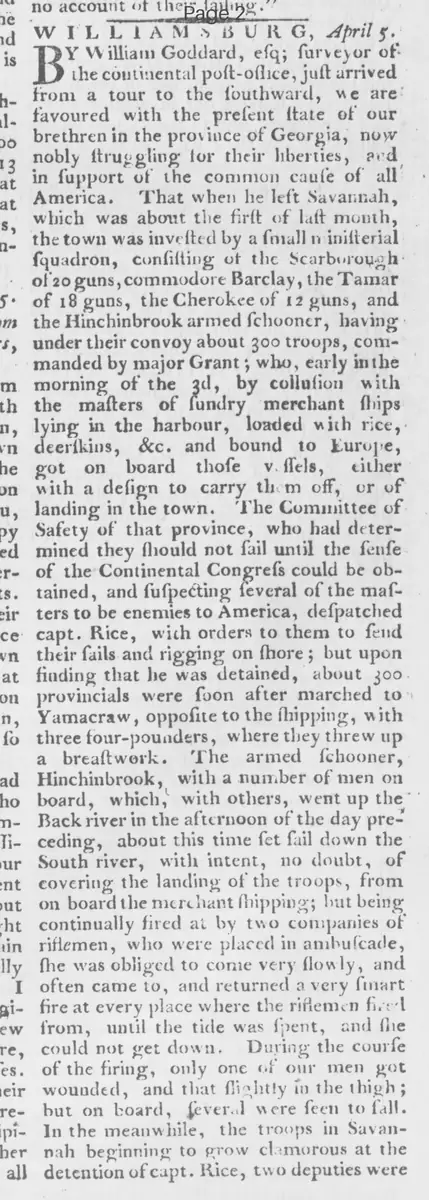
By William Goddard, esq; surveyor of the continental post-office, just arrived from a tour to the southward, we are favoured with the present state of our brethren in the province of Georgia, now nobly struggling for their liberties, and in support of the common cause of all America. That when he left Savannah, which was about the first of last month, the town was invested by a small ministerial squadron, consisting of the Scarbrough of 20 guns, commodore Barclay, the Tamar of 18 guns, the Cherokee of 12 guns, and the Hinchinbrook armed schooner, having under their convoy about 300 troops, commanded by major Grant; who, early in the morning of the 3d, by collusion with the masters of sundry merchant ships lying in the harbour, loaded with rice, deerskins, &c. and bound to Europe, got on board those vessels, either with a design to carry them off, or of landing in the town. The Committee of Safety of that province, who had determined they should not sail until the sense of the Continental Congress could be obtained, and suspecting several of the masters to be enemies to America, dispatched capt. Rice, with orders to them to send their sails and rigging on shore; but upon finding that he was detained, about 200 provincials were soon after marched to Yamacraw, opposite to the shipping, with three four-pounders, where they threw up a breastwork. The armed schooner, Hinchinbrook, with a number of men on board, which, with others, went up the Back river in the afternoon of the day preceding, about this time set sail down the South river, with intent, no doubt, of covering the landing of the troops, from on board the merchant shipping; but being continually fired at by two companies of riflemen, who were placed in ambuscade, she was obliged to come very slowly, and often came to, and returned a very smart fire at every place where the riflemen felt from, until the tide was spent, and she could not get down. During the course of the firing, only one of our men got wounded, and that slightly in the thigh; but on board, several were seen to fall. In the meanwhile, the troops in Savannah beginning to grow clamorous at the detention of capt. Rice, two deputies were
Sent on board the ministerial fleet, unarmed, to demand the release of him and his people, when Commodore Barclay and Major Grant, contrary to all the principles which cement society, and govern mankind, refused to deliver them up. This circumstance, added to the unmanly attack upon a few men in an open boat, produced a general discharge from the field-pieces and intrenchments on the banks of the river, which was returned, with great vigour, from the shipping, without their being able to do any execution, although cannon balls were incessantly whistling in the ears of our undaunted countrymen; but the besiegers, it is believed, lost many of their men, as they were seen frequently to fall. About 4 o'clock, the Committee of Safety gave orders to burn the vessels, being determined that all should perish, in a noble conflagration, lighted by themselves, rather than that the enemy should possess them, or get a footing in their country; whereupon the Inverness, Capt. McGillivray, was set on fire, with a cargo of rice, &c. valued at 5000l. sterling. and crew loose. The soldiers on board her, to save themselves from perishing, got ashore in the marsh, in the most laughable confusion, whilst our riflemen, and field-pieces, with grape shot, were incessantly galling them. The shipping were now also in confusion; some got up the river, under cover of the armed schooner before-mentioned, while others caught the flame, and, as night approached, exhibited a scene, as they passed and repassed with the tide, which, in any other but the present times, would have been truly horrible, but then a subject only of gratulation and applause. One of these vessels, commanded by Capt. Inglis (which the ministerial troops had been obliged to abandon) was taken, as also another commanded by Capt. Wardell, and both properly secured by the provincials, with the captains, the former of whom was so closely shaved by a rifle as to lose the tip of his nose. They were permitted, however, to write to Commodore Barclay in the evening; to inform him of their situation, and to request an exchange of prisoners, which he peremptorily refused.
The whole continent are indebted to the brave officers and soldiers at Savannah for their spirited opposition to ministerial tyranny, and their brave defence of one of the 13 United Colonies. Our thanks are particularly due to Col. McIntosh, Col. Elbert, Major Habersham, and Capt. Bowen, of the continental troops; to Mr. Bullock, Mr. Houton, and Mr. Walton, continental delegates; as also to Major Burgwin, of the South Carolina forces, and sundry other gentlemen, whose names are not remembered.
Since the defeat of Major Grant and Commodore Barclay, they have begun to plunder the gentlemen's plantations in the neighbourhood; and from Arthur Middleton, Esqr.'s, on the Carolina shore, they had carried off 65 slaves. Sir James Wright, their governor, with his two daughters, had retired on board the Scarborough, thereby abdicating his government, and leaving behind him an estate valued to at least 80,000l. sterling.
What sub-type of article is it?
What keywords are associated?
What entities or persons were involved?
Where did it happen?
Domestic News Details
Primary Location
Savannah, Georgia
Event Date
Early In The Morning Of The 3d [March 1776]
Key Persons
Outcome
one provincial wounded slightly in the thigh; several british seen to fall, believed many lost. inverness burned with cargo valued at 5000l. sterling. two vessels captured by provincials with captains. 65 slaves taken from arthur middleton's plantation. governor wright fled aboard scarborough, abdicating government, leaving estate worth 80,000l. sterling.
Event Details
British squadron (Scarbrough, Tamar, Cherokee, Hinchinbrook) with 300 troops under Major Grant attempted to seize merchant ships in Savannah harbor on March 3. Provincials under Committee of Safety detained ships, sent Capt. Rice to order sails ashore; he was captured. 200 provincials with artillery fortified Yamacraw. Riflemen ambushed Hinchinbrook. After failed prisoner exchange, cannon fire exchanged. Committee ordered burning of vessels; Inverness set afire, soldiers fled ashore. Other ships burned or captured; two secured by provincials. British retreated, later plundered plantations.