Thank you for visiting SNEWPapers!
Sign up free
The Northern Star, And Constitutionalist
Warren, Bristol County, Rhode Island
What is this article about?
A detailed account of a recent visit to Mammoth Cave in Edmonson County, Kentucky, describing the descent, exploration of chambers like the Cathedral and Bottomless Pit, natural formations, historical saltpetre mining remnants, and the cave's vast extent and wonders.
Clipping
OCR Quality
Full Text
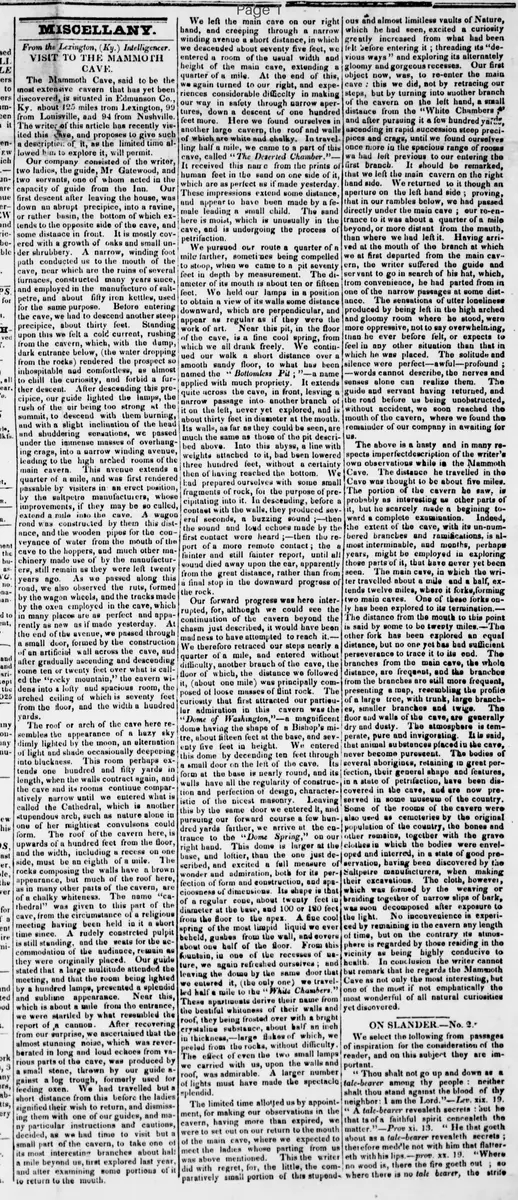
From the Lexington, (Ky.) Intelligencer.
VISIT TO THE MAMMOTH CAVE.
The Mammoth Cave, said to be the most extensive cavern that has yet been discovered, is situated in Edmonson Co., Ky. about 125 miles from Lexington, 99 from Louisville, and 94 from Nashville.
The writer of this article has recently visited this cave, and proposes to give such a description of it, as the limited time allowed him to explore it, will permit.
Our company consisted of the writer, two ladies, the guide, Mr Gatewood, and two servants, one of whom acted in the capacity of guide from the Inn. Our first descent after leaving the house, was down an abrupt precipice, into a ravine, or rather basin, the bottom of which extends to the opposite side of the cave, and some distance in front. It is mostly covered with a growth of oaks and small under shrubbery. A narrow, winding foot path conducted us to the mouth of the cave, near which are the ruins of several furnaces, constructed many years since, and employed in the manufacture of saltpetre, and about fifty iron kettles, used for the same purpose. Before entering the cave, we had to descend another steep precipice, about thirty feet. Standing upon this we felt a cold current, rushing from the cavern, which, with the damp, dark entrance below, (the water dropping from the rocks) rendered the prospect so inhospitable and comfortless, as almost to chill the curiosity, and forbid a further descent. After descending this precipice, our guide lighted the lamps, the rush of the air being too strong at the summit, to descend with them burning, and with a slight inclination of the head and shuddering sensations, we passed under the immense masses of overhanging crags, into a narrow winding avenue leading to the high arched rooms of the main cavern. This avenue extends a quarter of a mile, and was first rendered passable by visitors in an erect position by the saltpetre manufacturers, whose improvements, if they may be so called extend a mile into the cave. A wagon road was constructed by them in this distance, and the wooden pipes for the conveyance of water from the mouth of the cave to the hoppers, and much other machinery made use of by the manufacturers, still remain as they were left twenty years ago. As we passed along this road, we also observed the ruts, formed by the wagon wheels, and the tracks made by the oxen employed in the cave, which in many places are as perfect and apparently as new as if made yesterday. At the end of the avenue, we passed through a small door, formed by the construction of an artificial wall across the cave, and after gradually ascending and descending some ten or twenty feet over what is called the "rocky mountain," the cavern widens into a lofty and spacious room, the arched ceiling of which is seventy feet from the floor, and the width a hundred yards.
The roof or arch of the cave here resembles the appearance of a hazy sky dimly lighted by the moon, an alternation of light and shade occasionally deepening into blackness. This room perhaps extends one hundred and fifty yards in length, when the walls contract again, and the cave and its rooms continue comparatively narrow until we entered what is called the Cathedral, which is another stupendous arch, such as nature alone in one of her mightiest convulsions could form. The roof of the cavern here, is upwards of a hundred feet from the floor, and the width, including a recess on one side, must be an eighth of a mile. The rocks composing the walls have a brown appearance, but much of the roof here, as in many other parts of the cavern, are of a chalky whiteness. The name "cathedral" was given to this part of the cave, from the circumstance of a religious meeting having been held in it a short time since. A rudely constructed pulpit is still standing, and the seats for the accommodation of the audience, remain as they were originally placed. Our guide stated that a large multitude attended the meeting, and that the room being lighted by a hundred lamps, presented a splendid and sublime appearance. Near this, which is about a mile from the entrance, we were startled by what resembled the report of a cannon. After recovering from our surprise, we ascertained that the almost stunning noise, which was reverberated in long and loud echoes from various parts of the cave, was produced by a small stone, thrown by our guide against a log trough, formerly used for feeding oxen. We had travelled but a short distance from this before the ladies signified their wish to return, and dismissing them with one of our guides, and many particular instructions and cautions, decided, as we had time to visit but a small part of the cavern, to take one of its most interesting branches about half a mile beyond us, first explored last year, and after examining some portions of it to return to the mouth,
We left the main cave on our right hand, and creeping through a narrow winding avenue a short distance, in which we descended about seventy five feet, we entered a room of the usual width and height of the main cave, extending a quarter of a mile. At the end of this, we again turned to our right, and experienced considerable difficulty in making our way in safety through narrow apertures, down a descent of one hundred feet more. Here we found ourselves in another large cavern, the roof and walls of which are white and chalky. In travelling half a mile, we came to a part of this cave, called "The Deserted Chamber."
It received this name from the prints of human feet in the sand on one side of it, which are as perfect as if made yesterday. These impressions extend some distance, and appear to have been made by a female leading a small child. The sand here is moist, which is unusual in the cave, and is undergoing the process of petrifaction
We pursued our route a quarter of a mile farther, sometimes being compelled to stoop, when we came to a pit seventy feet in depth by measurement. The diameter of its mouth is about ten or fifteen feet. We held our lamps in a position to obtain a view of its walls some distance downward, which are perpendicular, and appear as regular as if they were the work of art. Near this pit, in the floor of the cave, is a fine cool spring, from which we all drank freely. We continued our walk a short distance over a smooth sandy floor, to what has been named the "Bottomless Pit; "—a name applied with much propriety. It extends quite across the cave, in front, leaving a narrow passage into another branch of it on the left, never yet explored, and is about thirty feet in diameter at the mouth. Its walls, as far as they could be seen, are much the same as those of the pit described above. Into this abyss, a line with weights attached to it, had been lowered three hundred feet, without a certainty then of having reached the bottom. We had prepared ourselves with some small fragments of rock, for the purpose of precipitating into it. In descending, before a contact with the walls. they produced several seconds, a buzzing sound;—then the sound and loud echoes made by the first contact were heard;—then the report of a more remote contact; the a fainter and still fainter report, until all sound died away upon the ear, apparently from the great distance, rather than from a final stop in the downward progress of the rock.
Our forward progress was here interrupted, for, although we could see the continuation of the cavern beyond the chasm just described, it would have been madness to have attempted to reach it.— We therefore retraced our steps nearly a quarter of a mile, and entered without difficulty, another branch of the cave, the floor of which, the distance we followed it, (about one mile) was principally composed of loose masses of flint rock. The curiosity that first attracted our particular admiration in this cavern was the "Dome of Washington,"—a magnificent dome having the shape of a Bishop's mitre, about fifteen feet at the base, and seventy five feet in height. We entered this dome by descending ten feet through a small door on the left of the cave. Its form at the base is nearly round, and its walls have all the regularity of construction and perfection of design, characteristic of the nicest masonry. Leaving this by the same door we entered it, and pursuing our forward course a few hundred yards farther, we arrive at the entrance to the "Dome Spring," on our right hand. This dome is larger at the base, and loftier, than the one just described, and excited a full measure of wonder and admiration, both for its perfection of form and construction, and spaciousness of dimensions. Its shape is that of a regular cone, about twenty feet in diameter at the base, and 100 or 150 feet from the floor to the apex. A fine cool spring of the most limpid liquid we ever beheld, gushes from the wall, and covers about one half of the floor. From this fountain, in one of the recesses of nature, we again refreshed ourselves; and leaving the dome by the same door that we entered it, (the only one) we travelled half a mile to the "White Chambers."
These apartments derive their name from the beautiful whiteness of their walls and roof, they being frosted over with a bright crystalline substance, about half an inch in thickness,—large flakes of which, we peeled from the rocks, without difficulty. The effect of even the two small lamps we carried with us, upon the walls and roof, was admirable. A larger number of lights must have made the spectacle splendid.
The limited time allotted us by appointment, for making our observations in the cavern, having more than expired, we were to set out on our return to the mouth of the main cave, where we expected to meet the ladies whose parting from us was above mentioned. This the writer did with regret, for, the little, the comparatively small portion of this stupendous and almost limitless vaults of Nature,
which he had seen, excited a curiosity greatly increased from what had been felt before entering it; threading its "devious ways" and exploring its alternately gloomy and gorgeous recesses. Our first object now, was, to re-enter the main cave: this we did, not by retracing our steps, but by turning into another branch of the cavern on the left hand, a small distance from the "White Chambers" and after pursuing it a few hundred yards, ascending in rapid succession steep precipices and crags, until we found ourselves once more in the spacious range of rooms we had left previous to our entering the first branch.' It should be remarked, that we left the main cavern on the right hand side. We returned to it though an aperture on the left hand side; proving, that in our rambles below, we had passed directly under the main cave; our re-entrance to it was about a quarter of a mile beyond, or more distant from the mouth, than where we had left it. Having arrived at the mouth of the branch at which we at first departed from the main cavern, the writer suffered the guide and servant to go in search of his hat, which, from convenience, he had parted from in one of the narrow passages at some distance. The sensations of utter loneliness produced by being left in the high arched and gloomy room where he stood, were more oppressive, not to say overwhelming, than he ever before felt, or expects to feel in any other situation than that in which he was placed. The solitude and silence were perfect—awful—profound; —words cannot describe, the nerves and senses alone can realize them. The guide and servant having returned, and the road before us being unobstructed, without accident, we soon reached the mouth of the cavern, where we found the remainder of our company in awaiting for us.
The above is a hasty and in many respects imperfect description of the writer's own observations while in the Mammoth Cave. The distance he travelled in the Cave was thought to be about five miles. The portion of the cavern he saw, is probably as interesting as other parts of it, but he scarcely made a beginning towards a complete examination. Indeed, the extent of the cave, with its un-numbered branches and ramifications, is almost interminable, and months, perhaps years, might be employed in exploring those parts of it, that have never yet been seen. The main cave, in which the writer travelled about a mile and a half, extends twelve miles, where it forks, forming two main caves. One of these forks only has been explored to its termination.— The distance from the mouth to this point is said by some to be twenty miles.—The other fork has been explored an equal distance, but no one yet has had sufficient perseverance to trace it to its end. The branches from the main cave, the whole distance, are frequent, and the branches from the branches are still more frequent, presenting a map, resembling the profile of a large tree, with trunk, large branches, smaller branches and twigs. The floor and walls of the cave, are generally dry and dusty. The atmosphere is temperate, pure and invigorating. It is said, that animal substances placed in the cave, never become putrescent. The bodies of several aborigines, retaining in great perfection, their general shape and features, in a state of petrifaction, have been discovered in the cave, and are now preserved in some museum of the country. Some of the rooms of the cavern were also used as cemeteries by the original population of the country, the bones and other remains, together with the grave clothes in which the bodies were enveloped and interred, in a state of good preservation, having been discovered by the Saltpetre manufacturers, when making their excavations. The cloth, however, which was formed by the weaving or braiding together of narrow slips of bark, was soon decomposed after exposure to the light. No inconvenience is experienced by remaining in the cavern any length of time, but on the contrary its atmosphere is regarded by those residing in the vicinity as being highly conducive to health. In conclusion the writer cannot but remark that he regards the Mammoth Cave as not only the most interesting, but one of the most if not emphatically the most wonderful of all natural curiosities yet discovered.
What sub-type of article is it?
What themes does it cover?
What keywords are associated?
What entities or persons were involved?
Where did it happen?
Story Details
Key Persons
Location
Mammoth Cave, Edmonson Co., Ky.
Story Details
The writer and companions explore Mammoth Cave, descending into its entrance, traversing the main avenue with remnants of saltpetre mining, visiting the Cathedral room, a branch with the Deserted Chamber, a pit, the Bottomless Pit, Dome of Washington, Dome Spring, and White Chambers, before returning, marveling at its vastness, formations, and historical uses.