Thank you for visiting SNEWPapers!
Sign up free
Poem
July 9, 1802
The National Intelligencer And Washington Advertiser
Washington, District Of Columbia
What is this article about?
A sonnet contemplating the solemn transition from day to evening, evoking melancholy through natural imagery and culminating in grief over a lost loved one's permanent absence.
Clipping
OCR Quality
95%
Excellent
Full Text
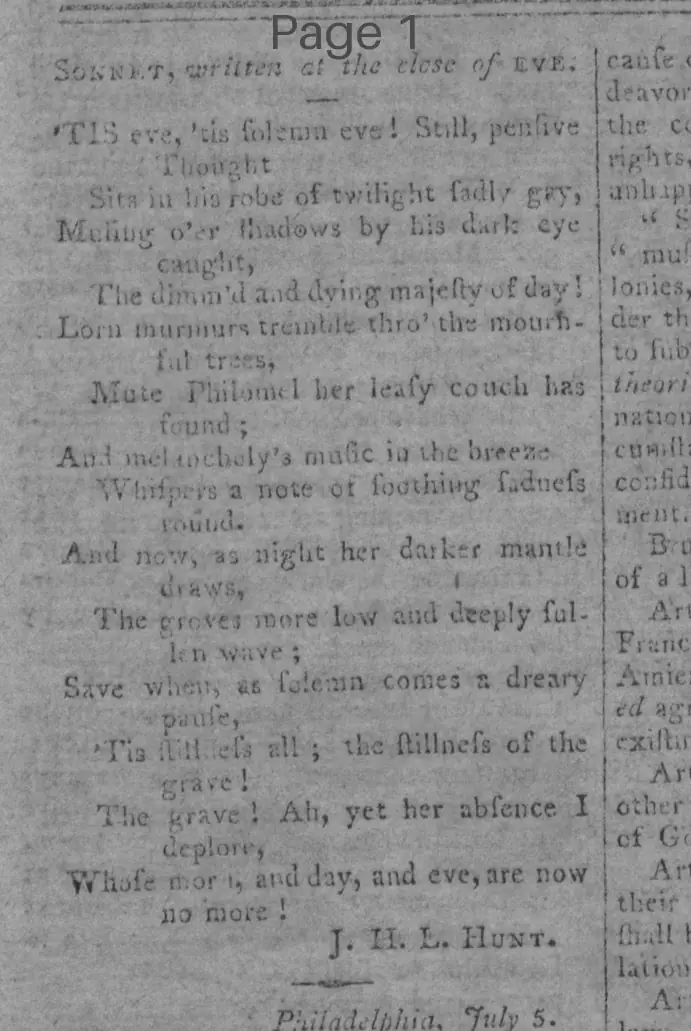
Sonnet, written at the close of Eve.
'Tis eve, 'tis solemn eve! Still, pensive Thought
Sits in his robe of twilight, sadly gay,
Moping o'er shadows by his dark eye caught,
The dimm'd and dying majesty of day!
Lorn murmurs tremble thro' the mournful trees,
Mute Philomel her leafy couch has found;
And melancholy's music in the breeze
Whispers a note of soothing sadness round.
And now, as night her darker mantle draws,
The groves more low and deeply undulate;
Save when, as solemn comes a dreary pause,
'Tis still as all; the stillness of the grave!
The grave! Ah, yet her absence I deplore,
Whose morn, and day, and eve, are now no more!
J. H. L. HUNT.
'Tis eve, 'tis solemn eve! Still, pensive Thought
Sits in his robe of twilight, sadly gay,
Moping o'er shadows by his dark eye caught,
The dimm'd and dying majesty of day!
Lorn murmurs tremble thro' the mournful trees,
Mute Philomel her leafy couch has found;
And melancholy's music in the breeze
Whispers a note of soothing sadness round.
And now, as night her darker mantle draws,
The groves more low and deeply undulate;
Save when, as solemn comes a dreary pause,
'Tis still as all; the stillness of the grave!
The grave! Ah, yet her absence I deplore,
Whose morn, and day, and eve, are now no more!
J. H. L. HUNT.
What sub-type of article is it?
Sonnet
What themes does it cover?
Nature Seasons
Death Mourning
What keywords are associated?
Evening Sonnet
Melancholy Eve
Mourning Absence
Nature Reflection
Grave Stillness
What entities or persons were involved?
J. H. L. Hunt.
Poem Details
Title
Sonnet, Written At The Close Of Eve.
Author
J. H. L. Hunt.
Subject
Written At The Close Of Eve
Key Lines
The Grave! Ah, Yet Her Absence I Deplore,
Whose Morn, And Day, And Eve, Are Now No More!