Thank you for visiting SNEWPapers!
Sign up free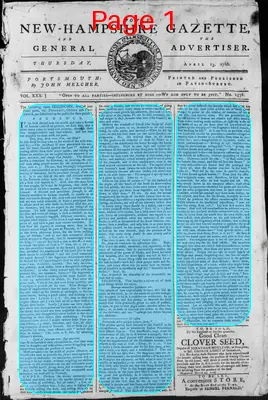
Literary
April 13, 1786
Fowle's New Hampshire Gazette And General Advertiser
Portsmouth, Rockingham County, New Hampshire
What is this article about?
This prose essay on 'Economy' focuses on 'Prudence,' arguing that thoughtlessness leads to poverty. It draws on biblical examples like the ant, Proverbs' wise woman, Joseph advising Pharaoh, and the unjust steward to emphasize foresight, preparation for the future, and moral responsibility. It critiques improvidence with historical figures like Steele, Sheridan, and Gay, and transitions to 'Order.'
Clipping
OCR Quality
95%
Excellent
Full Text
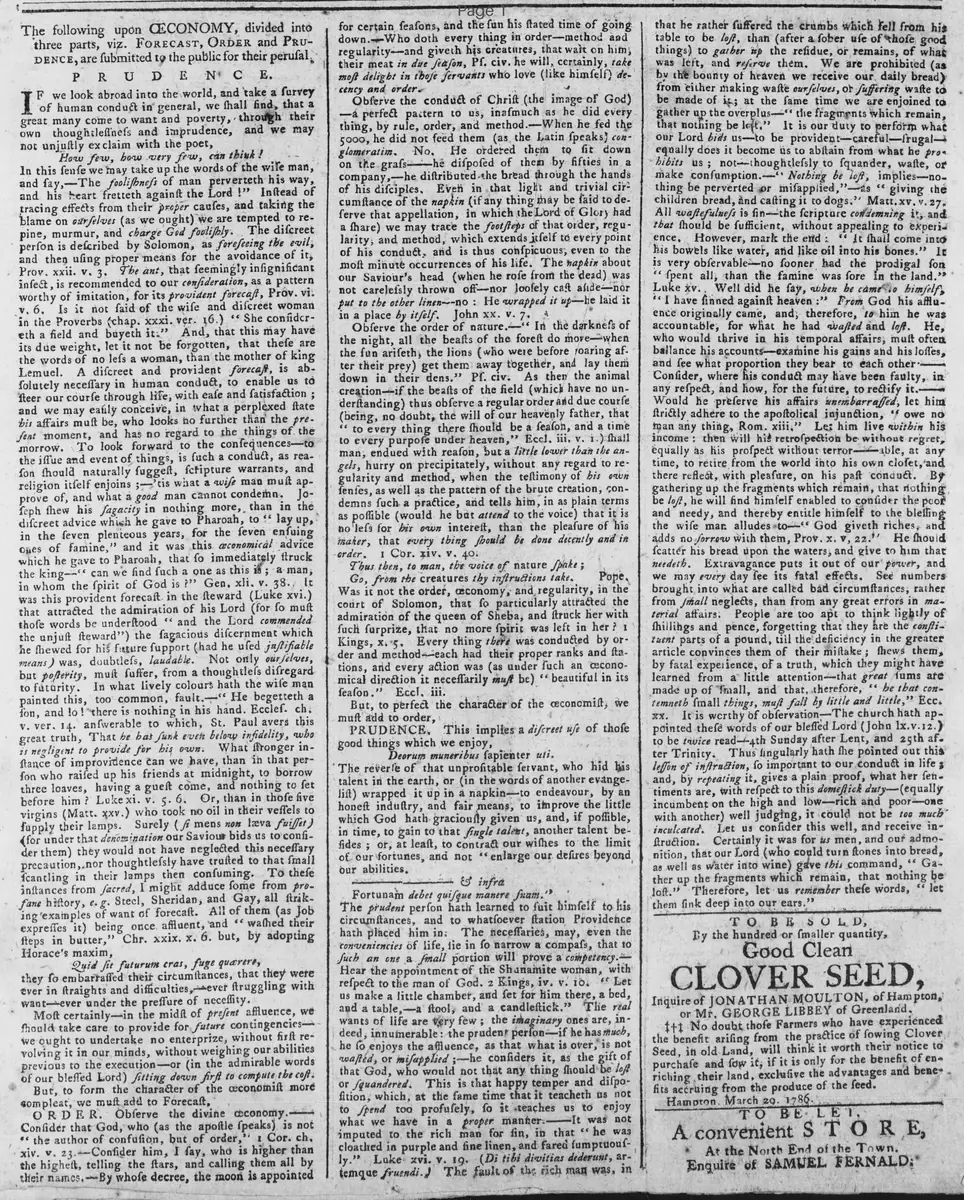
The following upon ECONOMY, divided into three parts, viz. FORECAST, ORDER and PRUDENCE, are submitted to the public for their perusal.
PRUDENCE.
If we look abroad into the world, and take a survey of human conduct in general, we shall find, that a great many come to want and poverty, through their own thoughtlessness and imprudence, and we may not unjustly exclaim with the poet,
How few, how very few, can think!
In this case we may take up the words of the wise man, and say,-The foolishness of man perverteth his way, and his heart fretteth against the Lord! Instead of tracing effects from their proper causes, and taking the blame on ourselves (as we ought) we are tempted to repine, murmur, and charge God foolishly. The discreet person is described by Solomon, as foreseeing the evil, and then using proper means for the avoidance of it, Prov. xxii. v. 3. The ant, that seemingly insignificant insect, is recommended to our consideration, as a pattern worthy of imitation, for its provident forecast, Prov. vi. v. 6. Is it not said of the wise and discreet woman in the Proverbs (chap. xxxi. ver. 16.) "She considereth a field and buyeth it." And, that this may have its due weight, let it not be forgotten, that these are the words of no less a woman, than the mother of king Lemuel. A discreet and provident forecast, is absolutely necessary in human conduct, to enable us to steer our course through life, with ease and satisfaction; and we may easily conceive, in what a perplexed state his affairs must be, who looks no further than the present moment, and has no regard to the things of the morrow. To look forward to the consequences--to the issue and event of things, is such a conduct, as reason should naturally suggest, scripture warrants, and religion itself enjoins ;--'tis what a wise man must approve of, and what a good man cannot condemn. Joseph shewed his sagacity in nothing more, than in the discreet advice which he gave to Pharaoh, to lay up, in the seven plenteous years, for the seven ensuing ones of famine," and it was this economical advice which he gave to Pharaoh, that so immediately struck the king--"can we find such a one as this is; a man, in whom the spirit of God is ?" Gen. xli. v. 38. It was this provident forecast, in the steward (Luke xvi.) that attracted the admiration of his Lord (for so must those words be understood "and the Lord commended the unjust steward") the sagacious discernment which he shewed for his future support (had he used justifiable means) was, doubtless, laudable. Not only ourselves, but posterity, must suffer, from a thoughtless disregard to futurity. In what lively colours hath the wise man painted this, too common, fault.-"He begetteth a son, and lo! there is nothing in his hand. Eccle. ch. v. ver. 14. answerable to which, St. Paul avers this great truth, That he has sunk even below infidelity, who is negligent to provide for his own. What stronger instance of improvidence can we have, than in that person who raised up his friends at midnight, to borrow three loaves, having a guest come, and nothing to set before him ? Luke xi. v. 5. 6. Or, than in those five virgins (Matt. xxv.) who took no oil in their vessels to supply their lamps. Surely (si meminisset non lava suiffer) (for under that denomination our Saviour bids us to consider them) they would not have neglected this necessary precaution, nor thoughtlessly have trusted to that small cantling in their lamps then consuming. To these instances from Sacred, I might adduce some from profane history, e. g. Steele, Sheridan, and Gay, all striking examples of want of forecast. All of them (as Job expresses it) being once affluent, and "washed their steps in butter," Chr. xxix. ch. 6. but, by adopting Horace's maxim,
Quid sit futurum cras, fuge quærere,
they so embarrassed their circumstances, that they were ever in straights and difficulties, ever struggling with want--ever under the pressure of necessity.
Most certainly-in the midst of present affluence, we should take care to provide for future contingencies- we ought to undertake no enterprise, without first revolving it in our minds, without weighing our abilities previous to the execution-or (in the admirable words of our blessed Lord) sitting down first to compute the cost. But, to form the character of the economist more complete, we must add to Forecast,
ORDER. Observe the divine economy. Consider that God, who (as the apostle speaks) is not ' the author of confusion, but of order," 1 Cor. ch. xiv. v. 23.--Consider him, I say, who is higher than the highest, telling the stars, and calling them all by their names.--By whose decree, the moon is appointed
PRUDENCE.
If we look abroad into the world, and take a survey of human conduct in general, we shall find, that a great many come to want and poverty, through their own thoughtlessness and imprudence, and we may not unjustly exclaim with the poet,
How few, how very few, can think!
In this case we may take up the words of the wise man, and say,-The foolishness of man perverteth his way, and his heart fretteth against the Lord! Instead of tracing effects from their proper causes, and taking the blame on ourselves (as we ought) we are tempted to repine, murmur, and charge God foolishly. The discreet person is described by Solomon, as foreseeing the evil, and then using proper means for the avoidance of it, Prov. xxii. v. 3. The ant, that seemingly insignificant insect, is recommended to our consideration, as a pattern worthy of imitation, for its provident forecast, Prov. vi. v. 6. Is it not said of the wise and discreet woman in the Proverbs (chap. xxxi. ver. 16.) "She considereth a field and buyeth it." And, that this may have its due weight, let it not be forgotten, that these are the words of no less a woman, than the mother of king Lemuel. A discreet and provident forecast, is absolutely necessary in human conduct, to enable us to steer our course through life, with ease and satisfaction; and we may easily conceive, in what a perplexed state his affairs must be, who looks no further than the present moment, and has no regard to the things of the morrow. To look forward to the consequences--to the issue and event of things, is such a conduct, as reason should naturally suggest, scripture warrants, and religion itself enjoins ;--'tis what a wise man must approve of, and what a good man cannot condemn. Joseph shewed his sagacity in nothing more, than in the discreet advice which he gave to Pharaoh, to lay up, in the seven plenteous years, for the seven ensuing ones of famine," and it was this economical advice which he gave to Pharaoh, that so immediately struck the king--"can we find such a one as this is; a man, in whom the spirit of God is ?" Gen. xli. v. 38. It was this provident forecast, in the steward (Luke xvi.) that attracted the admiration of his Lord (for so must those words be understood "and the Lord commended the unjust steward") the sagacious discernment which he shewed for his future support (had he used justifiable means) was, doubtless, laudable. Not only ourselves, but posterity, must suffer, from a thoughtless disregard to futurity. In what lively colours hath the wise man painted this, too common, fault.-"He begetteth a son, and lo! there is nothing in his hand. Eccle. ch. v. ver. 14. answerable to which, St. Paul avers this great truth, That he has sunk even below infidelity, who is negligent to provide for his own. What stronger instance of improvidence can we have, than in that person who raised up his friends at midnight, to borrow three loaves, having a guest come, and nothing to set before him ? Luke xi. v. 5. 6. Or, than in those five virgins (Matt. xxv.) who took no oil in their vessels to supply their lamps. Surely (si meminisset non lava suiffer) (for under that denomination our Saviour bids us to consider them) they would not have neglected this necessary precaution, nor thoughtlessly have trusted to that small cantling in their lamps then consuming. To these instances from Sacred, I might adduce some from profane history, e. g. Steele, Sheridan, and Gay, all striking examples of want of forecast. All of them (as Job expresses it) being once affluent, and "washed their steps in butter," Chr. xxix. ch. 6. but, by adopting Horace's maxim,
Quid sit futurum cras, fuge quærere,
they so embarrassed their circumstances, that they were ever in straights and difficulties, ever struggling with want--ever under the pressure of necessity.
Most certainly-in the midst of present affluence, we should take care to provide for future contingencies- we ought to undertake no enterprise, without first revolving it in our minds, without weighing our abilities previous to the execution-or (in the admirable words of our blessed Lord) sitting down first to compute the cost. But, to form the character of the economist more complete, we must add to Forecast,
ORDER. Observe the divine economy. Consider that God, who (as the apostle speaks) is not ' the author of confusion, but of order," 1 Cor. ch. xiv. v. 23.--Consider him, I say, who is higher than the highest, telling the stars, and calling them all by their names.--By whose decree, the moon is appointed
What sub-type of article is it?
Essay
What themes does it cover?
Moral Virtue
Temperance
What keywords are associated?
Prudence
Economy
Forecast
Biblical Wisdom
Improvidence
Moral Instruction
Divine Order
Literary Details
Title
Prudence
Subject
On Prudence In Economy And Foresight
Key Lines
How Few, How Very Few, Can Think!
The Foolishness Of Man Perverteth His Way, And His Heart Fretteth Against The Lord!
She Considereth A Field And Buyeth It.
Can We Find Such A One As This Is; A Man, In Whom The Spirit Of God Is ?
Sitting Down First To Compute The Cost.