Thank you for visiting SNEWPapers!
Sign up free
Editorial
August 1, 1827
Constitutional Whig
Richmond, Virginia
What is this article about?
Editorial in the Maryland Republican defends General Washington's character against a Baltimore Jackson paper's slander claiming he ordered shooting deserters and displaying their heads during the Revolution. A veteran recounts the incident involved Col. Lee, not Washington, who disapproved and had Lee tried.
Clipping
OCR Quality
95%
Excellent
Full Text
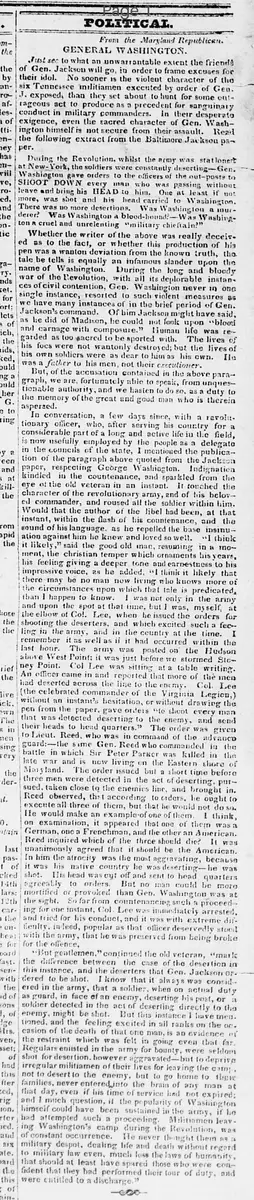
POLITICAL.
From the Maryland Republican.
GENERAL WASHINGTON.
Just see to what an unwarrantable extent the friends of Gen. Jackson will go, in order to frame excuses for their idol. No sooner is the violent character of the six Tennessee militiamen executed by order of Gen. J. exposed, than they set about to hunt for some outrageous act to produce as a precedent for sanguinary conduct in military commanders. In their desperate exigence, even the sacred character of Gen. Washington himself is not secure from their assault. Read the following extract from the Baltimore Jackson paper.
During the Revolution, whilst the army was stationed at New-York, the soldiers were constantly deserting--Gen. Washington gave orders to the officers of the out-postes to SHOOT DOWN every man who was passing without leave and bring his HEAD to him. One at least if not more, was shot and his head carried to Washington. There was no more desertions. Was Washington a murderer? Was Washington a blood-hound?--Was Washington cruel and unrelenting "military chieftain?"
Whether the writer of the above was really deceived as to the fact, or whether this production of his pen was a wanton deviation from the known truth, the tale he tells is equally an infamous slander upon the name of Washington. During the long and bloody war of the Revolution, with all its deplorable instances of civil contention, Gen. Washington never in one single instance, resorted to such violent measures as we have many instances of in the brief period of Gen. Jackson's command. Of him Jackson might have said, as he did of Madison, he could not look upon "blood and carnage with composure." Human life was regarded as too sacred to be sported with. The lives of his foes were not wantonly destroyed; but the lives of his own soldiers were as dear to him as his own. He was a father to his men, not their executioner.
But, of the accusation contained in the above paragraph, we are, fortunately able to speak, from unquestionable authority, and we hasten to do so, as a duty to the memory of the great and good man who is therein aspersed.
In conversation, a few days since, with a revolutionary officer, who, after serving his country for a considerable part of a long and active life in the field, is now usefully employed by the people as a delegate in the councils of the state, I mentioned the publication of the paragraph above quoted from the Jackson paper, respecting George Washington. Indignation kindled in the countenance, and sparkled from the eye of the old veteran in an instant. It touched the character of the revolutionary army, and of his beloved commander, and roused all the soldier within him. Would that the author of the libel had been, at that instant, within the flash of his countenance, and the sound of his language, as he repelled the base insinuation against him he knew and loved so well. "I think it likely," said the good old man, resuming in a moment, the christian temper which ornaments his years, his feeling giving a deeper tone and earnestness to his impressive voice, as he added, "I think it likely that there may be no man now living who knows more of the circumstances upon which that tale is predicated, than I happen to know. I was not only in the army and upon the spot at that time, but I was, myself, at the elbow of Col. Lee, when he issued the orders for shooting the deserters, and which excited such a feeling in the army, and in the country at the time. I remember it as well as if it had occurred within the last hour. The army was posted on the Hudson above West Point; it was just before we stormed Stony Point. Col. Lee was sitting at a table writing. An officer came in and reported that more of the men had deserted across the line to the enemy. Col. Lee (the celebrated commander of the Virginia Legion,) without an instant's hesitation, or without drawing the pen from the paper, gave orders "to shoot every man that was detected deserting to the enemy, and send their heads to head quarters." The order was given to Lieut. Reed, who was in command of the advance guard:--the same Gen. Reed who commanded in the battle in which Sir Peter Parker was killed in the late war and is now living on the Eastern shore of Maryland. The order issued but a short time before three men were detected in the act of deserting, pursued, taken close to the enemies line, and brought in. Reed observed, that according to orders, he ought to execute all three of them, but that he would not do so. He would make an example of one of them. I think, on examination, it appeared that one of them was a German, one a Frenchman, and the other an American. Reed inquired which of the three should die? It was unanimously agreed that it should be the American. In him the atrocity was the most aggravating, because it was his native country he was deserting--he was shot. His head was cut off and sent to head quarters agreeably to orders. But no man could be more mortified or provoked than Gen. Washington was at the sight. So far from countenancing such a proceeding for one instant, Col. Lee was immediately arrested, and tried for his conduct, and it was with extreme difficulty, indeed, popular as that officer deservedly stood with the army, that he was preserved from being broke for the offence,
"But gentlemen," continued the old veteran, "mark the difference between the case of the desertion in this instance, and the deserters that Gen. Jackson ordered to be shot. I know that it always was considered in the army, that a soldier, when on actual duty as guard, in face of an enemy, deserting his post, or a soldier detected in the act of deserting directly to the enemy, might be shot. But this instance I have mentioned, and the feeling excited in all ranks on the occasion of the death of that one man, is an evidence of the restraint which was felt in going even that far. Regulars enlisted in the army for bounty, were seldom shot for desertion, however aggravated--but to deprive irregular militiamen of their lives for leaving the camp, not to desert to the enemy, but to go home to their families, never entered into the brain of any man at that day, even if his time of service had not expired; and I much question, if the popularity of Washington himself could have been sustained in the army, if he had attempted such a proceeding. Militiamen leaving Washington's camp during the Revolution, was of constant occurrence. He never thought them as a military despot, dealing life and death without regard to military law even, much less the laws of humanity, that should at least have spared those who were confident that they had performed their tour of duty, and were entitled to a discharge."
From the Maryland Republican.
GENERAL WASHINGTON.
Just see to what an unwarrantable extent the friends of Gen. Jackson will go, in order to frame excuses for their idol. No sooner is the violent character of the six Tennessee militiamen executed by order of Gen. J. exposed, than they set about to hunt for some outrageous act to produce as a precedent for sanguinary conduct in military commanders. In their desperate exigence, even the sacred character of Gen. Washington himself is not secure from their assault. Read the following extract from the Baltimore Jackson paper.
During the Revolution, whilst the army was stationed at New-York, the soldiers were constantly deserting--Gen. Washington gave orders to the officers of the out-postes to SHOOT DOWN every man who was passing without leave and bring his HEAD to him. One at least if not more, was shot and his head carried to Washington. There was no more desertions. Was Washington a murderer? Was Washington a blood-hound?--Was Washington cruel and unrelenting "military chieftain?"
Whether the writer of the above was really deceived as to the fact, or whether this production of his pen was a wanton deviation from the known truth, the tale he tells is equally an infamous slander upon the name of Washington. During the long and bloody war of the Revolution, with all its deplorable instances of civil contention, Gen. Washington never in one single instance, resorted to such violent measures as we have many instances of in the brief period of Gen. Jackson's command. Of him Jackson might have said, as he did of Madison, he could not look upon "blood and carnage with composure." Human life was regarded as too sacred to be sported with. The lives of his foes were not wantonly destroyed; but the lives of his own soldiers were as dear to him as his own. He was a father to his men, not their executioner.
But, of the accusation contained in the above paragraph, we are, fortunately able to speak, from unquestionable authority, and we hasten to do so, as a duty to the memory of the great and good man who is therein aspersed.
In conversation, a few days since, with a revolutionary officer, who, after serving his country for a considerable part of a long and active life in the field, is now usefully employed by the people as a delegate in the councils of the state, I mentioned the publication of the paragraph above quoted from the Jackson paper, respecting George Washington. Indignation kindled in the countenance, and sparkled from the eye of the old veteran in an instant. It touched the character of the revolutionary army, and of his beloved commander, and roused all the soldier within him. Would that the author of the libel had been, at that instant, within the flash of his countenance, and the sound of his language, as he repelled the base insinuation against him he knew and loved so well. "I think it likely," said the good old man, resuming in a moment, the christian temper which ornaments his years, his feeling giving a deeper tone and earnestness to his impressive voice, as he added, "I think it likely that there may be no man now living who knows more of the circumstances upon which that tale is predicated, than I happen to know. I was not only in the army and upon the spot at that time, but I was, myself, at the elbow of Col. Lee, when he issued the orders for shooting the deserters, and which excited such a feeling in the army, and in the country at the time. I remember it as well as if it had occurred within the last hour. The army was posted on the Hudson above West Point; it was just before we stormed Stony Point. Col. Lee was sitting at a table writing. An officer came in and reported that more of the men had deserted across the line to the enemy. Col. Lee (the celebrated commander of the Virginia Legion,) without an instant's hesitation, or without drawing the pen from the paper, gave orders "to shoot every man that was detected deserting to the enemy, and send their heads to head quarters." The order was given to Lieut. Reed, who was in command of the advance guard:--the same Gen. Reed who commanded in the battle in which Sir Peter Parker was killed in the late war and is now living on the Eastern shore of Maryland. The order issued but a short time before three men were detected in the act of deserting, pursued, taken close to the enemies line, and brought in. Reed observed, that according to orders, he ought to execute all three of them, but that he would not do so. He would make an example of one of them. I think, on examination, it appeared that one of them was a German, one a Frenchman, and the other an American. Reed inquired which of the three should die? It was unanimously agreed that it should be the American. In him the atrocity was the most aggravating, because it was his native country he was deserting--he was shot. His head was cut off and sent to head quarters agreeably to orders. But no man could be more mortified or provoked than Gen. Washington was at the sight. So far from countenancing such a proceeding for one instant, Col. Lee was immediately arrested, and tried for his conduct, and it was with extreme difficulty, indeed, popular as that officer deservedly stood with the army, that he was preserved from being broke for the offence,
"But gentlemen," continued the old veteran, "mark the difference between the case of the desertion in this instance, and the deserters that Gen. Jackson ordered to be shot. I know that it always was considered in the army, that a soldier, when on actual duty as guard, in face of an enemy, deserting his post, or a soldier detected in the act of deserting directly to the enemy, might be shot. But this instance I have mentioned, and the feeling excited in all ranks on the occasion of the death of that one man, is an evidence of the restraint which was felt in going even that far. Regulars enlisted in the army for bounty, were seldom shot for desertion, however aggravated--but to deprive irregular militiamen of their lives for leaving the camp, not to desert to the enemy, but to go home to their families, never entered into the brain of any man at that day, even if his time of service had not expired; and I much question, if the popularity of Washington himself could have been sustained in the army, if he had attempted such a proceeding. Militiamen leaving Washington's camp during the Revolution, was of constant occurrence. He never thought them as a military despot, dealing life and death without regard to military law even, much less the laws of humanity, that should at least have spared those who were confident that they had performed their tour of duty, and were entitled to a discharge."
What sub-type of article is it?
Partisan Politics
Military Affairs
What keywords are associated?
Washington Defense
Jackson Criticism
Desertion Orders
Revolutionary War
Military Conduct
Partisan Slander
What entities or persons were involved?
Gen. Washington
Gen. Jackson
Col. Lee
Lieut. Reed
Revolutionary Officer Veteran
Editorial Details
Primary Topic
Defense Of Washington's Military Conduct Against Jackson Supporters' Slander
Stance / Tone
Strongly Pro Washington And Anti Jackson
Key Figures
Gen. Washington
Gen. Jackson
Col. Lee
Lieut. Reed
Revolutionary Officer Veteran
Key Arguments
Jackson Supporters Slander Washington By Falsely Claiming He Ordered Shooting Deserters And Displaying Heads
Washington Never Resorted To Such Violent Measures During The Revolution
The Incident Involved Col. Lee's Unauthorized Order, Leading To His Arrest And Trial
Washington Was Mortified By The Act And Did Not Countenance It
Contrast With Jackson's Execution Of Militiamen Going Home, Not Deserting To Enemy