Thank you for visiting SNEWPapers!
Sign up free
New Hampshire Statesman And Concord Register
Concord, Merrimack County, New Hampshire
What is this article about?
Report from the October 1825 Rockingham County Cattle Show committee on swine, emphasizing their economic value to New Hampshire farmers, best practices for rearing, feeding, and breeding, and awarding premiums for best boar and sow.
Merged-components note: Continuation of the same agricultural report on swine from the Rockingham Cattle Show, split across columns.
Clipping
OCR Quality
Full Text
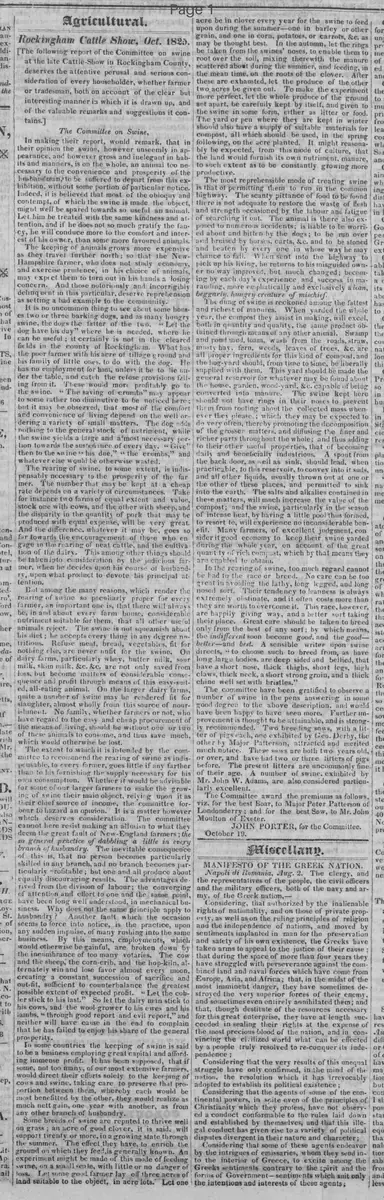
Rockingham Cattle Show, Oct. 1825.
The following report of the Committee on swine at the late Cattle-Show in Rockingham County, deserves the attentive perusal and serious consideration of every householder, whether farmer or tradesman, both on account of the clear but interesting manner in which it is drawn up, and of the valuable remarks and suggestions it contains.
The Committee on Swine.
In making their report, would remark, that in their opinion the swine, however unseemly in appearance, and however gross and inelegant in habits and manners, is on the whole, an animal too necessary to the convenience and prosperity of the husbandman, to be suffered to depart from this exhibition, without some portion of particular notice. Indeed, it is believed that most of the obloquy and contempt, of which the swine is made the object, might well be spared towards so useful an animal. Let him be treated with the same kindness and attention, and if he does not so much gratify the fancy, he will conduce more to the comfort and interest of his owner, than some more favoured animals.
The keeping of animals grows more expensive as they travel further north; so that the New-Hampshire farmer, who does not study economy, and exercise prudence, in his choice of animals may expect them to turn out in his hands a losing concern. And those notoriously and incorrigibly delinquent in this particular, deserve reprehension as setting a bad example to the community.
It is no uncommon thing to see about some houses two or three barking dogs, and as many hungry swine, the dogs the fatter of the two. "Let the dog have his day" where he is needed, where he can be useful; it certainly is not in the cleared fields in the county of Rockingham. What has the poor farmer with his acre of tillage ground and his family of little ones, to do with the dog. He has no employment for him, unless it be to tie under the table, and catch the refuse provisions falling from it. These would more profitably go to the swine. "The saving of crumbs" may appear to some rather too diminutive to be noticed here; but it may be observed, that most of the comfort and convenience of living depend on the well ordering a variety of small matters. The dog adds nothing to the general stock of nutriment, while the swine yields a large and almost necessary portion towards the sustenance of every day. "Give" then to the swine "his due," "the crumbs," and whatever else would be otherwise wasted.
The rearing of swine, to some extent, is indispensably necessary to the prosperity of the farmer. The number that may be kept at a cheap rate depends on a variety of circumstances. Take for instance two farms of equal extent and value. Stock one with cows, and the other with sheep, and the disparity in the quantity of pork that may be produced with equal expense, will be very great. And the difference, whatever it may be, goes so far towards the encouragement of those who engage in the rearing of neat cattle, and the cultivation of the dairy. This among other things should be taken into consideration by the judicious farmer, when he decides upon his course of husbandry, upon what product to devote his principal attention.
But among the many reasons, which render the rearing of swine so peculiarly proper for every farmer, an important one is, that there will always be, in and about every farm house, considerable nutriment suitable for them, that all other useful animals reject. The swine is not squeamish about his diet; he accepts every thing in any degree nutritious. Refuse meat, bread, vegetables, fit for nothing else, are never unfit for the swine. On dairy farms, particularly whey, butter milk, sour milk, skim milk, &c. &c. are not only saved from loss, but become matters of considerable consequence and profit through means of this easy-suited, all-eating animal. On the larger dairy farms, quite a number of swine may be rendered fit for slaughter, almost wholly from this source of nourishment. No family, whether farmers or not, who have regard to the easy and cheap procurement of the means of living, should be without one or two of these animals to consume, and thus save much, which would otherwise be lost.
The extent to which it is intended by the committee to recommend the rearing of swine as indispensable, to every farmer, goes little if any farther than to his furnishing the supply necessary for his own consumption. Whether it would be advisable for some of our larger farmers to make the growing of swine their main object, relying upon it as their chief source of income, the committee forbear to hazard an opinion. It is a matter however which deserves consideration. The committee cannot here resist making an allusion to what they deem the great fault of New-England farmers; the so general practice of dabbling a little in every branch of husbandry. The inevitable consequence of this is, that no person becomes particularly skilled in any branch, and no branch becomes particularly profitable; but one and all produce about equally discouraging results. The advantages derived from the division of labour; the converging of attention and effort to one and the same point, have been long well understood, in mechanical business. Why does not the same principle apply to husbandry? Another fault which the occasion seems to force into notice, is the practice, upon any sudden impulse, of many rushing into the same business. By this means, employments, which would otherwise be gainful, are broken down by the incumbrance of too many votaries. The cow and the sheep, the corn-crib, and the hop-kiln, alternately win and lose favor almost every moon, creating a constant succession of sacrifice and out-fit, sufficient to counterbalance the greatest possible extent of expected profit. "Let the cobbler stick to his last." So let the dairy man stick to his cows, and the wool-grower to his ewes and his lambs, "through good report and evil report," and neither will have cause in the end to complain that he has failed to enjoy his share of the general prosperity.
In some countries the keeping of swine is said to be a business employing great capital and affording immense profit. It has been supposed, that if some, not too many, of our most extensive farmers, would direct their efforts solely to the keeping of cows and swine, taking care to preserve that proportion between them, whereby each would be most benefitted by the other, they would realize as much nett gain, one year with another, as from any other branch of husbandry.
Some breeds of swine are reputed to thrive well on grass; an acre of good clover, it is said, will support twenty or more, in a growing state through the summer. The effect they have, to enrich the ground on which they feed, is generally known. An experiment might be made of this mode of feeding swine, on a small scale, with little or no danger of loss. Let some good farmer lay off three acres of land suitable to the object, in acre lots. Let one acre be in clover every year for the swine to feed upon during the summer—one in barley or other grain, and one in corn, potatoes, or carrots, &c. as may be thought best. In the autumn, let the rings be taken from the swines' noses, to enable them to root over the soil, mixing therewith the manure scattered about during the summer, and feeding, in the mean time, on the roots of the clover. After these are exhausted, let the produce of the other two acres be given out. To make the experiment more perfect, let the whole produce of the ground set apart, be carefully kept by itself, and given to the swine in some form, either as litter or food. The yard or pen where they are kept in winter should also have a supply of suitable materials for compost, all which should be used, in the spring following, on the acre planted. It might reasonably be expected, from this mode of culture, that the land would furnish its own nutriment, manure, to such extent as to be constantly growing more productive.
The most reprehensible mode of treating swine is that of permitting them to run in the common highway. The scanty pittance of food to be found there is not adequate to restore the waste of flesh and strength occasioned by the labour and fatigue of searching it out. The animal is there also exposed to numerous accidents; is liable to be worried about and bitten by the dogs; to be run over and bruised by horses, carts, &c. and to be stoned and beaten by every one in whose way he may chance to fall. When sent into the highway to pick up his living, he returns to his misguided owner no way improved, but much changed; becoming by each day's experience and success in marauding, more emphatically and exclusively a lean, beggarly, hungry creature of mischief.
The dung of swine is reckoned among the fattest and richest of manures. When yarded the whole year, the compost they assist in making, will excel, both in quantity and quality, the same product obtained through means of any other animal. Swamp and pond mud, loam, wash from the roads, straw, musty hay, fern, weeds, leaves of trees, &c. are all proper ingredients for this kind of compost, and the hog-yard should, from time to time, be liberally supplied with them. This yard should be made the general reservoir for whatever may be found about the house, garden, wood-yard, &c. capable of being converted into manure. The swine kept here should not have rings in their noses to prevent the from rooting about the collected mass whenever they please; which they may be expected to do very often, thereby promoting the decomposition of the grosser matters, and diffusing the finer and richer parts throughout the whole; and thus adding to their other useful properties, that of becoming daily and beneficially industrious. A spout from the back door, as well as sink, should lead, when practicable, to this reservoir, to convey into it suds, and all other liquids, usually thrown out at one or the other of these places, and permitted to sink into the earth. The salts and alkalies contained in these matters, will much increase the value of the compost; and the swine, particularly in the season of intense heat, by having a little pool thus formed, to resort to, will experience no inconsiderable benefit. Many farmers, of excellent judgment, consider it good economy to keep their swine yarded during the whole year, on account of the great quantity of rich compost, which by that means they are enabled to obtain.
In the rearing of swine, too much regard cannot be had to the race or breed. No care can be too great in avoiding the lathy, long legged, and long nosed sort. Their tendency to leanness is always extremely obstinate, and it often costs more than they are worth to overcome it. This race, however, are happily giving way, and a better sort taking their place. Great care should be taken to breed only from the best of any sort; by which means, the indifferent soon become good, and the good—better—and best. A sensible writer upon swine directs, "to choose such to breed from, as have long large bodies, are deep sided and bellied, that have a short nose, thick thighs, short legs, high claws, thick neck, a short strong groin, and a thick chine well set with bristles."
The committee have been gratified to observe a number of swine in the pens answering in some good degree to the above description, and would have been happy to have seen more. Further improvement is thought to be attainable, and is strongly recommended. Two breeding sows, with a litter of pigs each, one exhibited by Gen. Derby, the other by Major Patterson, attracted and merited much notice. These sows are both two years old, or over, and have had two or three litters of pigs before. The present litters are uncommonly fine of their age. A number of swine, exhibited by Mr. John W. Adams, are also considered particularly excellent.
The Committee award the premiums as follows, viz. for the best Boar, to Major Peter Patterson of Londonderry; and for the best Sow, to Mr. John Moulton of Exeter.
JOHN PORTER, for the Committee.
October 19.
What sub-type of article is it?
What keywords are associated?
What entities or persons were involved?
Where did it happen?
Domestic News Details
Primary Location
Rockingham County, New Hampshire
Event Date
October 1825
Key Persons
Outcome
premiums awarded: best boar to major peter patterson of londonderry; best sow to mr. john moulton of exeter.
Event Details
Report of the Committee on Swine at the Rockingham Cattle Show, discussing the importance of swine to farmers, recommendations for economical rearing, feeding practices, breeding, and manuring benefits, with observations on exhibited swine and awards.