Thank you for visiting SNEWPapers!
Sign up free
Literary
January 19, 1798
Gazette Of The United States, & Philadelphia Daily Advertiser
Philadelphia, Philadelphia County, Pennsylvania
What is this article about?
An article from the New-London Oracle presenting two rules for pronouncing words ending in 'ed' as past tenses or participles, based on whether the primitive word ends in a consonant or 'e'. Examples include graced, laced, loved. Signed Cadmus.
Clipping
OCR Quality
85%
Good
Full Text
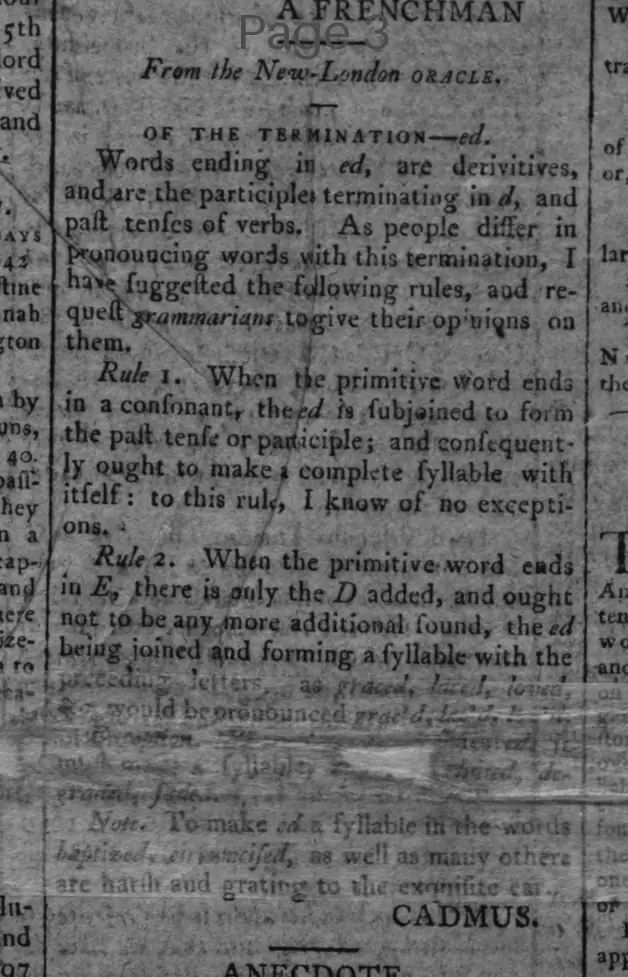
From the New-London Oracle,
OF THE TERMINATION—Ed.
Words ending in ed, are derivatives, and are the participle terminating in d, and past tenses of verbs. As people differ in pronouncing words with this termination, I have suggested the following rules, and request grammarians to give their opinions on them.
Rule 1. When the primitive word ends in a consonant, the ed is subjoined to form the past tense or participle; and consequently ought to make a complete syllable with itself: to this rule, I know of no exceptions.
Rule 2. When the primitive word ends in E, there is only the D added, and ought not to be any more additional sound, the ed being joined and forming a syllable with the preceding letters.
as graced, laced, loved, would be pronounced grac'd, lac'd, lov'd,
hited, de-
Note. To make ed a syllable in the words baptised, circumcised, as well as many others are harsh and grating to the exquisite ear.
CADMUS.
OF THE TERMINATION—Ed.
Words ending in ed, are derivatives, and are the participle terminating in d, and past tenses of verbs. As people differ in pronouncing words with this termination, I have suggested the following rules, and request grammarians to give their opinions on them.
Rule 1. When the primitive word ends in a consonant, the ed is subjoined to form the past tense or participle; and consequently ought to make a complete syllable with itself: to this rule, I know of no exceptions.
Rule 2. When the primitive word ends in E, there is only the D added, and ought not to be any more additional sound, the ed being joined and forming a syllable with the preceding letters.
as graced, laced, loved, would be pronounced grac'd, lac'd, lov'd,
hited, de-
Note. To make ed a syllable in the words baptised, circumcised, as well as many others are harsh and grating to the exquisite ear.
CADMUS.
What sub-type of article is it?
Essay
What keywords are associated?
Pronunciation Rules
Past Tense
Participle
Grammar
Ed Termination
What entities or persons were involved?
Cadmus.
Literary Details
Title
Of The Termination—Ed.
Author
Cadmus.
Key Lines
Rule 1. When The Primitive Word Ends In A Consonant, The Ed Is Subjoined To Form The Past Tense Or Participle; And Consequently Ought To Make A Complete Syllable With Itself: To This Rule, I Know Of No Exceptions.
Rule 2. When The Primitive Word Ends In E, There Is Only The D Added, And Ought Not To Be Any More Additional Sound, The Ed Being Joined And Forming A Syllable With The Preceding Letters.
As Graced, Laced, Loved, Would Be Pronounced Grac'd, Lac'd, Lov'd,