Thank you for visiting SNEWPapers!
Sign up free
Berkeley And Jefferson Intelligencer
Martinsburg, Berkeley County, Virginia
What is this article about?
Napoleon writes to the King of Prussia on October 12, 1806, from Gera, urging peace to avoid bloodshed before an impending battle. The letter, carried by Capt. Montesquieu, arrives late on October 14 after fighting has begun. The King regrets the timing but notes his army's eagerness for war.
Clipping
OCR Quality
Full Text
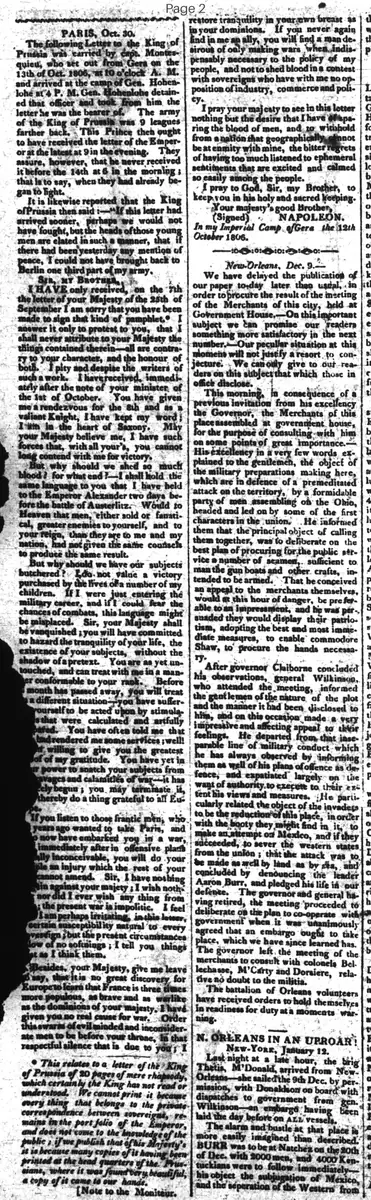
The following Letter to the King of Prussia was carried by Capt. Montesquieu, who set out from Gera on the 13th of Oct. 1806, at 10 o'clock A. M. and arrived at the camp of Gen. Hohenlohe at 4 P. M. Gen. Hohenlohe detained that officer and took from him the letter he was the bearer of. The army of the King of Prussia was 9 leagues farther back. This Prince then ought to have received the letter of the Emperor at the latest at 9 in the evening. They assure, however, that he never received it before the 14th at 6 in the morning; that is to say, when they had already begun to fight.
It is likewise reported that the King of Prussia then said 'If this letter had arrived sooner, perhaps we would not have fought, but the heads of those young men are elated in such a manner, that if there had been yesterday any mention of peace, I could not have brought back to Berlin one third part of my army.'
SIR, My BROTHER,
I HAVE only received, on the 7th the letter of your Majesty of the 25th of September. I am sorry that you have been made to sign that kind of pamphlet. I answer it only to protest to you, that I shall never attribute to your Majesty the things contained therein—all are contrary to your character, and the honour of both. I pity and despise the writers of such a work. I have received immediately after the note of your minister of the 1st of October. You have given me a rendezvous for the 6th and as a valiant Knight, I have kept my word. I am in the heart of Saxony. May your Majesty believe me, I have such forces that, with all yours, you cannot long contend with me for victory.
But why should we shed so much blood? For what end? I shall hold the same language to you that I have held to the Emperor Alexander two days before the battle of Austerlitz. Would to Heaven that men, either sold or fanatical, greater enemies to yourself, and to your reign, than they are to me and my nation, had not given the same counsels to produce the same result.
But why should we have our subjects butchered? I do not value a victory purchased by the lives of a number of my children. If I were just entering the military career, and if I could fear the chances of combats, this language might be misplaced. Sir, your Majesty shall be vanquished; you will have committed to hazard the tranquility of your life, the existence of your subjects, without the shadow of a pretext. You are as yet untouched, and can treat with me in a manner conformable to your rank. Before a month has passed away, you will treat in a different situation—you have suffered yourself to be acted upon by stimulants that were calculated and artfully bared. You have often told me that I had rendered you some services; well! I am willing to give you the greatest proof of my gratitude. You have yet in your power to snatch your subjects from the ravages and calamities of war—it has only begun; you may terminate it, thereby do a thing grateful to all Europe.
If you listen to those frantic men, who years ago wanted to take Paris, and who now have embarked you in a war, immediately after an offensive plan by inconceivable, you will do your people an injury which the rest of your life cannot amend. Sir, I have nothing in against your majesty; I wish nothing, nor did I ever wish anything from you but peace. The present war is impolitic. I feel I am perhaps irritating in this letter, certain susceptibility natural to every sovereign but the present circumstances allow of no softenings; I tell you things as I think them.
Besides, your Majesty, give me leave to say, that it is no great discovery for Europe to learn that France is three times more populous, as brave and as warlike as the dominions of your majesty. I have given you no real cause for war. Order this swarm of evil minded and inconsiderate men to be before your throne, in that respectful silence that is due to you.
This relates to a letter of the King of Prussia of 20 pages of mere rhapsody, which certainly the King has not read or understood. We cannot print it because everything that belongs to the private correspondence between sovereigns, remains in the portfolio of the Emperor, and does not come to the knowledge of the public. If we publish that of his Majesty's it is because many copies of it having been printed at the head quarters of the Prussians, where it was found very beautiful; a copy of it came to our hands.
restore tranquility in your own breast, as in your dominions. If you never again find in me an ally, you will find a man desirous of only making wars when indispensably necessary to the policy of my people, and not to shed blood in a contest with sovereigns who have with me no opposition of industry, commerce and policy.
I pray your majesty to see in this letter nothing but the desire that I have of sparing the blood of men, and to withhold from a nation that geographically cannot be at enmity with mine, the bitter regrets of having too much listened to ephemeral sentiments that are excited and calmed so easily among the people.
I pray to God, Sir, my Brother, to keep you in his holy and sacred keeping.
Your majesty's good Brother,
(Signed) NAPOLEON.
In my Imperial Camp of Gera the 12th October 1806.
What sub-type of article is it?
What keywords are associated?
What entities or persons were involved?
Where did it happen?
Foreign News Details
Primary Location
Saxony
Event Date
12th October 1806
Key Persons
Outcome
the letter arrived after fighting had begun on october 14; the king of prussia indicated that peace might have been possible if received sooner, but his army was eager for battle.
Event Details
Napoleon sent a letter to the King of Prussia from his camp in Gera on October 12, 1806, carried by Capt. Montesquieu who departed on October 13. The letter urged the King to seek peace to avoid unnecessary bloodshed, warning of inevitable defeat and criticizing influences pushing for war. It arrived late at Gen. Hohenlohe's camp, and the King received it after the battle started on October 14.