Thank you for visiting SNEWPapers!
Sign up free
The Virginia Gazette
Richmond, Williamsburg, Richmond County, Virginia
What is this article about?
In a 1750 letter to the Gentleman's Magazine, F.L. critiques frequent executions as ineffective deterrents and proposes castration for male felons and transportation for female offenders to better punish and reform criminals driven by lust and idleness. It argues these measures would instill fear and benefit society more than death. Mentions a separate letter by Philanthropus advocating sparing condemned prisoners for hard labor.
Merged-components note: This is a continuation of the letter to the editor across pages, discussing criminal punishment proposals.
Clippings
1 of 2
OCR Quality
Full Text
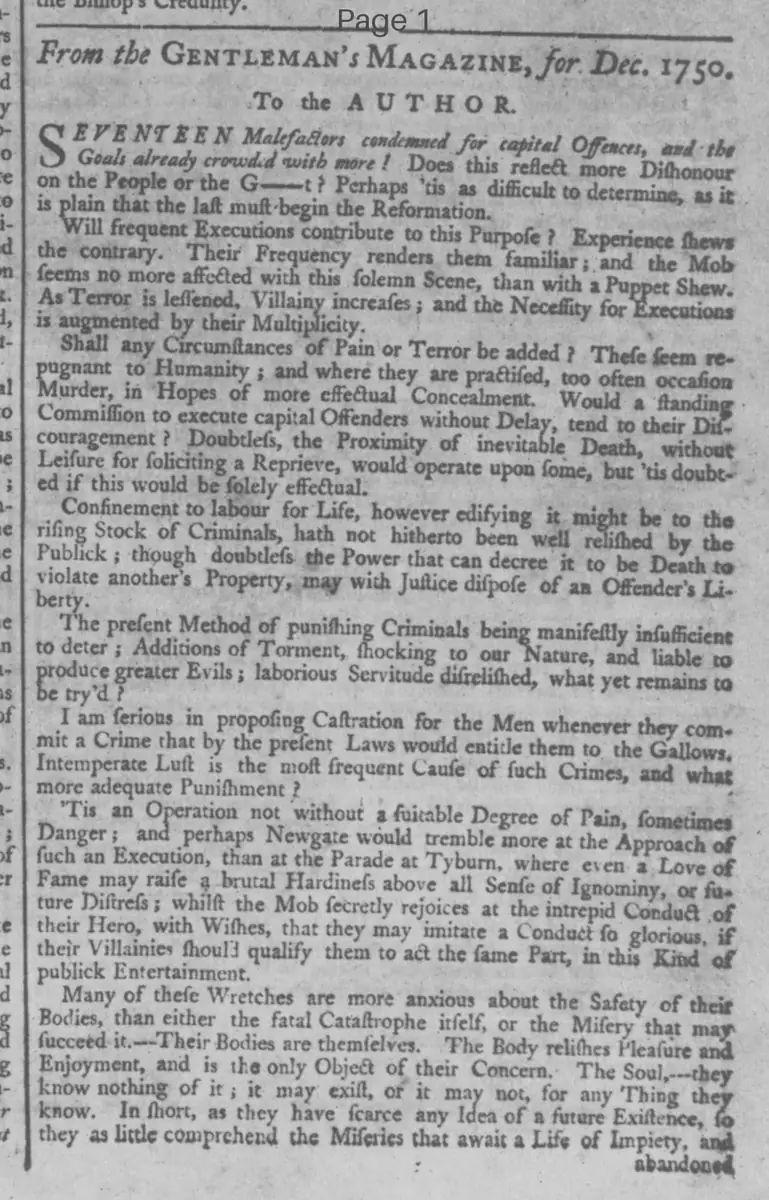
To the Author.
SEVENTEEN Malefactors condemned for capital Offences, and the Goals already crowded with more! Does this reflect more Dishonour on the People or the G-t? Perhaps 'tis as difficult to determine, as it is plain that the last must begin the Reformation.
Will frequent Executions contribute to this Purpose? Experience shews the contrary. Their Frequency renders them familiar; and the Mob seems no more affected with this solemn Scene, than with a Puppet Shew. As Terror is lessened, Villainy increases; and the Necessity for Executions is augmented by their Multiplicity.
Shall any Circumstances of Pain or Terror be added? These Seem repugnant to Humanity; and where they are practised, too often occasion Murder, in Hopes of more effectual Concealment. Would a standing Commission to execute capital Offenders without Delay, tend to their Discouragement? Doubtless, the Proximity of inevitable Death, without Leisure for soliciting a Reprieve, would operate upon some, but 'tis doubted if this would be solely effectual.
Confinement to labour for Life, however edifying it might be to the rising Stock of Criminals, hath not hitherto been well relished by the Publick: though doubtless the Power that can decree it to be Death to violate another's Property, may with Justice dispose of an Offender's Liberty.
The present Method of punishing Criminals being manifestly insufficient to deter; Additions of Torment, shocking to our Nature, and liable to produce greater Evils; laborious Servitude relished, what yet remains to be try'd?
I am serious in proposing Castration for the Men whenever they commit a Crime that by the present Laws would entitle them to the Gallows. Intemperate Lust is the most frequent Cause of such Crimes, and what more adequate Punishment?
'Tis an Operation not without a suitable Degree of Pain, sometimes Danger; and perhaps Newgate would tremble more at the Approach of such an Execution, than at the Parade at Tyburn, where even a Love of Fame may raise a brutal Hardiness above all Sense of Ignominy, or future Distresses; whilst the Mob secretly rejoices at the intrepid Conduct of their Hero, with Wishes, that they may imitate a Conduct so glorious, if their Villainies should qualify them to act the same Part, in this Kind of publick Entertainment.
Many of these Wretches are more anxious about the Safety of their Bodies, than either the fatal Catastrophe itself, or the Misery that may succeed it.--Their Bodies are themselves. The Body relishes Pleasure and Enjoyment, and is the only Object of their Concern. The Soul,--they know nothing of it; it may exist, or it may not, for any Thing they know. In short, as they have scarce any Idea of a future Existence, so they as little comprehend the Miseries that await a Life of Impiety, and abandoned Debauchery. Pain and Ignominy in this Life will co-operate much more strongly upon them, than the distant Apprehensions of Death, to which they must of Course submit, with the rest of Mankind, and the Miseries that may attend 'em hereafter, of which they have little or no Apprehensions.
A Kind of Ignominy too, that subjects them to the highest Contempt of those very Creatures who have principally contributed to their Ruin. Should a capital C be marked on each Cheek, their contemptible, infamous Circumstance would be known to every one they meet: Yet they would still be capable of Labour, and in a Condition of benefiting Society both by it and Example.
But will not this have the Effect dreaded from severer Executions? Most probably not. Because the Punishment is more moderate.
But the Women, what must they suffer --Transportation for the very first Offence, be it greater or less. ---What better Punishment for Crimes that spring from Idleness and Lust, than Labour? In this Country they may work if they will; if they will not, none can force them. But in our Colonies they must work, if they can, yet not to Oppression; -- and Objects that breathe here in Laziness, Filth, Dishonesty and Wickedness, to the Scandal and Pest of Society, there live, and very often become useful, honest and industrious.
It is therefore humbly proposed to the Consideration of those who are attentive to the publick Good, who see with Concern the daily Increase of Vice, Dishonesty, brutal Lust, and brutal Violence exerted in supporting of it; who wish well to private Safety, and the publick Reputation of their Country, that, Novel as the proposed Mutilation seems, if it should appear to be a probable Remedy, as well as an adequate Punishment, all proper Measures may be taken, by those most immediately concerned in providing Laws for publick Safety, to make this the Basis of an effectual one.
F. L.
A Letter signed Philanthropus in the Gen. Ev. Post. Dec. 27. (probably by one of the 17 condemned) proposes that they be all spared, and kept to work, as for the future all Felons, at short Allowance of Provisions, and nobody suffered to visit them. This might provide Materials for the Fishery, and deter more than Death.
What sub-type of article is it?
What themes does it cover?
What keywords are associated?
What entities or persons were involved?
Letter to Editor Details
Author
F. L.
Recipient
To The Author.
Main Argument
current executions fail to deter crime due to familiarity and lack of fear; proposes castration for male felons and transportation for female offenders as more effective punishments targeting lust and idleness, allowing labor and societal benefit while instilling terror and ignominy.
Notable Details